State playbook - Wisconsin

Matchbook, tuned for Wisconsin payroll, 4K, and Badger State credits.

Wisconsin layers a progressive state income tax up to 7.65% on top of federal and FICA, so Section 125 and Section 132(f) elections compound meaningfully. The state also runs statewide 4-year-old kindergarten (4K), Wisconsin Shares child care subsidy, BadgerCare Plus, and an Edvest 529 deduction - levers most broker ROI decks miss.

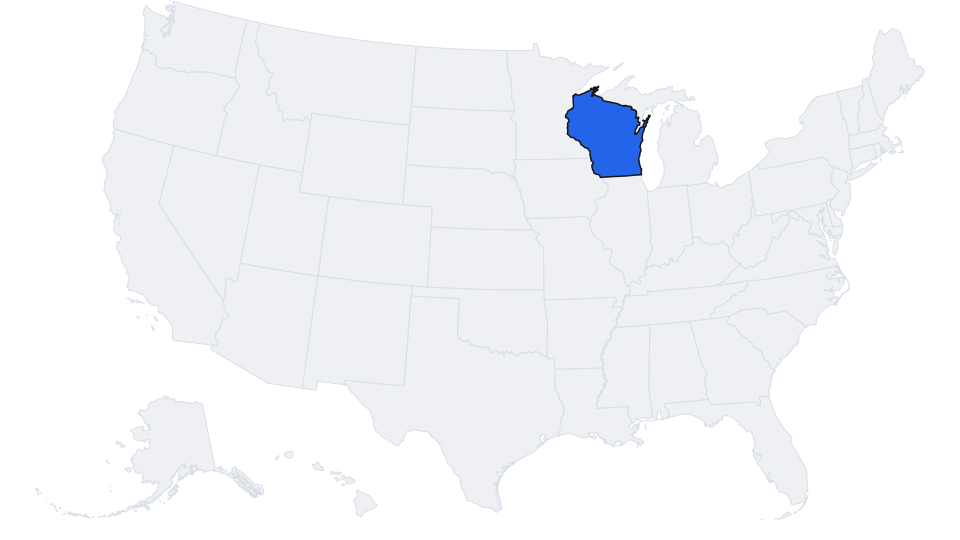
Map of the United States with Wisconsin highlighted
Tax mechanics

Payroll tax in Wisconsin

State income tax

Applies

Wisconsin has a four-bracket progressive individual income tax for 2025: 3.50%, 4.40%, 5.30%, and a top rate of 7.65% (top bracket starts at about $315,310 single / $420,420 MFJ). Because Section 125 salary reductions also reduce Wisconsin taxable wages, a $3,300 healthcare FSA election saves a 22% federal bracket Wisconsin employee roughly $1,225 - about $175 more than the same election would save a no-state-tax Florida peer. Matchbook models the full federal plus FICA plus Wisconsin marginal stack per household.

Wisconsin Unemployment Insurance

Wage base $14,000 (2025 and 2026)

Rate range: Schedule D in 2025 and 2026: 0.00%-12.00% on taxable payroll; new employer rate 3.05% (3.25% for construction) on first $14,000 per employee

Wisconsin's $14,000 SUI wage base is double Florida's and meaningfully above the federal FUTA base, so Section 125 salary reductions can produce real employer UI savings on part-time, seasonal, or lower-wage workers before they cross the base. Matchbook retains the Wisconsin UI savings line in the employer ROI report for employees with projected YTD wages under the base, and suppresses it for salaried workers who cross $14K within the first pay periods.

Employer FICA

7.65% / 1.45% split

Employer FICA is 7.65% on wages up to the Social Security wage base ($176,100 in 2025; projected about $183,600 in 2026) and 1.45% above it. Matchbook models this per employee rather than quoting a flat rate.

Employer credits and levers

State and federal credits worth stacking

Credits that most broker ROI decks omit. Matchbook surfaces these in the employer report.

Wisconsin Development Zones (Enterprise Zone, Development Opportunity Zone)

Refundable and non-refundable Wisconsin income and franchise tax credits administered by WEDC for job creation, capital investment, employee training, and supply-chain spend inside designated zones. Credits offset Wisconsin corporate income and franchise tax and can be claimed alongside federal Work Opportunity Tax Credit.

Source →

Wisconsin Business Development Tax Credit

WEDC-administered refundable credit against Wisconsin income and franchise tax for creating and retaining full-time jobs, capital investment, employee training, and locating corporate HQ in Wisconsin. Replaced the former Economic Development and Jobs tax credits; contracts now run through the Business Development program.

Source →

Wisconsin Research Tax Credits

Non-refundable (with limited refundability) Wisconsin research credits for qualified research expenses in Wisconsin, modeled on IRC Section 41 but computed on a Wisconsin basis. Enhanced credits are available for research related to internal combustion engines and energy-efficient products. Stacks with the federal R&D credit.

Source →

Wisconsin Historic Preservation Tax Credit

20% Wisconsin income and franchise tax credit for qualified rehabilitation expenditures on certified historic buildings, stacking with the federal 20% historic rehab credit for a combined 40% on qualifying projects. Administered by WEDC with the Wisconsin Historical Society.

Source →

Household programs

State programs that change what your employees should elect

Matchbook coordinates these against DCFSA, FSA, and HSA elections at the household level.

Childcare subsidy

Wisconsin Shares Child Care Subsidy

Income-tested child care subsidy administered by DCF for families at or below 185% FPL at entry and up to 200% FPL at redetermination, for children under 13 (under 19 with special needs). Families contribute a copayment on a sliding scale.

Matchbook: Wisconsin Shares reduces the out-of-pocket dependent care cost and therefore the right DCFSA election for qualifying households. Matchbook asks Wisconsin employees whether they receive or qualify for Shares before recommending DCFSA contribution levels.

Source →

Preschool

4K and 5K Wisconsin (4-year-old and 5-year-old Kindergarten)

Wisconsin offers publicly funded 4-year-old kindergarten (4K) in nearly every school district statewide, typically as a half-day or 437-hour program, plus universal 5K. Because 4K is a partial-day program in most districts, wrap-around care remains DCFSA-eligible.

Matchbook: The correct DCFSA election for a Wisconsin 4K family is full-day center cost minus the 4K-funded hours, not zero. Matchbook ships a 4K-aware DCFSA recommender that models the partial-day offset by district schedule.

Source →

Leave

Wisconsin Family and Medical Leave Act (WFMLA)

Wisconsin's WFMLA predates federal FMLA and provides unpaid job-protected leave: 6 weeks parental, 2 weeks own serious health condition, 2 weeks to care for a family member, per calendar year. It applies to employers with 50 or more permanent employees; covered employees must have worked 52 weeks and 1,000 hours. WFMLA can run concurrently with federal FMLA but has independent definitions and notice rules.

Matchbook: WFMLA is unpaid, so Matchbook pairs it with employer STD, PTO stacking, and HSA or DCFSA election-change guidance during leave. Matchbook's Wisconsin leave module ingests both WFMLA and federal FMLA clocks so the employer handbook surfaces the more generous overlap.

Source →

Health programs

Coverage coordination checkpoints

BadgerCare Plus (Wisconsin Medicaid and CHIP)

Wisconsin's combined Medicaid and CHIP program covering children in households up to 300% FPL and adults up to 100% FPL (Wisconsin has not adopted the ACA Medicaid expansion but covers childless adults up to 100% FPL via a 1115 waiver). Premiums apply above 200% FPL for children.

Matchbook: Employees declining dependent coverage on the employer plan should be screened against BadgerCare Plus thresholds before Matchbook defaults to the family tier. Matchbook ships a BadgerCare Plus screener tuned to the 300% FPL children's ceiling.

Source →

ACA Marketplace (Federally Facilitated Marketplace)

Wisconsin uses the federal exchange at healthcare.gov. 2026 employer-affordability threshold is 9.96% of household income. Enhanced premium tax credits expired at the end of 2025, so Wisconsin 2026 premiums see meaningful increases; the family-glitch fix still applies.

Matchbook: If employer family coverage exceeds 9.96% of household income, Matchbook surfaces the Marketplace dependent subsidy path - especially material in Wisconsin after the enhanced PTC expiration where BadgerCare Plus eligibility stops.

Source →

Retirement and wealth

State-level retirement and wealth context

ABLE Wisconsin (via national ABLE partners)

Wisconsin does not operate its own ABLE plan; Wisconsin residents use the national ABLE plans (e.g., ABLE National Resource Center partner states). 2025 contribution limit $19,000; employed beneficiaries may add up to $15,060 more. $100K SSI asset-exclusion cap.

Matchbook: FSA or HSA dollars reimburse medical expenses; ABLE covers broader qualified disability expenses. When SSI asset limits are in play, Matchbook routes disability-related spend to ABLE first and flags the lack of an in-state plan so Wisconsin employees do not over-search for a home-state option.

Source →

Edvest 529 and Tomorrow's Scholar

Wisconsin's two 529 college savings plans. Wisconsin allows a state income tax deduction for contributions - $4,000 per beneficiary per year for 2025 (indexed), with carryforward for excess contributions. The deduction is only available for contributions to Edvest or Tomorrow's Scholar, not out-of-state 529 plans.

Matchbook: Wisconsin has a real home-state tilt: the $4,000-per-beneficiary Wisconsin deduction is worth up to about $306 per beneficiary at the 7.65% top rate. Matchbook recommends Edvest or Tomorrow's Scholar over out-of-state plans for Wisconsin residents and calibrates the contribution recommendation to the per-beneficiary cap.

Source →

Section 132(f) commuter

Pre-tax commuter reality in Wisconsin

2025 IRC Section 132(f) cap is $325 per month for transit and $325 per month for qualified parking; 2026 amounts indexed.

Parking and state credits

Parking: Downtown Milwaukee and downtown Madison monthly parking frequently approaches or exceeds the $325 cap; Green Bay, Appleton, and Eau Claire typically sit below.

State credit: None - Wisconsin has no state-level commuter tax credit beyond conformity with federal Section 132(f) exclusion.

Disaster readiness

Wisconsin disaster-relief playbook

IRC Section 139 qualified disaster relief payments are not W-2 wages: no FICA, no FUTA, no federal income tax withholding, no Wisconsin income tax withholding, and the employer gets a full deduction. Triggered by a federal disaster declaration. Wisconsin qualifying events include tornadoes, severe storms, floods, and winter storms; recent declarations include 2024 severe storms and flooding and 2019 severe winter storms.

  • Pre-drafted Section 139 policy template so Wisconsin employers can disburse tax-free relief within 48 hours of a federal declaration for tornado, flood, or winter-storm events.
  • Post-event Section 125 election-change guidance: a tornado or flood alone is not a listed change-in-status event under Treas. Reg. 1.125-4 unless it triggers a change in residence, employment, or cost-of-coverage.
  • FEMA Individual Assistance interaction: Section 139 payments generally stack with FEMA IA, but Matchbook flags duplication risks in the disbursement log.
  • Wisconsin-specific employer disaster leave review (Wisconsin has no statutory paid disaster leave beyond WFMLA, so employer policy is the governing rule).
Matchbook for Wisconsin

What we ship specifically for Wisconsin employers

  • Progressive-stack calibration in the employee savings engine - recompute marginal stacks using Wisconsin's 3.50% / 4.40% / 5.30% / 7.65% brackets and tighten DCFSA and FSA under-election guardrails for Wisconsin households.
  • 4K-aware DCFSA recommender that models the partial-day Wisconsin 4K schedule by district and computes the correct wrap-around election rather than defaulting to zero.
  • BadgerCare Plus screener at open enrollment using the 300% FPL children's threshold to recover dependents from the employer family tier where it is not cost-optimal.
  • Edvest and Tomorrow's Scholar home-state 529 tilt with the $4,000-per-beneficiary Wisconsin deduction modeled explicitly; avoid the silent loss from out-of-state plan selection.
  • WFMLA plus federal FMLA overlap module for Wisconsin employer handbooks and leave tracking, including the 52-week / 1,000-hour eligibility test.
  • Wisconsin UI savings line retained in the employer ROI report for part-time and lower-wage employees under the $14,000 wage base, suppressed for salaried workers who cross the base within weeks.
  • IRC Section 139 disaster playbook template for Wisconsin tornado, flood, and winter-storm declarations with a pre-drafted employer policy and post-event Section 125 election-change guidance.
  • Benefits graph ingests: Wisconsin DOR bracket and deduction updates, DWD UI rate notices and Schedule D, WEDC credit allocations, DCF Wisconsin Shares eligibility, DPI 4K district schedules, DHS BadgerCare Plus rules, and FEMA Wisconsin DR numbers.

Pilot Matchbook with a Wisconsin-aware engine.

Talk to us about a 30-day pilot calibrated to Wisconsin payroll, programs, and disaster rules.