State playbook - West Virginia

Matchbook, tuned for West Virginia payroll, Pre-K, and flood country.

West Virginia has cut its top personal income rate to 4.82% (with further triggered reductions in motion), runs one of the country's most mature statewide Universal Pre-K systems, and sits in a recurring federal disaster corridor. Each of those changes what Matchbook should recommend - pre-tax stack math, DCFSA wrap-around sizing, and a pre-drafted IRC Section 139 policy all move.

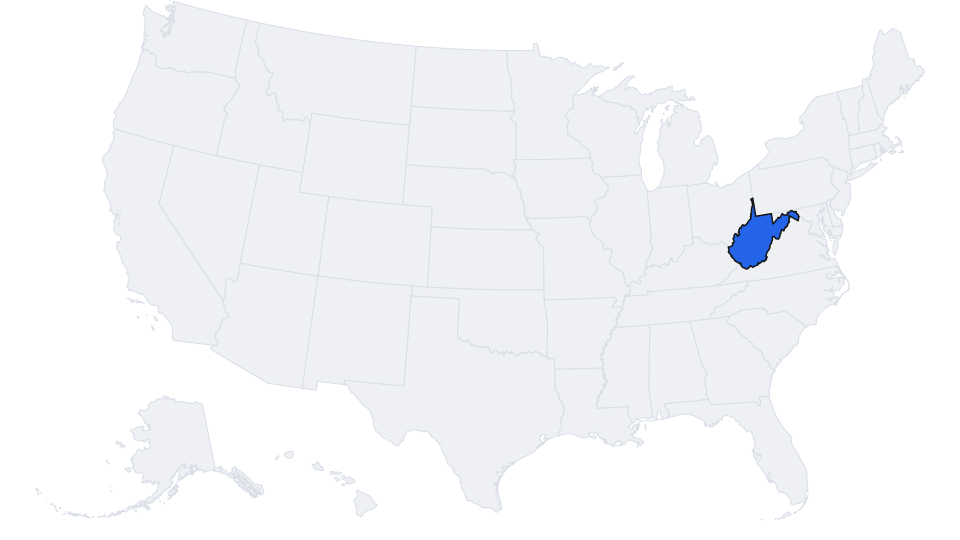
Map of the United States with West Virginia highlighted
Tax mechanics

Payroll tax in West Virginia

State income tax

Applies

West Virginia uses a graduated personal income tax with a top marginal rate of 4.82% after the 2025 cut, down from 5.12% in 2024, with additional triggered reductions legislated. The pre-tax savings stack for a top-bracket WV employee is roughly federal marginal rate plus 7.65% FICA plus 4.82% state - meaningful but smaller than high-tax coastal states. Matchbook recalibrates marginal savings per employee when WV pushes another trigger-based cut through.

West Virginia Unemployment Compensation

Wage base $9,521 (indexed to statewide average wage)

Rate range: 1.5%-8.5%; new in-state employer rate 2.7%; out-of-state construction 8.5%

The WV wage base is indexed to statewide average wages and sits just under $10K, so Section 125 salary reductions produce employer SUI savings only for part-year, part-time, or low-wage workers. Matchbook suppresses the SUI savings line for salaried employees who cross the base in the first quarter and keeps it on for true part-time workers - the same rule set we use in Florida, calibrated to WV's higher base.

Employer FICA

7.65% / 1.45% split

Employer FICA is 7.65% up to the Social Security wage base ($176,100 in 2025; projected about $183,600 in 2026) and 1.45% above it. Matchbook models FICA per employee rather than quoting a flat rate.

Employer credits and levers

State and federal credits worth stacking

Credits that most broker ROI decks omit. Matchbook surfaces these in the employer report.

West Virginia Economic Opportunity Tax Credit

Credit of 10%-25% of qualified investment for businesses creating at least 10 new jobs in manufacturing, information processing, warehousing, non-retail distribution, qualified R&D, corporate HQ relocation, or destination tourism. Credit offsets up to 80% (or 100% if median new-hire pay exceeds the statewide nonfarm average) of corporate net income tax and personal income tax on pass-through income attributable to the investment.

Source →

West Virginia Manufacturing Investment Credit

For NAICS 31-33 manufacturers: credit against up to 60% of corporate net income tax based on qualified investment in eligible manufacturing property, with no new-job threshold required. A core stacking candidate alongside federal Section 45F for WV manufacturers sponsoring on-site childcare.

Source →

High-Technology Manufacturing Credit (and R&D as EOTC activity)

High-tech manufacturers of computers, peripherals, electronic components, or semiconductors that create 20+ new jobs within one year of placing qualified investment in service can offset 100% of CNIT and PIT on pass-through income for 20 consecutive years. Qualified R&D is a named eligible activity under the EOTC umbrella.

Source →

Federal IRC Section 45F (stacks with WV credits)

Federal employer-provided childcare credit. 25% credit with $150K cap in 2025; rises to 40% with $500K cap in 2026, and 50% with $600K cap for small employers. Matchbook surfaces combined WV plus federal modeled benefit when an employer evaluates on-site care.

Source →

Household programs

State programs that change what your employees should elect

Matchbook coordinates these against DCFSA, FSA, and HSA elections at the household level.

Preschool

West Virginia Universal Pre-K

West Virginia Universal Pre-K has operated statewide in all 55 counties since the 2012-13 school year under W.Va. Code 18-5-44, and is one of the most mature universal Pre-K programs in the country. Four-year-olds (and some special-needs three-year-olds) are eligible for free Pre-K, with a statutory requirement that at least half of programs operate in collaboration with private centers or Head Start - actual collaboration rate was 83% in 2021-22.

Matchbook: Matchbook treats WV as a universal Pre-K state by default. The right DCFSA election for a WV family with a 4-year-old is the full-day center cost minus the Pre-K-funded hours, not zero and not the full center bill. The high collaboration rate means many WV employees receive Pre-K at their existing childcare provider - Matchbook prompts the provider question explicitly during DCFSA sizing.

Source →

Childcare subsidy

West Virginia Child Care Subsidy Program

State subsidy administered by Choices CCR&R and the Bureau for Family Assistance. Initial eligibility at 150% FPL, with redetermination income ceiling up to 185% FPL. Sliding-scale family fee; changes must be reported within 5 days.

Matchbook: Subsidy receipt reduces the right DCFSA election. Matchbook asks WV employees whether they receive Child Care Subsidy before recommending DCFSA levels, and coordinates with the Universal Pre-K split for 4-year-olds.

Source →

Health programs

Coverage coordination checkpoints

WV CHIP

Children's Health Insurance Program covers children in households above Medicaid limits but below 300% FPL. Pregnant women in the same income band may also qualify. Applications flow through WV PATH or the CHIP Helpline.

Matchbook: Employees declining dependent coverage on the employer plan should be screened against WV CHIP thresholds before Matchbook defaults to the family tier.

Source →

West Virginia Medicaid (expansion state)

WV expanded Medicaid in 2014, covering adults 19-64 up to 138% FPL. A Medicaid-expansion work requirement is scheduled to begin in 2027, which will put additional WV households at risk of procedural disenrollment.

Matchbook: Matchbook's WV screener flags households likely to be affected by the 2027 work requirement and pre-stages the employer plan or Marketplace path so there is no coverage gap.

Source →

ACA Marketplace (Federally Facilitated Marketplace)

WV uses HealthCare.gov. With enhanced premium tax credits expired at the end of 2025, 2026 WV premiums increased sharply - Highmark BCBS approved for 13.9%, CareSource for 7.6% - and the subsidy cliff has returned for households above 400% FPL. Employer-affordability threshold for 2026 is 9.96% of household income.

Matchbook: If employer family coverage exceeds 9.96% of household income, Matchbook surfaces the Marketplace dependent subsidy path. In WV the family-glitch fix is especially material because of how sharply after-subsidy premiums moved in 2026.

Source →

Retirement and wealth

State-level retirement and wealth context

WVABLE (powered by STABLE)

WV's Section 529A program is administered by the WV State Treasurer's Office in partnership with the Ohio Treasurer's STABLE platform. 2025 contribution limit $19,000; employed beneficiaries may add up to $15,060 more. $555,000 state account limit; $100K SSI asset cap.

Matchbook: FSA and HSA dollars reimburse medical expenses; WVABLE covers broader qualified disability expenses. Because WVABLE runs on STABLE, Matchbook routes WV disability-related spend through the same ABLE ruleset it uses for Ohio, with WV-specific limits.

Source →

SMART529 (WV 529)

WV offers a full state income tax deduction for SMART529 contributions up to $18,000 per taxpayer per year ($36,000 MFJ), with no income cap. Deduction is subject to recapture on non-qualified distributions. Qualified distributions are free from WV state income tax.

Matchbook: Unlike Florida, WV residents get a real home-state tilt. Matchbook's college-savings recommender defaults to SMART529 for WV employees up to the deduction cap before considering out-of-state plans.

Source →

Section 132(f) commuter

Pre-tax commuter reality in West Virginia

2025 IRC Section 132(f) cap is $325 per month for transit and $325 per month for qualified parking.

Parking and state credits

Parking: Charleston and Morgantown CBD parking typically sits well below the $325 monthly cap, so the employer's 132(f) win in WV is usually the transit side, not parking.

State credit: None - West Virginia has no state-level commuter tax credit.

Disaster readiness

West Virginia disaster-relief playbook

IRC Section 139 qualified disaster relief payments are not W-2 wages: no FICA, no FUTA, no federal income tax withholding, and the employer gets a full deduction. Triggered by a federal disaster declaration, which WV has received repeatedly - the June 2016 floods (DR-4273), multiple severe-storm and winter-storm declarations, and 2024-25 flooding events have all qualified.

  • Pre-drafted Section 139 policy template so WV employers can disburse tax-free relief within 48 hours of a federal declaration.
  • Post-flood Section 125 election-change guidance: a storm is not a listed change-in-status event under Treas. Reg. 1.125-4 unless it triggers a change in residence, employment, or cost-of-coverage.
  • FEMA Individual Assistance interaction: Section 139 payments generally stack with FEMA IA, but Matchbook flags duplication risks in the disbursement log.
  • WV-specific employer disaster leave review (WV has no statutory paid disaster leave, so employer policy is the governing rule).
Matchbook for West Virginia

What we ship specifically for West Virginia employers

  • Universal Pre-K-aware DCFSA recommender - ingest the WVDE Pre-K collaboration map and size DCFSA as full-day cost minus Pre-K hours, not zero.
  • WV marginal-rate recalibration whenever a new triggered income-tax cut takes effect - recompute the employee pre-tax stack at the new top rate.
  • Suppress the SUI savings line for full-time salaried WV employees above the indexed wage base in the employer ROI report; keep it live for part-time workforces.
  • EOTC plus Manufacturing Investment Credit plus federal Section 45F stacking calculator for WV manufacturers evaluating on-site childcare.
  • SMART529 home-state tilt in the college-savings recommender, capped at the $18K / $36K MFJ deduction limit with recapture flagged.
  • Medicaid 2027 work-requirement screener - flag WV households likely to lose Medicaid procedurally and pre-stage employer plan or Marketplace paths before the trigger date.
  • IRC Section 139 flood playbook template with pre-drafted employer policy and post-event Section 125 election-change guidance, primed to WV's recurring FEMA declaration cadence.
  • Benefits graph ingests: WV Tax Division PIT rate notices, WorkForce WV SUI wage-base publications, WVDE Universal Pre-K enrollment data, WV BFA Child Care Subsidy caseload, FEMA DR numbers for WV, and HealthCare.gov 2026 rate filings for WV.

Pilot Matchbook with a West Virginia-aware engine.

Talk to us about a 30-day pilot calibrated to West Virginia payroll, programs, and disaster rules.