State playbook - Vermont

Matchbook, tuned for Vermont payroll, childcare, and floods.

Vermont stacks a progressive income tax topping 8.75%, a dedicated Child Care Contribution payroll tax (0.44% employer, up to 0.11% employee withholding), and Act 166 Universal Pre-K on top of Dr. Dynasaur and Vermont Health Connect. Pre-tax elections are unusually valuable here; DCFSA sizing is unusually nuanced; and flood-driven Section 139 relief is a recurring employer lever.

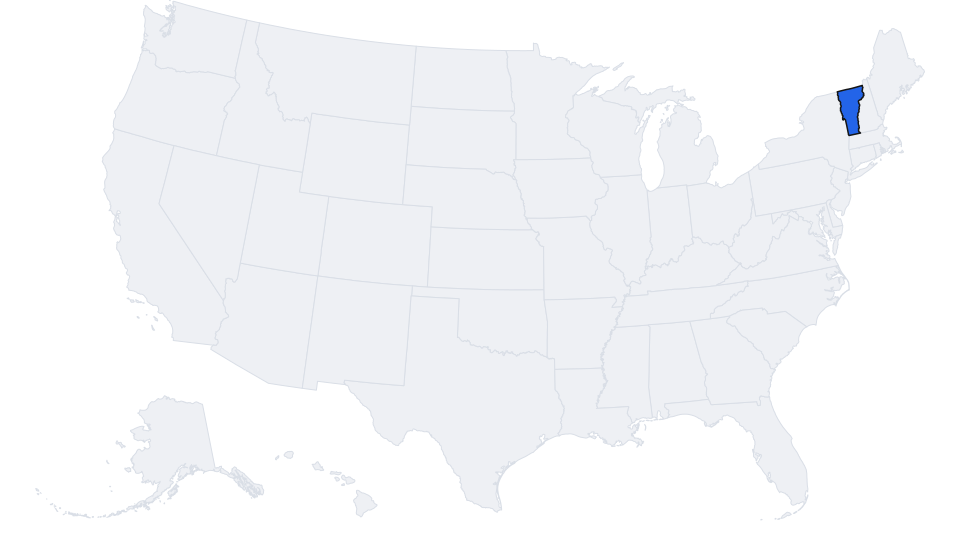
Map of the United States with Vermont highlighted
Tax mechanics

Payroll tax in Vermont

State income tax

Applies

Vermont has four brackets from 3.35% to 8.75% for 2026. Vermont conforms to federal AGI, so Section 125 salary reductions and Section 132(f) commuter elections reduce Vermont taxable wages as well as federal. A $3,300 healthcare FSA election saves about $1,500 for a 22% federal bracket Vermont employee (22% fed + 7.65% FICA + 6.60% VT marginal), versus about $1,050 for the same Florida employee. Matchbook widens under-election guardrails for Vermont because the marginal savings-per-dollar is among the highest in the country.

Vermont Unemployment Insurance (UI) Contributions

Wage base $15,400 (2026)

Rate range: Five-schedule system (21 rates each); Rate Schedule 3 is the equilibrium schedule. Employer rate depends on experience rating and the schedule in effect for the fiscal year.

Vermont's $15,400 UI wage base is more than double Florida's $7,000, so Section 125 salary reductions produce real employer UI savings for part-time and early-tenure employees. Matchbook models per-employee YTD wages rather than assuming every salaried worker is already over the base. Vermont also layers a Child Care Contribution payroll tax on top of UI - see the CCC note below.

Employer FICA

7.65% / 1.45% split

Employer FICA is 7.65% on wages up to the Social Security wage base ($176,100 in 2025; projected about $183,600 in 2026) and 1.45% above it. On top of FICA, Vermont employers owe the Child Care Contribution (CCC) of 0.44% on all Vermont wages (no wage base cap), and may withhold up to 25% of that (0.11%) from employees. Section 125 and Section 132(f) salary reductions reduce wages subject to the CCC as well, so Matchbook adds a 0.44% employer saving line (or 0.33% employer / 0.11% employee when the withholding option is used) to the Vermont ROI report - a lever that does not exist in any other state.

Employer credits and levers

State and federal credits worth stacking

Credits that most broker ROI decks omit. Matchbook surfaces these in the employer report.

Vermont Child Care Contribution (CCC) payroll tax

Effective July 1, 2024 and continuing in 2026: 0.44% employer tax on all wages subject to Vermont income tax withholding (no wage base cap). Employer may withhold up to 25% of the tax (0.11%) from employee paychecks; employers are not required to withhold the same amount from every employee. Funds Vermont's Act 76 childcare expansion. Self-employed individuals pay 0.11% on SE income.

Source →

Vermont Research and Development Tax Credit

State credit equal to 27% of the federal Section 41 R&D credit allowed for qualifying Vermont expenditures. Applies to personal income, business, or corporate income tax; 10-year carryforward. Claim on Form BA-404.

Source →

Downtown and Village Center Tax Credit Program

State income tax credit of 10%-50% of eligible rehabilitation expenses for commercial properties over 30 years old inside designated downtowns and village centers. FY2026 allocation at least $3M; applications due August 1, 2025; administered by the VT Dept. of Housing and Community Development. Stacks with the 20% federal historic rehab credit for a combined benefit up to about 70% of eligible expenses.

Source →

Vermont Employment Growth Incentive (VEGI)

Performance-based cash incentive (not a tax credit) for businesses creating net new full-time jobs at 140% or 160% of the Vermont minimum wage, with qualifying capital investment. Paid in five installments over five years if targets are maintained. Not available for every employer, but worth flagging for growth-stage hiring plans.

Source →

Federal IRC Section 45F (stacks with Vermont programs)

Federal employer-provided childcare credit. 25% credit with $150K cap in 2025; rises to 40% with $500K cap in 2026, and 50% with $600K cap for eligible small employers. Matchbook models the 45F benefit against the Vermont CCC liability when an employer evaluates sponsoring or contracting care capacity.

Source →

Household programs

State programs that change what your employees should elect

Matchbook coordinates these against DCFSA, FSA, and HSA elections at the household level.

Preschool

Universal Prekindergarten (Act 166)

Statewide, publicly funded pre-K of at least 10 hours per week for 35 weeks a year for all 3, 4, and 5 year olds in a prequalified program, regardless of household income. 2025-26 per-child funding about $3,982. Delivered through public schools or partner private providers.

Matchbook: Act 166 covers a bounded slice of the week (10 hours), so wrap-around center care remains DCFSA-eligible. The correct Vermont DCFSA election for a pre-K family is full-day center cost minus the Act 166-funded hours, not zero. Matchbook models this split explicitly and cross-checks against CCFAP if the household also qualifies.

Source →

Childcare subsidy

Child Care Financial Assistance Program (CCFAP)

Sliding-scale subsidy for children birth through age 12 in regulated care. Income eligibility extended up to 575% FPL under Act 76 implementation; funded in part by the Child Care Contribution payroll tax. Must have a qualifying service need (employment, training, or seeking employment).

Matchbook: CCFAP reduces out-of-pocket dependent-care cost and therefore the correct DCFSA election. Matchbook asks Vermont employees whether they qualify before recommending a DCFSA contribution, and prompts higher-income families (now eligible up to 575% FPL) who historically assumed they were out of scope.

Source →

Paid leave

Vermont Earned Sick Time

Employees accrue 1 hour of paid sick time for every 52 hours worked, capped at 40 hours per 12-month period. Paid at the greater of the employee's normal hourly rate or the Vermont minimum wage. Up to one-year waiting period permitted for new hires.

Matchbook: Earned Sick Time reduces the probability of FSA-reimbursable sick-day childcare cost and slightly compresses DCFSA need for dual-earner households. Matchbook factors accrued sick time into the DCFSA under-election guardrail.

Source →

Health programs

Coverage coordination checkpoints

Dr. Dynasaur (Vermont Medicaid / CHIP for children)

Free or low-cost coverage for children and teenagers under 19 with household MAGI up to 317% FPL. Monthly premiums are suspended indefinitely as of 2026, and all enrolled children receive 12 months of protected continuous enrollment. Pregnant women covered up to 208% FPL.

Matchbook: Vermont employees declining dependent coverage on the employer plan should be screened against Dr. Dynasaur thresholds before Matchbook defaults to the family tier. The 12-month continuous enrollment guarantee changes the risk calculus for parents weighing employer dependent tier vs. Dr. Dynasaur.

Source →

Vermont Health Connect (state-based exchange)

Vermont operates its own ACA marketplace. 2026 open enrollment November 1 - January 15 (December 15 deadline for January 1 coverage). With expiration of federal enhanced premium tax credits, households above 400% FPL lose Marketplace subsidy access beginning plan year 2026, and APTC clawback of excess advance credit applies in full.

Matchbook: Matchbook surfaces the Vermont Health Connect dependent pathway when employer family coverage exceeds the 2026 affordability threshold (9.96% of household income), and flags the 2026 subsidy-cliff shift so employees can reconsider electing the employer family tier instead of Marketplace coverage.

Source →

Retirement and wealth

State-level retirement and wealth context

Vermont ABLE (VermontABLE / STABLE platform)

Vermont's Section 529A program for individuals with disabilities originating before age 26. 2025 contribution cap $19,000; employed beneficiaries may add up to the federal employed-beneficiary limit. Qualified distributions for disability expenses are federal and Vermont income-tax free.

Matchbook: FSA or HSA dollars reimburse medical expenses; ABLE covers broader qualified disability expenses. When SSI asset limits are in play, Matchbook routes disability-related spend to ABLE first for Vermont employees, mirroring the Florida logic.

Source →

Vermont Higher Education Investment Plan (VHEIP / VT529)

Vermont 529 plan offers a Vermont income tax credit of 10% on the first $2,500 contributed per beneficiary per year (maximum $250 credit per beneficiary, or $500 for joint filers per beneficiary). Non-qualified distributions trigger a 10% Vermont recapture on amounts previously credited.

Matchbook: Unlike Florida, Vermont has a real home-state 529 tilt: the 10% VT credit on VHEIP contributions makes VT529 the default college-savings vehicle for Vermont residents. Matchbook surfaces the $2,500/beneficiary sweet spot at open enrollment because it maxes the credit without triggering the recapture risk.

Source →

Section 132(f) commuter

Pre-tax commuter reality in Vermont

2026 IRC Section 132(f) cap is $340 per month for transit and $340 per month for qualified parking, up from $325 in 2025.

Parking and state credits

Parking: Downtown Burlington and Montpelier parking typically sits below the $340 cap; most of rural Vermont has no paid parking market, which compresses the parking side of 132(f). Vanpool to the Burlington metro and Upper Valley commutes are the more commonly utilized transit leg.

State credit: None - Vermont has no state-level commuter tax credit, but 132(f) elections reduce wages subject to VT income tax (top marginal 8.75%) and the 0.44% Child Care Contribution in addition to federal and FICA.

Disaster readiness

Vermont disaster-relief playbook

IRC Section 139 qualified disaster relief payments are not W-2 wages: no FICA, no FUTA, no federal income tax withholding, and the employer gets a full deduction. Vermont conforms to federal AGI, so Section 139 payments are also exempt from Vermont income tax. Triggered by a federal disaster declaration - the July 2023 flood (DR-4720, declared July 14, 2023, incident period July 7-21) and subsequent 2024 flooding and winter storms have all qualified.

  • Pre-drafted Section 139 policy template so Vermont employers can disburse tax-free relief within 48 hours of a federal declaration - flood damage, temporary housing, replacement of ruined property, and transportation costs all qualify.
  • Post-flood Section 125 election-change guidance: a flood alone is not a listed change-in-status event under Treas. Reg. 1.125-4 - it qualifies only when it triggers a change in residence, employment, or cost-of-coverage. Matchbook flags the specific facts that convert a flood into a qualifying event.
  • FEMA Individual Assistance interaction: Section 139 payments generally stack with FEMA IA, but Matchbook flags duplication risks in the disbursement log.
  • Vermont Earned Sick Time interaction: employees displaced by flooding may use accrued sick time for dependent care or illness caused by the disaster; Matchbook clarifies that sick-time wages are ordinary wages (subject to FICA and the CCC) while Section 139 relief is not.
Matchbook for Vermont

What we ship specifically for Vermont employers

  • Vermont CCC module: add the 0.44% employer / 0.11% optional employee Child Care Contribution to the Vermont ROI report so Section 125 and 132(f) elections show the full three-tax employer savings stack (FICA + UI + CCC) - a line item that does not exist in any other state.
  • High-marginal-rate calibration in the employee savings engine - recompute marginal stacks including the top 8.75% VT bracket and widen DCFSA and FSA under-election guardrails for Vermont households with taxable income in the top two brackets.
  • Act 166 Universal Pre-K wrap-around logic in the DCFSA recommender (10 hrs/week covered, full-day center cost minus covered hours = DCFSA target), cross-checked against CCFAP eligibility up to 575% FPL.
  • Dr. Dynasaur and Vermont Health Connect screener at open enrollment: 317% FPL child threshold, 12-month continuous enrollment, and the 2026 APTC subsidy-cliff restoration that pushes over-400% FPL households back toward employer dependent tiers.
  • VHEIP credit optimizer - surface the $2,500/beneficiary annual sweet spot to max the 10% VT credit ($250 / $500 joint per beneficiary) and the 10% recapture risk on non-qualified distributions.
  • Section 139 flood playbook with a pre-drafted employer policy and post-flood Section 125 election-change guidance; ingests FEMA DR numbers for Vermont automatically.
  • Benefits graph ingests: VT DOL UI rate schedules and wage base, VT DOT CCC filings, VT ACCD Downtown/Village Center award lists, VT DCF CCFAP income tables, VT Agency of Education Act 166 rates, Vermont Health Connect 2026 rate filings, and FEMA DR declarations for Vermont.

Pilot Matchbook with a Vermont-aware engine.

Talk to us about a 30-day pilot calibrated to Vermont payroll, programs, and disaster rules.