State playbook - Texas

Matchbook, tuned for Texas payroll, programs, hurricanes, and Uri-style winter storms.

Texas compresses the employee savings stack (no state income tax), caps the employer SUI win (the Texas Workforce Commission UI wage base is $9,000), and adds state-specific levers - Enterprise Zone refunds, TWC Child Care Services, Texas Pre-K, CHIP, and IRC 139 disaster relief for hurricanes, tornados, and winter storms - that most broker ROI decks miss.

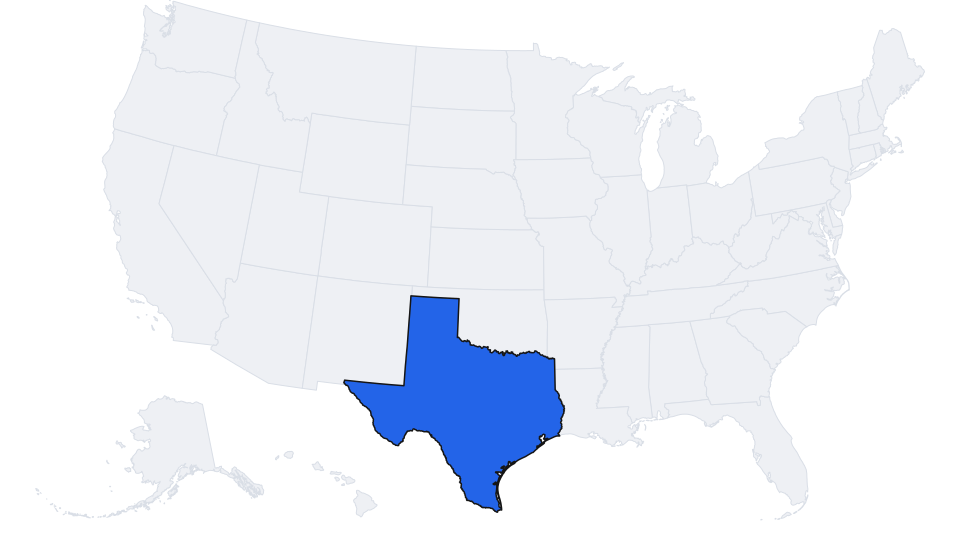
Map of the United States with Texas highlighted
Tax mechanics

Payroll tax in Texas

State income tax

No state income tax

Texas is one of nine states with no personal income tax (the Texas Constitution requires a statewide referendum to enact one). Employee pre-tax savings stack is federal marginal rate plus 7.65% FICA only - no state marginal layer. A $3,300 healthcare FSA election saves about $1,050 for a 22% federal bracket Texas employee versus about $1,360 for the same California employee. Matchbook calibrates under-election guardrails tighter for Texas because the marginal cost of forfeiture is unchanged but the savings-per-dollar is lower.

Texas Unemployment Insurance (TWC)

Wage base $9,000 (2025 and 2026)

Rate range: 0.25%-6.25% total; minimum rate 0.25% and maximum 6.25% for 2025; new employer rate 2.7% or the NAICS industry average, whichever is higher

Because the TWC UI wage base is only $9,000, Section 125 salary reductions produce zero employer UI savings for any salaried employee - they cross $9K of YTD wages within the first few pay periods. Matchbook suppresses the TWC UI savings line in the Texas employer ROI report for anyone above the base. The only meaningful employer payroll-tax win in Texas is the 7.65% FICA match on Section 125 and Section 132(f) elections.

Employer FICA

7.65% / 1.45% split

Employer FICA is 7.65% on wages up to the Social Security wage base ($176,100 in 2025; projected about $183,600 in 2026) and 1.45% above it. Matchbook models this per employee rather than quoting a flat rate.

Employer credits and levers

State and federal credits worth stacking

Credits that most broker ROI decks omit. Matchbook surfaces these in the employer report.

Texas Enterprise Zone Program

State sales and use tax refund of up to $2,500 per new or retained job (capped at 500 jobs or $1.25M per project, higher for Double or Triple Jumbo projects) for qualified businesses investing in economically distressed areas. Administered by the Texas Economic Development and Tourism Office; biannual application windows.

Source →

Texas Research and Development Tax Credit (franchise tax)

Franchise tax credit for qualified research expenses under Texas Tax Code Chapter 171, Subchapter M. Credit is 5% of the excess QRE over the base amount (8.722% if contracting with a Texas public or private institution of higher education). In 2025, SB 2206 extended and restructured the credit through 2046 with a sales-tax-exemption alternative; note the sales tax exemption option sunsets effective January 1, 2026.

Source →

Federal IRC Section 45F (primary childcare lever in Texas)

Because Texas has no corporate income tax (only a franchise tax) and no standalone state childcare credit, the federal employer-provided childcare credit is the main childcare-infrastructure lever. 25% credit with $150K cap in 2025; rises to 40% with $500K cap in 2026, and 50% with $600K cap for small employers.

Source →

Chapter 403 / Texas Jobs, Energy, Technology and Innovation Act (JETI)

Successor to the expired Chapter 313 school-value-limitation program. Enacted under HB 5 (2023), JETI (Texas Tax Code Chapter 403, Subchapter T) provides school district M&O tax reductions for large industrial, manufacturing, and energy projects creating qualifying jobs. Employers evaluating Texas siting should pair JETI modeling with the Enterprise Zone refund and the Skills Development Fund.

Source →

Household programs

State programs that change what your employees should elect

Matchbook coordinates these against DCFSA, FSA, and HSA elections at the household level.

Childcare subsidy

TWC Child Care Services (CCS) subsidy

Texas Workforce Commission subsidized childcare delivered through 28 local workforce boards. Income-eligible working families (generally at or below 85% State Median Income at entry) receive vouchers at participating providers. Substantial waitlists statewide in 2025; Texas Rising Star providers receive tiered reimbursement.

Matchbook: CCS reduces out-of-pocket dependent-care cost and therefore reduces the right DCFSA election. Matchbook asks Texas employees whether they are enrolled or waitlisted before recommending DCFSA contribution levels.

Source →

Preschool

Texas Public Pre-K

Texas offers free public pre-K for eligible 3- and 4-year-olds (income-qualifying, English learners, homeless, foster, or military families). HB 3 (2019) requires full-day pre-K for eligible 4-year-olds in ISDs, but the program is not universal. Not every district offers it and wrap-around care remains DCFSA-eligible.

Matchbook: The correct DCFSA election for a Texas pre-K family is the full-day center cost minus the publicly funded hours, not zero. Matchbook models this split explicitly and only when the employee's ISD actually offers the program.

Source →

Health programs

Coverage coordination checkpoints

Texas CHIP

Children's Health Insurance Program for families up to 201% FPL. Enrollment fees capped at $50 per family per year with modest copays. Administered by Texas HHSC. Texas has not expanded Medicaid, so the CHIP-to-Marketplace handoff is the critical lever for families at 138%-200% FPL.

Matchbook: Employees declining dependent coverage on the employer plan should be screened against CHIP thresholds before Matchbook defaults to the family tier.

Source →

Texas Medicaid - non-expansion state

Texas has not adopted the ACA Medicaid expansion; adult eligibility is limited (parents to roughly 15% FPL, no childless-adult coverage). The 2023-24 unwind removed more than 2 million Texans from Medicaid, the largest procedural disenrollment in the country. Open enrollment is the right touchpoint to recover procedurally-disenrolled dependents onto employer coverage, CHIP, or the Marketplace.

Matchbook: Matchbook's Texas screener flags households that may have lost Medicaid for reasons unrelated to eligibility and offers the employer-plan or Marketplace enrollment path.

Source →

ACA Marketplace (Federally Facilitated Marketplace)

Texas uses the federal exchange. 2026 employer-affordability threshold is 9.96% of household income. Enhanced premium tax credits expired at the end of 2025, so Texas 2026 premiums see double-digit increases. Texas had the largest Marketplace enrollment in the country in 2025 (about 3.9 million plan selections), making the coverage-gap and family-glitch handoffs especially material.

Matchbook: If employer family coverage exceeds 9.96% of household income, Matchbook surfaces the Marketplace dependent subsidy path - especially material in Texas after the enhanced PTC expiration and given the large uninsured and CHIP-adjacent population.

Source →

Retirement and wealth

State-level retirement and wealth context

Texas ABLE

Texas's Section 529A program for disabled beneficiaries, administered by the Texas Prepaid Higher Education Tuition Board. 2025 contribution limit $19,000; employed beneficiaries may add up to $15,060 more. $500K account limit with a Texas contribution cap alignment; $100K SSI asset-limit carve-out.

Matchbook: FSA or HSA dollars reimburse medical expenses; Texas ABLE covers broader qualified disability expenses. When SSI asset limits are in play, Matchbook routes disability-related spend to Texas ABLE first.

Source →

Texas Tuition Promise Fund and Texas College Savings Plan (529)

Texas offers a prepaid tuition plan (Texas Tuition Promise Fund) and a direct-sold 529 (Texas College Savings Plan). No Texas state income tax deduction exists because Texas has no state income tax. Texas residents can use any state's 529 plan without penalty; no home-state tilt is needed.

Matchbook: Matchbook does not over-weight Texas Tuition Promise for Texas employees when evaluating household college-savings strategy - pick on fees, investment menu, and prepaid-vs-savings fit.

Source →

Section 132(f) commuter

Pre-tax commuter reality in Texas

2025 IRC Section 132(f) cap is $325 per month for transit and $325 per month for qualified parking.

Parking and state credits

Parking: Downtown Austin, Houston, and Dallas CBD parking frequently approaches or exceeds the $325 monthly cap; Fort Worth and San Antonio parking usually sits below the cap.

State credit: None - Texas has no state-level commuter tax credit.

Disaster readiness

Texas disaster-relief playbook

IRC Section 139 qualified disaster relief payments are not W-2 wages: no FICA, no FUTA, no federal income tax withholding, and the employer gets a full deduction. Triggered by a federal disaster declaration - Texas qualifies under multiple perils: Gulf hurricanes (Harvey 2017, Beryl 2024), the February 2021 Winter Storm Uri, the May 2024 Houston derecho, recurring tornado outbreaks, and ongoing Panhandle wildfires (Smokehouse Creek 2024).

  • Pre-drafted Section 139 policy template so Texas employers can disburse tax-free relief within 48 hours of a federal declaration (hurricane landfall, ice-storm power outage, tornado, or wildfire).
  • Winter Storm Uri-style playbook: tax-free reimbursement of burst-pipe repair, generator fuel, hotel stays, and food spoilage when a federal declaration is in place - Matchbook ships the reimbursement categories pre-mapped.
  • Post-storm Section 125 election-change guidance: a hurricane, ice storm, or wildfire alone is not a listed change-in-status event under Treas. Reg. 1.125-4 - it qualifies only when it triggers a change in residence, employment, or cost-of-coverage.
  • FEMA Individual Assistance interaction: IRS Section 139 payments generally stack with FEMA IA, but Matchbook flags duplication risks in the disbursement log.
  • Texas-specific employer disaster leave review (Texas has no statutory paid disaster leave and no state PFML, so employer policy is the governing rule).
Matchbook for Texas

What we ship specifically for Texas employers

  • No-state-tax calibration in the employee savings engine - recompute marginal stacks at 0% state and widen DCFSA and FSA under-election guardrails for Texas households.
  • Federal IRC Section 45F calculator in the employer ROI report - the primary childcare-infrastructure lever because Texas has no corporate income tax and no standalone state childcare credit.
  • TWC Child Care Services waitlist logic in the DCFSA recommender, ingesting local workforce board eligibility and Texas Rising Star tiering.
  • Suppress the TWC UI savings line for salaried workers in the Texas employer FICA and SUI report - the $9,000 wage base makes it misleading.
  • IRC Section 139 hurricane and winter-storm playbook template with a pre-drafted employer policy and post-storm Section 125 election-change guidance, mapped to Uri-style perils.
  • CHIP, Medicaid-unwind, and Marketplace coverage-gap screener at open enrollment, given Texas is a non-expansion state with the largest procedural disenrollment in the country.
  • Enterprise Zone, JETI Chapter 403, and Texas R&D credit flags in the employer site-selection and incentive report.
  • Benefits graph ingests: TWC UI rate notices, Comptroller franchise-tax and R&D credit filings, Governor's Office EZP designations, TEA pre-K eligibility, HHSC CHIP thresholds, FEMA DR numbers for Texas, and FFM 2026 rate filings.

Pilot Matchbook with a Texas-aware engine.

Talk to us about a 30-day pilot calibrated to Texas payroll, programs, and disaster rules.