State playbook - South Dakota

Matchbook, tuned for South Dakota payroll, programs, and prairie storms.

South Dakota has no personal or corporate income tax, which compresses the employee pre-tax savings stack and eliminates the CIT-offset lever entirely. The Reemployment Assistance wage base is $15,000, there is no state pre-K program, and childcare supply is thin - a different ROI story than high-tax states, and one most broker decks ignore.

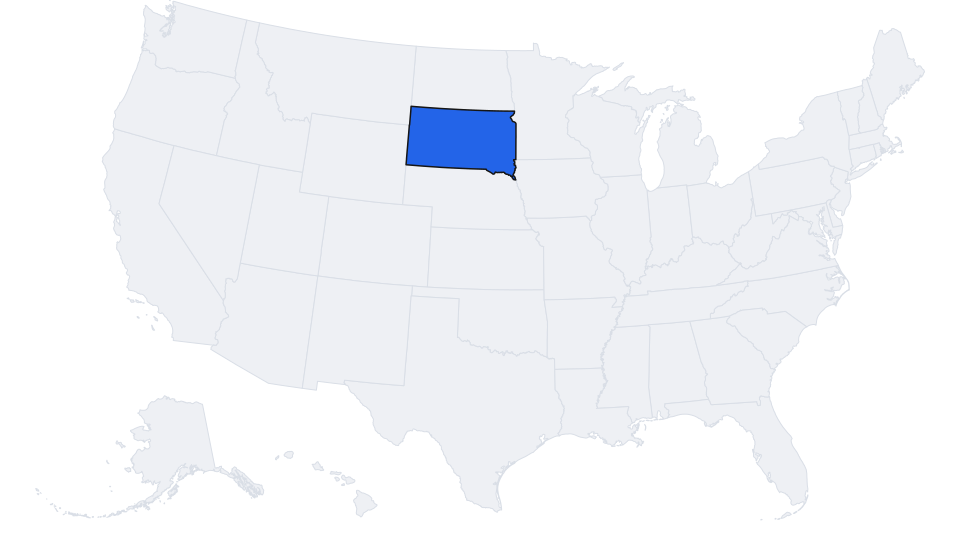
Map of the United States with South Dakota highlighted
Tax mechanics

Payroll tax in South Dakota

State income tax

No state income tax

South Dakota is one of nine states with no personal income tax. Employee pre-tax savings stack is federal marginal rate plus 7.65% FICA only - no state marginal layer. A $3,300 healthcare FSA election saves about $1,050 for a 22% federal bracket South Dakota employee versus about $1,360 for the same California employee. Matchbook calibrates under-election guardrails tighter for South Dakota because the marginal cost of forfeiture is unchanged but the savings-per-dollar is lower.

South Dakota Reemployment Assistance Tax

Wage base $15,000 (2026)

Rate range: 0.00%-9.35%; new non-construction employer rate 1.20% plus 0.55% Investment Fee in year one; construction new employer rate 6.00%

The SD RA wage base is $15,000 - more than double Florida's $7,000 but well below Washington's. Section 125 salary reductions produce some employer RA savings early in the year for lower-wage and part-time employees, but salaried workers cross $15K within the first quarter. Matchbook models RA savings per employee based on YTD wages and Investment Fee eligibility rather than quoting a flat percentage.

Employer FICA

7.65% / 1.45% split

Employer FICA is 7.65% on wages up to the Social Security wage base ($176,100 in 2025; projected about $183,600 in 2026) and 1.45% above it. With no state income tax and no state payroll tax beyond RA, FICA is effectively the entire employer payroll-tax lever Matchbook can move in South Dakota.

Employer credits and levers

State and federal credits worth stacking

Credits that most broker ROI decks omit. Matchbook surfaces these in the employer report.

South Dakota Reinvestment Payment Program

Discretionary reinvestment payment from the Board of Economic Development for qualifying projects with at least $20M in new equipment/facilities investment (lower thresholds for agricultural processing and wind/solar). Payment is a partial refund of the contractor's excise tax and sales/use tax on project materials - not a credit against income tax, because South Dakota has no corporate income tax.

Source →

Federal IRC Section 45F (primary childcare lever in SD)

Federal employer-provided childcare credit. 25% credit with $150K cap in 2025; rises to 40% with $500K cap in 2026, and 50% with $600K cap for small employers. Because South Dakota has no state corporate income tax and no stacking state childcare credit, Section 45F is the only meaningful tax-credit lever for SD employers evaluating on-site or sponsored childcare.

Source →

South Dakota bank franchise tax (context, not a credit)

South Dakota imposes a bank franchise tax on financial institutions (6.0% on the first $400M of net income, stepping down in brackets). This is the only state-level income-style tax on businesses in SD. For banks headquartered in Sioux Falls, Matchbook flags this as the only surface where a state-tax-credit argument could theoretically apply - but no childcare or dependent-care credit currently offsets it.

Source →

Household programs

State programs that change what your employees should elect

Matchbook coordinates these against DCFSA, FSA, and HSA elections at the household level.

Childcare subsidy

South Dakota Child Care Assistance (CCAP)

DSS-administered subsidy for income-qualifying working families. Eligibility generally up to 209% FPL at entry with a 12-month eligibility period. Provider reimbursement rates were raised in 2023-2024 to stabilize the thin SD childcare market.

Matchbook: CCAP reduces out-of-pocket dependent-care cost and therefore reduces the right DCFSA election. Matchbook asks South Dakota employees whether they qualify before recommending DCFSA contribution levels, and factors in SD's well-documented childcare desert conditions when modeling realistic care costs.

Source →

Preschool

No state pre-K program

South Dakota is one of a small group of states with no state-funded pre-K program. There is no VPK, no TK, and no universal 4-year-old preschool - families pay private tuition or rely on Head Start (income-qualifying) for under-5 care.

Matchbook: Because SD has no public pre-K offset, the correct DCFSA election for a 3- or 4-year-old is the full-year private preschool cost, not a wrap-around residual. Matchbook flags SD employees with preschool-age children as candidates for the full $7,500 household DCFSA cap (2026 limit) more often than employees in pre-K states.

Source →

Health programs

Coverage coordination checkpoints

South Dakota CHIP

Children's health coverage for families above Medicaid thresholds up to 209% FPL. No monthly premiums; nominal copays only. Administered by DSS and branded within the broader Medicaid/CHIP enrollment channel.

Matchbook: Employees declining dependent coverage on the employer plan should be screened against CHIP thresholds before Matchbook defaults to the family tier - particularly material in SD where rural premiums on employer plans are high.

Source →

South Dakota Medicaid expansion

Voters approved Medicaid expansion by constitutional amendment in November 2022; implementation began July 1, 2023. Adults up to 138% FPL are eligible. Post-unwind caseloads have stabilized in 2024-2025 after procedural disenrollments during redetermination.

Matchbook: Matchbook's SD screener flags households near 138% FPL who may have lost expansion Medicaid for procedural reasons and offers the employer-plan or Marketplace enrollment path at open enrollment.

Source →

ACA Marketplace (Federally Facilitated Marketplace)

South Dakota uses the federal exchange (HealthCare.gov). 2026 employer-affordability threshold is 9.96% of household income. Enhanced premium tax credits expired at the end of 2025, so SD 2026 premiums see double-digit increases - especially acute in the single-carrier rural rating areas. Family-glitch fix still applies.

Matchbook: If employer family coverage exceeds 9.96% of household income, Matchbook surfaces the Marketplace dependent subsidy path. SD has no state PFML program, so Matchbook does not model a state paid-leave payroll offset here.

Source →

Retirement and wealth

State-level retirement and wealth context

ABLE SD (STABLE program)

South Dakota offers ABLE accounts through Ohio's STABLE Account platform under the ABLE SD branding. 2025 contribution limit $19,000; employed beneficiaries may add up to $15,060 more via ABLE to Work. $500K lifetime balance cap; $100K SSI asset-disregard cap.

Matchbook: FSA or HSA dollars reimburse medical expenses; ABLE covers broader qualified disability expenses. When SSI asset limits are in play, Matchbook routes disability-related spend to ABLE SD first. No state income tax deduction applies because SD has no state income tax.

Source →

CollegeAccess 529

South Dakota's 529 plan, administered by the South Dakota Investment Council and distributed through Allianz Global Investors. No state income tax deduction exists because South Dakota has no state income tax. SD residents can use any state's 529 plan without penalty; no home-state tilt is needed.

Matchbook: Matchbook does not over-weight CollegeAccess 529 for South Dakota employees when evaluating household college-savings strategy - residents should pick on fund quality and fees, not home-state tax benefit.

Source →

Section 132(f) commuter

Pre-tax commuter reality in South Dakota

2025 IRC Section 132(f) cap is $325 per month for transit and $325 per month for qualified parking.

Parking and state credits

Parking: Sioux Falls and Rapid City CBD parking typically sits well below the $325 monthly cap. Transit ridership in both cities is modest and most SD employees commute by car, which limits the 132(f) transit lever but leaves the parking lever available in downtown cores.

State credit: None - South Dakota has no state income tax and therefore no state-level commuter tax credit.

Disaster readiness

South Dakota disaster-relief playbook

IRC Section 139 qualified disaster relief payments are not W-2 wages: no FICA, no FUTA, no federal income tax withholding, and the employer gets a full deduction. Triggered by a federal disaster declaration. Recent SD disasters that qualified include severe storms, tornadoes, and flooding (DR-4689, DR-4775, DR-4819) and recurring winter blizzards across the plains.

  • Pre-drafted Section 139 policy template so SD employers can disburse tax-free relief within 48 hours of a federal declaration - relevant for spring flooding, summer tornado outbreaks, and winter blizzard events.
  • Post-storm Section 125 election-change guidance: a blizzard or tornado alone is not a listed change-in-status event under Treas. Reg. 1.125-4 - it qualifies only when it triggers a change in residence, employment, or cost-of-coverage.
  • FEMA Individual Assistance interaction: IRS Section 139 payments generally stack with FEMA IA, but Matchbook flags duplication risks in the disbursement log.
  • South Dakota-specific employer disaster leave review (SD has no statutory paid disaster or sick leave, so employer policy is the governing rule).
Matchbook for South Dakota

What we ship specifically for South Dakota employers

  • No-state-tax calibration in the employee savings engine - recompute marginal stacks at 0% state and widen DCFSA and FSA under-election guardrails for SD households; identical engine branch to the FL/TX/WY calibrations.
  • No-pre-K DCFSA implication: default preschool-age dependents to full-year private tuition in the DCFSA recommender rather than a VPK/TK wrap-around residual. SD is in the minority of states without any public pre-K program.
  • Suppress the state-CIT credit section of the employer ROI report entirely - SD has no corporate income tax. Retain the bank franchise tax note only for Sioux Falls financial-sector employers.
  • Surface federal IRC Section 45F as the sole employer childcare tax-credit lever for SD employers, without the stacking state-credit math used in FL/NE/KS reports.
  • Model employer Reemployment Assistance savings per employee against the $15,000 wage base and surface the 0.55% Investment Fee separately - the SD rate table is structurally different from the FL flat-minimum pattern.
  • IRC Section 139 disaster playbook template covering SD's recurring blizzard, tornado, and flooding declarations, with a pre-drafted employer policy and post-storm Section 125 election-change guidance.
  • CHIP and Medicaid-expansion redetermination screener at open enrollment to route procedurally-disenrolled dependents to employer coverage, SD CHIP, or the FFM Marketplace.
  • Benefits graph ingests: SD DLR Reemployment Assistance rate notices, SD DSS CCAP and Medicaid eligibility tables, SD GOED Reinvestment Payment awards, FEMA DR numbers for SD, and FFM 2026 rate filings for SD rating areas.

Pilot Matchbook with a South Dakota-aware engine.

Talk to us about a 30-day pilot calibrated to South Dakota payroll, programs, and disaster rules.