State playbook - Rhode Island

Matchbook, tuned for Rhode Island payroll, paid leave, and coastal storms.

Rhode Island stacks a graduated 3.75%-5.99% income tax on top of FICA, layers two employee-funded programs (TDI at 1.1% and TCI expanded to 8 weeks in 2026) on top of standard payroll withholding, and adds state-specific employer levers - Rebuild RI, Qualified Jobs, and Job Training credits - plus RIte Care, RI Pre-K, HealthSource RI, and IRC 139 coastal-storm relief that most broker ROI decks miss.

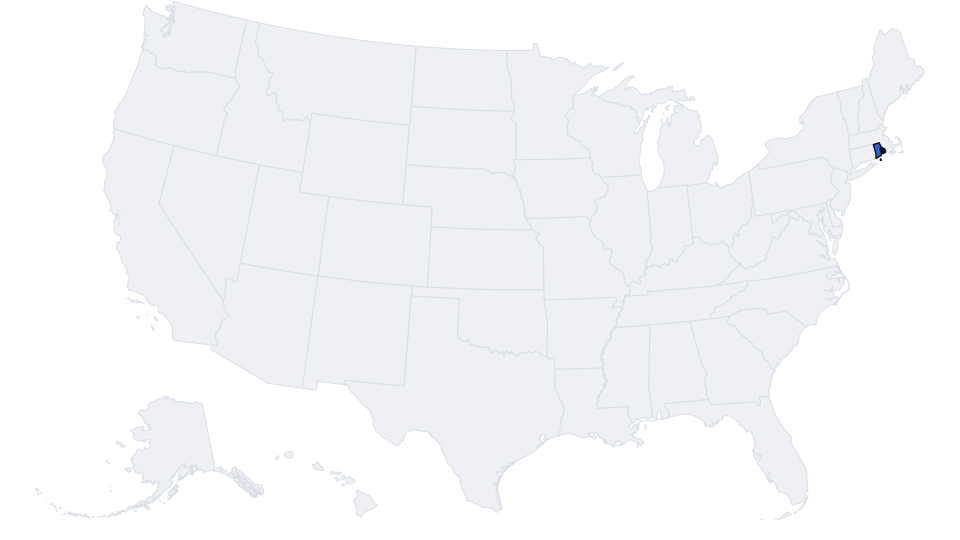
Map of the United States with Rhode Island highlighted
Tax mechanics

Payroll tax in Rhode Island

State income tax

Applies

Rhode Island is a graduated-rate income-tax state: 3.75% up to $82,050 (2026 inflation-adjusted), 4.75% from $82,050 to $186,550, and 5.99% above $186,550. Employee pre-tax savings stack is federal marginal rate plus 7.65% FICA plus the Rhode Island marginal rate. A $3,300 healthcare FSA election saves about $1,253 for a 22% federal bracket Rhode Island employee in the middle 4.75% RI bracket, versus about $1,050 for the same Florida employee. Matchbook calibrates under-election guardrails wider for Rhode Island because the marginal cost of forfeiture is unchanged but the savings-per-dollar is higher.

Rhode Island Employment Security (UI) Tax

Wage base $30,800 (2026); $29,700 for employers in the highest UI tax group

Rate range: Experience-rated schedule; new employer rate 1.21% for 2026 (includes 0.21% Job Development Assessment)

Rhode Island layers two employee-funded insurance programs on top of federal FICA: TDI at 1.1% of wages up to a $100,000 wage base in 2026 (maximum employee contribution $1,100), and TCI funded inside the same TDI contribution. Section 125 salary reductions reduce taxable wages for TDI and TCI as well as for FICA and RI UI, so a Rhode Island FSA election produces employer-side savings on the UI wage base (up to $30,800 per employee) and employee-side savings on TDI/TCI (up to $100,000 per employee). Matchbook models the combined RI-specific payroll-tax wedge per employee.

Employer FICA

7.65% / 1.45% split

Employer FICA is 7.65% on wages up to the Social Security wage base ($176,100 in 2025; projected about $183,600 in 2026) and 1.45% above it. Matchbook models this per employee rather than quoting a flat rate and stacks it with the RI state marginal rate plus the employee-side TDI/TCI 1.1% wedge.

Employer credits and levers

State and federal credits worth stacking

Credits that most broker ROI decks omit. Matchbook surfaces these in the employer report.

Rebuild Rhode Island Tax Credit

Commerce RI gap-financing credit of up to 30% of project costs, capped at $15M per project, paid out over five years. Redeemable with the state for 90% of value or transferable. Commercial projects require at least 25,000 sqft and at least 25 full-time employees post-construction; minimum project cost typically $5M. Program sunset extended to December 31, 2025; track reauthorization in any Rhode Island employer ROI modeling.

Source →

Qualified Jobs Incentive Tax Credit

Up to $7,500 per net new full-time job per year, for up to 10 years, roughly equivalent to W-2 withholdings the state receives on each new hire. Minimum 10 net new jobs for most industries, redeemable for cash at 90% of value, with clawback if job-creation targets are not met. Administered by Rhode Island Commerce.

Source →

Rhode Island Job Training Tax Credit

Corporate income tax credit equal to 50% of direct training costs, up to $5,000 per employee over three years, for retraining or upskilling existing workers. Employee must be retained 13 consecutive weeks and at least 455 hours. Stacks with the federal Work Opportunity Tax Credit administered through DLT.

Source →

Federal IRC Section 45F (stacks with RI on-site care investment)

Federal employer-provided childcare credit. 25% credit with $150K cap in 2025; rises to 40% with $500K cap in 2026, and 50% with $600K cap for small employers. Matchbook surfaces the federal credit in Rhode Island employer ROI when evaluating sponsored or on-site childcare; Rhode Island has no state-level 45F analog, so the federal credit is the primary childcare-investment lever.

Source →

Household programs

State programs that change what your employees should elect

Matchbook coordinates these against DCFSA, FSA, and HSA elections at the household level.

Childcare subsidy

Rhode Island Child Care Assistance Program (CCAP)

Income-eligible subsidized childcare for children under age 13 (up to 18 if special needs). Income limit raised to 261% FPL effective January 1, 2025, putting a family of three at about $69,557 entry. Family co-pay between 2% and 7% of gross income, regardless of number of children enrolled.

Matchbook: CCAP reduces out-of-pocket dependent-care cost and therefore reduces the right DCFSA election. Matchbook asks Rhode Island employees whether they qualify before recommending DCFSA contribution levels - the 261% FPL threshold means many middle-income Rhode Island households now qualify who did not under the old 200% FPL rule.

Source →

Preschool

RI Pre-K

Lottery-based free state-funded pre-K for 4-year-olds in 20 participating communities including Providence, Cranston, Warwick, Pawtucket, Woonsocket, and East Providence. Full school-day model, roughly six hours per day for the school year. Not universal; seats are allocated by lottery.

Matchbook: Because RI Pre-K is lottery-allocated rather than guaranteed, Matchbook models two DCFSA scenarios per eligible household: full-day center cost if not selected, wrap-around cost only if selected. Matchbook defaults to the un-selected scenario until the lottery closes.

Source →

Paid medical leave

Rhode Island Temporary Disability Insurance (TDI)

Employee-funded state short-term disability. 2026 contribution rate 1.1% of wages up to a $100,000 wage base; maximum employee contribution $1,100 per year. Benefits replace 60% of average weekly wage in 2026, rising to 70% in 2027 and 75% in 2028 under recent expansion legislation.

Matchbook: Matchbook coordinates TDI with employer-sponsored STD to avoid double-coverage waste. Because TDI is already funded by the employee via payroll, supplemental buy-up STD is only worth the premium above TDI's 60% replacement - Matchbook quantifies this gap for each Rhode Island employee at open enrollment.

Source →

Paid family leave

Rhode Island Temporary Caregiver Insurance (TCI)

Employee-funded paid family leave for bonding with a new child or caring for a seriously ill family member (child, spouse, domestic partner, sibling, parent, parent-in-law, grandparent). Expanded to 7 weeks as of January 1, 2025, and to 8 weeks as of January 1, 2026. Dependent allowance doubled from $10 to $20 per week per dependent under 18. TCI is funded inside the TDI 1.1% contribution - no separate rate.

Matchbook: Matchbook flags TCI as the dominant leave source for new-parent and eldercare scenarios in Rhode Island. Employers offering supplemental paid parental leave should coordinate with TCI so benefits are sequenced, not duplicated; Matchbook's Rhode Island leave planner does this automatically.

Source →

Paid sick leave

Rhode Island Healthy and Safe Families and Workplaces Act (Paid Sick/Safe Leave)

Employers with 18 or more employees must provide up to 40 hours of paid sick and safe leave per year; smaller employers must provide unpaid leave of the same amount. Accrual is one hour per 35 hours worked. Covers employee and family illness, preventive care, public health emergencies, and domestic-violence-related absence. Effective January 1, 2026, all new hires must receive a written wage notice at start of employment.

Matchbook: Matchbook's Rhode Island onboarding flow now serves the 2026 written wage notice at hire automatically so employers do not manage the compliance artifact in a separate system.

Source →
Health programs

Coverage coordination checkpoints

RIte Care (Medicaid/CHIP)

Rhode Island's combination Medicaid and CHIP managed care program. Children and young adults under 19 eligible up to 266% FPL, no premiums and no cost sharing. All children are eligible regardless of immigration status. Foster-care, kinship, and guardianship children eligible with no income limit. RIte Smiles provides dental coverage for children.

Matchbook: Employees declining dependent coverage on the employer plan should be screened against the RIte Care 266% FPL threshold before Matchbook defaults to the family tier - the Rhode Island CHIP ceiling is materially higher than the Florida KidCare ceiling and catches more middle-income families.

Source →

HealthSource RI (state ACA exchange)

Rhode Island operates its own state-based marketplace. 2026 open enrollment closed with enrollment down about 10% and net premiums roughly doubled on average after the federal enhanced premium tax credit expired. Governor McKee's FY27 budget proposes state-funded subsidies for households under 200% FPL to partially offset the federal rollback. CSRs still available for enrollees under 250% FPL in Silver plans.

Matchbook: If employer family coverage exceeds the ACA employer-affordability threshold (9.96% of household income for 2026) or the employee would be eligible for cost-sharing reductions on a HealthSource RI Silver plan, Matchbook surfaces the Marketplace dependent subsidy path - especially material in Rhode Island after the 2026 premium spike.

Source →

Retirement and wealth

State-level retirement and wealth context

RI's ABLE

Rhode Island's Section 529A program for disabled beneficiaries. 2026 contribution limit $20,000; employed beneficiaries may add additional earned-income contributions. Starting January 2026, federal eligibility opens to those whose disability began before age 46 (previously age 26), materially expanding Rhode Island eligibility including veterans.

Matchbook: FSA or HSA dollars reimburse medical expenses; ABLE covers broader qualified disability expenses. When SSI asset limits are in play, Matchbook routes disability-related spend to ABLE first. The 2026 age-46 expansion expands Matchbook's Rhode Island ABLE-eligible population significantly.

Source →

CollegeBound Saver (Rhode Island 529)

Rhode Island Section 529 plan administered by the General Treasurer. Rhode Island income tax deduction of up to $500 per year (single) or $1,000 per year (married filing jointly) for contributions, with unlimited carry-forward of excess. Non-qualified distributions and out-of-state rollovers trigger Rhode Island recapture.

Matchbook: Because Rhode Island offers a home-state deduction, Matchbook tilts Rhode Island residents toward CollegeBound Saver rather than out-of-state 529 plans unless fees or investment options materially differ. The annual deduction cap is low ($1,000 MFJ), so Matchbook caps the Rhode Island 529 recommendation at the deductible contribution before surfacing any out-of-state plan analysis.

Source →

Section 132(f) commuter

Pre-tax commuter reality in Rhode Island

2025 IRC Section 132(f) cap is $325 per month for transit and $325 per month for qualified parking. RIPTA base fare is $2 per ride; monthly passes typically sit well under the federal cap, so full pre-tax utilization is straightforward for Rhode Island commuters.

Parking and state credits

Parking: Downtown Providence parking frequently sits under the $325 monthly cap; Kennedy Plaza transit-hub parking is well below. Rhode Island employees commuting to Boston via MBTA commuter rail can stack the transit pre-tax election up to the $325 cap.

State credit: None - Rhode Island has no state-level commuter tax credit on top of the federal Section 132(f) exclusion.

Disaster readiness

Rhode Island disaster-relief playbook

IRC Section 139 qualified disaster relief payments are not W-2 wages: no FICA, no FUTA, no federal income tax withholding, no Rhode Island income tax withholding, and the employer gets a full deduction. Triggered by a federal disaster declaration, which recent Rhode Island events have qualified for - including DR-4765-RI (December 2023 storms and flooding), DR-4766-RI (January 2024 storms and flooding), and DR-4753-RI (September 2023 severe storms, flooding, and tornadoes).

  • Pre-drafted Section 139 policy template so Rhode Island employers can disburse tax-free relief within 48 hours of a federal declaration - coastal flooding, nor'easter power outage, and blizzard triggers all mapped.
  • Post-storm Section 125 election-change guidance: a flood or nor'easter alone is not a listed change-in-status event under Treas. Reg. 1.125-4 - it qualifies only when it triggers a change in residence, employment, or cost-of-coverage.
  • TDI/TCI interaction: Rhode Island employees unable to work because of injury or illness sustained in a disaster can claim TDI in parallel with Section 139 relief; Matchbook logs both so wage-replacement math stays clean for the CFO.
  • FEMA Individual Assistance interaction: Section 139 payments generally stack with FEMA IA, but Matchbook flags duplication risks in the disbursement log.
  • Rhode Island has no statutory paid disaster leave, so employer policy is the governing rule - Matchbook surfaces the employer disaster-leave policy alongside TDI eligibility at the time of a declaration.
Matchbook for Rhode Island

What we ship specifically for Rhode Island employers

  • Graduated-rate calibration in the employee savings engine - recompute marginal stacks at the correct Rhode Island bracket (3.75%, 4.75%, or 5.99%) per employee, and widen DCFSA and FSA under-election guardrails because the Rhode Island marginal stack is denser than no-tax states.
  • TDI and TCI coordination layer - sequence employer-sponsored STD buy-up on top of TDI's 60% replacement and coordinate employer parental leave with the 8-week TCI entitlement so benefits stack rather than duplicate.
  • CCAP and RI Pre-K screener in the DCFSA recommender, ingesting the 261% FPL CCAP threshold and the 20-community RI Pre-K lottery map.
  • Rebuild RI, Qualified Jobs, and Job Training credit stacking model in the employer ROI report - high leverage for Rhode Island employers expanding headcount or training workforce, with federal Section 45F stacking when on-site childcare is in the plan.
  • IRC Section 139 coastal-storm playbook with a pre-drafted Rhode Island employer policy and post-storm Section 125 election-change guidance keyed to recent DR-4765 and DR-4766 designated counties.
  • RIte Care and HealthSource RI screener at open enrollment to catch dependents who qualify under the 266% FPL CHIP ceiling or who would be better served by a HealthSource RI Silver plan with CSRs after the 2026 premium spike.
  • Rhode Island 2026 new-hire written wage notice served inside the Matchbook onboarding flow so employers satisfy the Paid Sick and Safe Leave Act compliance requirement automatically.
  • Benefits graph ingests: Rhode Island Division of Taxation inflation adjustments, RI DLT UI and TDI/TCI rate notices, Commerce RI tax credit awards, RIDE RI Pre-K community list, DHS CCAP income thresholds, HealthSource RI rate filings, and FEMA DR numbers for Rhode Island.

Pilot Matchbook with a Rhode Island-aware engine.

Talk to us about a 30-day pilot calibrated to Rhode Island payroll, programs, and disaster rules.