State playbook - Pennsylvania

Matchbook, tuned for Pennsylvania PIT, local EIT, and the Section 125 mismatch.

Pennsylvania stacks a flat 3.07% state PIT on top of local Earned Income Tax (0.5%-4%, with Philadelphia residents at about 3.75%), and treats Section 125 cafeteria plan contributions differently than the IRS does. That mismatch - plus a $10,000 SUI wage base, Act 32 local withholding, Pennie marketplace mechanics, and a statewide childcare credit - rewrites both the employee savings stack and the employer ROI report.

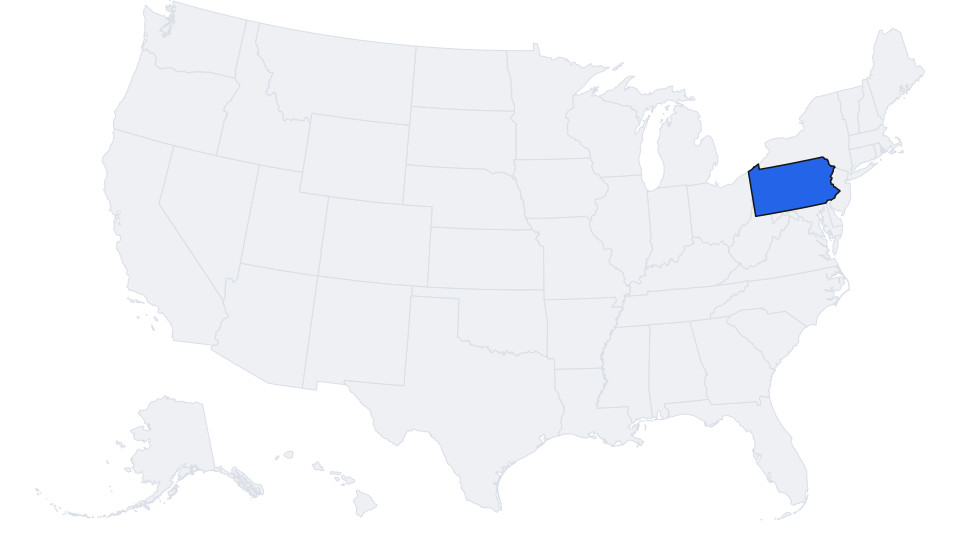
Map of the United States with Pennsylvania highlighted
Tax mechanics

Payroll tax in Pennsylvania

State income tax

Applies

Pennsylvania imposes a flat 3.07% Personal Income Tax on compensation with no standard deduction and no personal exemption. Local Earned Income Tax (EIT) layers on top under Act 32 of 2008: residents pay the higher of their resident rate or the non-resident work-location rate, typically 0.5%-2.0% in most municipalities and 3.75% for Philadelphia residents (Philadelphia uses its own Wage Tax, not Act 32). Matchbook models the combined PIT plus EIT marginal rate per employee, because a Philadelphia resident electing a $3,300 FSA saves roughly 3.07% PIT + 3.75% Wage Tax + 7.65% FICA + federal marginal on pre-tax dollars - materially more than a Pittsburgh resident at 3.07% PIT + 3% EIT + federal.

Pennsylvania Unemployment Compensation (UC)

Wage base $10,000 (2026, unchanged since 1984)

Rate range: Employer: 1.419%-10.3734% standard range in 2025; new employer rate 3.822% (non-construction). Employee: 0.07% flat on total wages (no wage base cap for the employee portion).

Pennsylvania is one of only three states with an employee UC contribution (0.07%). It applies to total wages with no cap, so Section 125 salary reductions produce a small but real employee UC savings on every dollar reduced - Matchbook surfaces this in the employee ROI line. Employer UC savings, by contrast, cap out quickly at the $10,000 wage base - any salaried employee crosses it within the first quarter, so Matchbook suppresses employer UC savings for salaried workers in the Pennsylvania employer report, mirroring the Florida RT treatment.

Employer FICA

7.65% / 1.45% split

Employer FICA is 7.65% on wages up to the Social Security wage base ($176,100 in 2025; projected about $183,600 in 2026) and 1.45% above it. Matchbook models this per employee rather than quoting a flat rate.

Pennsylvania specific

Section 125 federal-state treatment mismatch - the Pennsylvania trap

Pennsylvania PIT generally follows federal Section 125 treatment for employer-sponsored health, dental, vision, and group-term life premiums paid through a cafeteria plan - these reductions are excluded from PA-taxable compensation. But the treatment diverges for other Section 125 components: Pennsylvania does not recognize the federal exclusion for employee 401(k) elective deferrals (401(k) deferrals are PA PIT taxable in the year deferred), HSA employee contributions through a cafeteria plan are PA PIT exempt but stand-alone payroll HSA contributions outside a Section 125 plan are not, and DCFSA contributions generally follow federal treatment and are PA PIT exempt. Local EIT follows Act 32 and Pennsylvania Department of Revenue guidance, which aligns with PIT on most Section 125 items but with Philadelphia-specific nuances for the Wage Tax.

Matchbook: Matchbook's Pennsylvania payroll mapping flags the 401(k) pre-tax versus Roth decision differently than in non-PA states - because the PA PIT hit is taken now either way, the Roth premium for a Pennsylvania employee is smaller than the federal-only calculation suggests. Matchbook also validates that HSA contributions are routed through a cafeteria plan (not direct payroll deduction) so the employee captures both PIT and EIT exemption, which is frequently misconfigured in payroll systems that treat HSA as a stand-alone pre-tax deduction.

Source →

Employer credits and levers

State and federal credits worth stacking

Credits that most broker ROI decks omit. Matchbook surfaces these in the employer report.

Pennsylvania Educational Improvement Tax Credit (EITC)

Credit against PA corporate net income tax, capital stock/franchise tax, bank shares tax, insurance premiums tax, or PIT (for pass-through owners) for contributions to Scholarship Organizations, Educational Improvement Organizations, or Pre-K Scholarship Organizations. 75% credit for a one-year commitment, 90% for a two-year commitment. $340M program cap in FY 2024-25 after Act 34 of 2023 expansion.

Source →

Pennsylvania Opportunity Scholarship Tax Credit (OSTC)

Parallel credit for contributions supporting scholarships for students in low-achieving schools. Same 75%/90% structure as EITC. Combined EITC plus OSTC cap exceeded $470M for FY 2024-25. Both credits are first-come, first-served and typically exhaust within hours of the July 1 application window opening for existing donors.

Source →

Pennsylvania Child and Dependent Care Enhancement Tax Credit

Refundable PA PIT credit for working families, expanded under Act 34 of 2023. Matches 100% of the federal Child and Dependent Care Credit for Pennsylvania filers, up to $1,050 (one child) or $2,100 (two or more). Fully refundable since tax year 2023.

Source →

Pennsylvania Research and Development Tax Credit

10% credit against PIT or CNIT for qualified R&D expenses (20% for small businesses under $5M in gross receipts). Total program cap $55M per year; credits are transferable and often sell on the secondary market at 88-92 cents on the dollar.

Source →

Pennsylvania Neighborhood Assistance Program (NAP)

Tax credit (55%-75% depending on program track) against most PA business taxes for contributions to approved community-impact projects in distressed areas. Includes the Neighborhood Assistance Tax Credit, Special Program Priorities, and Enterprise Zone components.

Source →

Federal IRC Section 45F (stacks with Pennsylvania childcare infrastructure grants)

Federal employer-provided childcare credit. 25% credit with $150K cap in 2025; rises to 40% with $500K cap in 2026, and 50% with $600K cap for small employers. Pennsylvania does not offer a direct state-level employer childcare credit equivalent to Florida's, but DCED's Childcare Contribution Tax Credit (proposed/pending in recent sessions) is on the watch list.

Source →

Household programs

State programs that change what your employees should elect

Matchbook coordinates these against DCFSA, FSA, and HSA elections at the household level.

Childcare subsidy

Child Care Works (CCW)

Pennsylvania's subsidized childcare program, administered by the Office of Child Development and Early Learning (OCDEL). Eligibility up to 200% FPL at entry, 235% FPL at redetermination. Copayment scales with income; expanded infant/toddler rates took effect in 2024.

Matchbook: CCW participation reduces the out-of-pocket dependent-care cost that drives the DCFSA election. Matchbook screens Pennsylvania households against CCW thresholds before recommending DCFSA contribution levels - a CCW family often has a DCFSA recommendation near zero.

Source →

Preschool

Pennsylvania Pre-K Counts and Head Start Supplemental Assistance

State-funded high-quality pre-K for 3- and 4-year-olds in families up to 300% FPL. Not universal (unlike Florida VPK). Part-day and school-day slots available; wrap-around care typically remains DCFSA-eligible.

Matchbook: For Pennsylvania Pre-K Counts families, Matchbook models the DCFSA election as full-day center cost minus the Pre-K Counts-funded hours, not zero.

Source →

Paid leave

Philadelphia Paid Sick Leave (Promoting Healthy Families and Workplaces Act)

Philadelphia employers with 10 or more employees must provide up to 40 hours of paid sick leave per year; employers with fewer than 10 must provide unpaid sick leave. Accrual at 1 hour per 40 hours worked. Pittsburgh has a parallel Paid Sick Days Act. Pennsylvania has no statewide paid sick leave mandate as of 2026.

Matchbook: Matchbook's Pennsylvania leave library is zoned by municipality, not just state - Philadelphia and Pittsburgh employees get different accrual guidance than Erie or Scranton employees from the same multi-site employer.

Source →

Health programs

Coverage coordination checkpoints

Pennsylvania CHIP

Children's Health Insurance Program covering uninsured kids in families above Medicaid limits. Free CHIP up to 208% FPL; low-cost CHIP and full-cost CHIP tiers above. Pennsylvania CHIP covers all children regardless of family income if other conditions are met, making it unusually expansive.

Matchbook: Employees declining dependent coverage on the employer plan should be screened against CHIP tiers before Matchbook defaults to the family tier - the free CHIP threshold is meaningfully higher than Florida KidCare.

Source →

Pennie - Pennsylvania's State-Based Marketplace

Pennsylvania transitioned from the federal marketplace to Pennie in plan year 2021. 2026 employer-affordability threshold is 9.96% of household income. Enhanced premium tax credits expired at the end of 2025; Pennie applied its own reinsurance program to partially offset 2026 premium increases.

Matchbook: If employer family coverage exceeds 9.96% of household income, Matchbook surfaces the Pennie dependent subsidy path. Pennie's state-based reinsurance means the post-2025 premium shock is smaller than in FFM states, so the Marketplace dependent option remains more competitive in Pennsylvania than in Florida.

Source →

Pennsylvania Medicaid - post-unwind recovery

Pennsylvania disenrolled roughly 500,000 Medicaid enrollees during unwinding, with a lower procedural disenrollment share than the national average due to DHS's ex parte renewal processes. Open enrollment remains the right touchpoint to recover procedurally-disenrolled dependents onto employer coverage, CHIP, or Pennie.

Matchbook: Matchbook's Pennsylvania screener flags households that may have lost Medicaid for reasons unrelated to eligibility and offers the enrollment path - prioritizing CHIP for kids given the expansive eligibility tiers.

Source →

Retirement and wealth

State-level retirement and wealth context

PA ABLE

Pennsylvania's Section 529A program for disabled beneficiaries. 2025 contribution limit $19,000; employed beneficiaries may add up to $15,060 more. PA PIT deduction up to $19,000 per beneficiary per contributor for PA ABLE contributions. $100K SSI asset cap.

Matchbook: FSA or HSA dollars reimburse medical expenses; PA ABLE covers broader qualified disability expenses and also delivers a PA PIT deduction (unlike a federal-only ABLE plan). When SSI asset limits are in play for a Pennsylvania household, Matchbook routes disability-related spend to PA ABLE first.

Source →

PA 529 Guaranteed Savings Plan (GSP) and PA 529 Investment Plan (IP)

Pennsylvania offers both a prepaid-tuition GSP and a direct-sold IP. PA PIT deduction up to $19,000 per beneficiary per contributor ($38,000 if married filing jointly), and Pennsylvania is one of a small number of states that grants the PIT deduction for contributions to any state's 529 plan (not just in-state).

Matchbook: Because the PA 529 PIT deduction follows the contributor regardless of plan state, Matchbook does not force Pennsylvania employees into PA 529 if another plan has better fees or investment options - the 3.07% PIT deduction is preserved either way.

Source →

Section 132(f) commuter

Pre-tax commuter reality in Pennsylvania

2025 IRC Section 132(f) cap is $325 per month for transit and $325 per month for qualified parking. Pennsylvania PIT follows the federal exclusion for Section 132(f) qualified transportation fringes, and Philadelphia Wage Tax and most Act 32 EIT jurisdictions do as well - meaning a Philadelphia SEPTA commuter saves 3.07% PIT + 3.75% Wage Tax + 7.65% FICA + federal marginal on every Section 132(f) dollar.

Parking and state credits

Parking: Philadelphia Center City and University City parking routinely exceeds the $325 monthly cap; Pittsburgh Golden Triangle parking frequently approaches it. Harrisburg, Scranton, Erie parking typically sits well below the cap.

State credit: None - Pennsylvania has no state-level commuter tax credit. The value is entirely the federal Section 132(f) exclusion stacked with the PA PIT, local EIT or Wage Tax, and FICA exclusions, which is why the Pennsylvania commuter savings stack is unusually deep for SEPTA and PRT riders.

Disaster readiness

Pennsylvania disaster-relief playbook

IRC Section 139 qualified disaster relief payments are not W-2 wages: no FICA, no FUTA, no federal income tax withholding, and the employer gets a full deduction. Pennsylvania conforms for PA PIT purposes. Triggered by a federal disaster declaration - recent Pennsylvania declarations have covered Hurricane Ida remnants (2021), Tropical Storm Debby remnants (2024), winter storms, and severe flooding.

  • Pre-drafted Section 139 policy template so employers can disburse tax-free relief within 48 hours of a federal declaration.
  • Post-event Section 125 election-change guidance: a flood or storm alone is not a listed change-in-status event under Treas. Reg. 1.125-4 - it qualifies only when it triggers a change in residence, employment, or cost-of-coverage.
  • FEMA Individual Assistance interaction: IRC Section 139 payments generally stack with FEMA IA, but Matchbook flags duplication risks in the disbursement log.
  • Pennsylvania-specific employer disaster leave review (Pennsylvania has no statewide statutory paid disaster leave, so employer policy is the governing rule; Philadelphia and Pittsburgh sick-leave ordinances may apply).
Matchbook for Pennsylvania

What we ship specifically for Pennsylvania employers

  • Combined PIT plus EIT plus Wage Tax marginal-rate engine for the employee savings stack - Philadelphia residents see materially deeper Section 125 and Section 132(f) savings than Allegheny County residents, and the recommender must reflect that.
  • Section 125 federal-state mismatch checker: flag 401(k) pre-tax elections as PA PIT taxable now, validate HSA contributions are cafeteria-plan-routed, and verify DCFSA and premium-only-plan configurations match PA Department of Revenue guidance.
  • PA UC employee 0.07% surfacing: show the employee UC savings line on Section 125 elections in the Pennsylvania ROI report, which no other state's report includes.
  • Suppress employer UC savings for salaried workers in the Pennsylvania employer FICA and UC report - the $10,000 wage base makes it misleading, same pattern as Florida.
  • EITC and OSTC application-day alert for Pennsylvania employers with CNIT or PIT liability - the July 1 window exhausts fast, and a 90% credit on a two-year commitment is a materially better lever than most deduction-based giving strategies.
  • PA Child and Dependent Care Enhancement Credit coordination with the DCFSA recommender - a Pennsylvania two-child household should rarely max the $7,500 DCFSA because the state refundable credit stacks better above a certain income.
  • Act 32 local EIT mapping by residence and work municipality - Matchbook's Pennsylvania payroll configuration validates that the resident PSD code is correctly registered and that the non-resident rate comparison is running.
  • Pennie marketplace coordination and CHIP screener for dependent-coverage decisions - CHIP's expansive tiers mean more Pennsylvania kids qualify than in FFM states.
  • IRC Section 139 flood and winter-storm playbook template with a pre-drafted employer policy and post-event Section 125 election-change guidance.
  • Benefits graph ingests: PA DOR PIT and employer credit allocations, PA DOL UC rate notices, OCDEL CCW eligibility, PDE Pre-K Counts rosters, FEMA DR numbers for Pennsylvania, Pennie 2026 rate filings, and Philadelphia Department of Revenue Wage Tax rate notices.

Pilot Matchbook with a Pennsylvania-aware engine.

Talk to us about a 30-day pilot calibrated to Pennsylvania payroll, programs, and disaster rules.