State playbook - Oregon

Matchbook, tuned for Oregon payroll, PFA and SHS surtaxes, and Paid Leave Oregon.

Oregon stacks one of the highest effective pre-tax savings rates in the country - 9.9% state top bracket plus the Multnomah County Preschool for All Personal Income Tax (up to 3%) and the Metro Supportive Housing Services tax (1%) - on top of federal and FICA. Oregon also runs the nation's highest SUI wage base ($54,300 in 2025) and a mandatory Paid Leave Oregon program with split employer-employee contributions that interact with federal Section 45S.

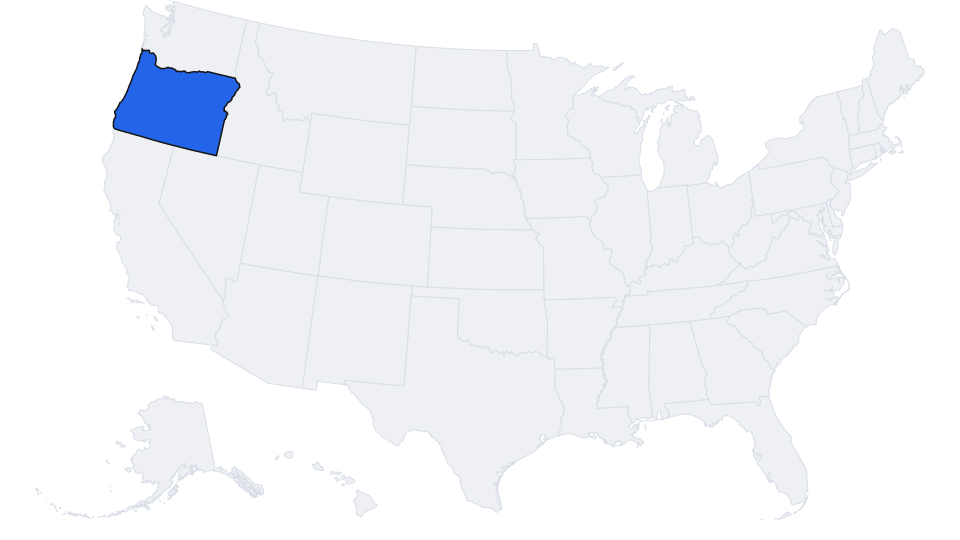
Map of the United States with Oregon highlighted
Tax mechanics

Payroll tax in Oregon

State income tax

Applies

Oregon personal income tax is progressive with brackets from 4.75% to 9.9% (top bracket begins around $125K single / $250K joint). Portland-area employees stack additional surtaxes. A Multnomah County resident earning over $250K single pays an additional 3% Preschool for All tax on income above the threshold, and a Metro-area resident earning over $125K single pays 1% Supportive Housing Services tax on income above the threshold. Combined top marginal rate for a high-earner Portland resident approaches 13.9% state-plus-local before federal. A $3,300 healthcare FSA election saves roughly $1,560 for a Portland top-bracket employee versus about $1,050 for a no-state-tax Florida employee. Matchbook calibrates Oregon under-election guardrails wider because the savings-per-dollar is unusually high.

Oregon Unemployment Insurance Tax

Wage base $54,300 (2025); projected to rise in 2026 - the highest SUI wage base in the United States

Rate range: 0.9%-5.4% (Schedule variable by year); new non-construction employer rate 2.4% in 2025

Oregon's SUI wage base is the highest in the country, so Section 125 salary reductions produce meaningful employer UI savings well into the year for most employees - unlike Florida where the $7K base makes the UI line misleading. Matchbook preserves and features the OR UI savings line in the employer ROI report. Oregon also layers the Paid Leave Oregon contribution (1.0% of wages in 2025, 60% employee / 40% employer for employers with 25+ workers, capped at $176,100 SSA-equivalent wage base) and the Workers' Benefit Fund assessment - both are reduced by Section 125 elections.

Employer FICA

7.65% / 1.45% split

Employer FICA is 7.65% on wages up to the Social Security wage base ($176,100 in 2025; projected about $183,600 in 2026) and 1.45% above it. Matchbook models this per employee, and separately models the OR UI, Paid Leave Oregon employer share, and Workers' Benefit Fund assessment - each of which compounds the Section 125 employer savings line in Oregon.

Employer credits and levers

State and federal credits worth stacking

Credits that most broker ROI decks omit. Matchbook surfaces these in the employer report.

Oregon Employer-Provided Dependent Care Assistance Credit (ORS 315.204)

Oregon corporate excise tax credit of up to 50% of employer expenses for dependent care assistance provided to employees, capped per employer per year. Stacks with federal IRC Section 45F for on-site care and with the Section 129 DCAP exclusion at the employee level. One of the few state-level employer childcare credits still active after Oregon's 2023 credit sunset review.

Source →

Oregon Research and Development Tax Credit (semiconductor-focused, 2024-2029)

Refundable Oregon R&D credit reauthorized in 2024 (HB 2009 / SB 1525) targeting semiconductor and advanced manufacturing qualified research expenses. Up to 25% of incremental QREs with a per-taxpayer cap; designed to complement the federal CHIPS Act investment in Hillsboro and Washington County.

Source →

Oregon Enterprise Zones and Long-Term Rural Enterprise Zones

Property tax abatement (3-5 years standard, up to 15 years rural) for qualifying business investment, paired with local first-source hiring agreements. Not a payroll-tax credit directly, but Matchbook surfaces EZ status in the employer ROI report because EZ companies often have the cash-flow headroom to fund richer Section 125 and Section 132(f) plans.

Source →

Federal IRC Section 45F (stacks with Oregon employer dependent care credit)

Federal employer-provided childcare credit. 25% credit with $150K cap in 2025; rises to 40% with $500K cap in 2026, and 50% with $600K cap for small employers. Matchbook surfaces the combined Oregon plus federal modeled benefit when an Oregon employer evaluates on-site or contracted care.

Source →

Federal IRC Section 45S (paid family and medical leave) - Paid Leave Oregon interaction

Section 45S credit for wages paid under an employer paid-family-leave policy. Oregon requires coordination with Paid Leave Oregon benefits - employer top-up wages that bridge to an employee's full salary generally qualify for Section 45S if the written policy meets the 50% minimum and two-week duration tests. Matchbook models the 45S credit on the top-up portion only, not on PLO benefits themselves.

Source →

Household programs

State programs that change what your employees should elect

Matchbook coordinates these against DCFSA, FSA, and HSA elections at the household level.

State paid family and medical leave

Paid Leave Oregon

Active since September 2023. Up to 12 weeks of paid family, medical, or safe leave per year (14 weeks for pregnancy-related conditions). 2025 contribution rate 1.0% of wages up to SSA wage base, split 60% employee / 40% employer for employers with 25+ workers; employers under 25 pay only the employee share. Benefits replace 65%-100% of wages depending on income.

Matchbook: Paid Leave Oregon benefits are state-paid, not W-2 wages from the employer, so they are not reduced by Section 125 elections and do not generate employer FICA savings. Matchbook models the employer top-up (if any) as Section 45S-eligible wages and flags the coordination with short-term disability - Oregon STD plans must be integrated so employees don't double-dip or lose benefits unintentionally.

Source →

State paid sick leave

Oregon Sick Time (ORS 653.601-661)

All Oregon employers must provide paid sick time; accrual is 1 hour per 30 hours worked, up to 40 hours per year. Employers with 10+ employees (6+ in Portland) must pay the time; smaller employers may provide unpaid time. Separate from Paid Leave Oregon.

Matchbook: Matchbook's PTO and leave planner separates OR Sick Time (short-horizon) from Paid Leave Oregon (weeks-long) and from employer vacation - important for hourly Oregon workers who otherwise conflate them at open enrollment.

Source →

Childcare subsidy

Employment Related Day Care (ERDC)

Oregon's subsidized childcare program for working families. Eligibility up to 200% FPL at entry, 300% FPL at redetermination (post-2022 expansion). Copays are capped at 7% of income for most families. Administered by Oregon DHS.

Matchbook: ERDC reduces out-of-pocket dependent-care cost and therefore reduces the right DCFSA election. Matchbook asks Oregon employees whether they qualify before recommending DCFSA contribution levels, and coordinates ERDC copay with the Oregon Working Family Household and Dependent Care credit at tax time.

Source →

Preschool

Preschool Promise and Oregon Pre-K

Preschool Promise provides free high-quality preschool for Oregon 3- and 4-year-olds in families under 200% FPL (part-day or full-day depending on slot). Oregon Pre-K (Head Start) serves families under 100% FPL. Multnomah County Preschool for All layers universal free preschool funded by the PFA surtax.

Matchbook: Preschool Promise slots are typically part-day, so wrap-around care remains DCFSA-eligible. Matchbook models the Oregon preschool split (subsidized hours minus full-day center cost) rather than defaulting the DCFSA election to zero.

Source →

Local universal preschool

Multnomah County Preschool for All

Multnomah County-funded universal free preschool, funded by the PFA surtax on high earners (1.5% over $125K / $250K; 3% over $250K / $400K). Enrollment expanding annually toward universal access by 2030.

Matchbook: Multnomah employees see the PFA tax on their paycheck and the program on their household ledger. Matchbook's employee-facing Portland report surfaces the PFA as a visible net-of-tax benefit when the employee has a 3-5 year old enrolled.

Source →

Health programs

Coverage coordination checkpoints

Oregon Health Plan (Medicaid) and Healthy Kids (CHIP)

OHP covers adults up to 138% FPL and children up to 305% FPL (Healthy Kids/CHIP). Oregon was the first state to receive a 5-year continuous Medicaid eligibility waiver for children 0-6. OHP redeterminations resumed post-unwinding with lower procedural disenrollment than the national average.

Matchbook: Employees declining dependent coverage on the employer plan should be screened against Healthy Kids thresholds (305% FPL) before Matchbook defaults to the family tier. Oregon's 0-6 continuous eligibility means young-child coverage decisions don't need to be revisited annually.

Source →

Oregon Health Insurance Marketplace (state-based on federal platform)

Oregon operates a state-based marketplace using the federal HealthCare.gov platform (SBM-FP). 2026 employer-affordability threshold is 9.96% of household income. Enhanced premium tax credits expired at the end of 2025; Oregon filed a reinsurance 1332 waiver extension that blunts some of the 2026 rate increase but not all. Family-glitch fix still applies.

Matchbook: If employer family coverage exceeds 9.96% of household income, Matchbook surfaces the Oregon Marketplace dependent subsidy path. Oregon's reinsurance program produces meaningfully lower 2026 individual-market rates than unsubsidized Florida or Texas comparators.

Source →

Oregon Basic Health Program (Bridge Plan)

Oregon Health Plan Bridge, launched July 2024, covers adults between 138%-200% FPL with no premiums and minimal cost-sharing - Oregon is the second state after Minnesota to operate a BHP. Important for the 'benefits cliff' just above Medicaid.

Matchbook: Matchbook's Oregon affordability screener routes 138%-200% FPL employees declining employer coverage to the Bridge Plan rather than the Marketplace - Bridge has zero premium versus subsidized Marketplace coverage.

Source →

Retirement and wealth

State-level retirement and wealth context

OregonSaves

State-run Roth IRA auto-enrollment program for employees whose employer does not offer a qualified retirement plan. All Oregon employers must register. 5% default contribution, auto-escalating 1% per year to 10%.

Matchbook: Employers with a 401(k) or similar qualified plan file a certificate of exemption. Matchbook surfaces OregonSaves status in the employer ROI report and, for employees at non-plan employers, models OregonSaves Roth IRA contributions against Section 125 cash-flow tradeoffs.

Source →

Oregon ABLE Savings Plan (ABLE for ALL)

Oregon's Section 529A program for disabled beneficiaries; branded ABLE for ALL and open to residents of any state. 2025 contribution limit $19,000; employed beneficiaries may add up to $15,060 more under ABLE to Work. $500K balance cap; $100K SSI asset exclusion.

Matchbook: FSA or HSA dollars reimburse medical expenses; ABLE covers broader qualified disability expenses. When SSI asset limits are in play, Matchbook routes disability-related spend to ABLE first. Oregon taxpayers get a state tax credit for ABLE contributions (not just a deduction).

Source →

Oregon College Savings Plan - state tax credit (not deduction)

Oregon converted its 529 tax benefit from a deduction to a refundable credit in 2020. 2025 maximum credit is $180 single / $360 joint, phased by AGI. Contribution must be made by December 31 to an Oregon-sponsored plan to qualify.

Matchbook: Unlike most states (which give a deduction that scales with marginal rate), Oregon's credit is flat-dollar - so high earners get the same $180/$360 as middle earners. Matchbook does not over-weight Oregon College Savings Plan for Oregon high-earners; out-of-state 529 plans with better expense ratios can be a better fit.

Source →

Section 132(f) commuter

Pre-tax commuter reality in Oregon

2025 IRC Section 132(f) cap is $325 per month for transit and $325 per month for qualified parking. Oregon conforms to the federal exclusion, so 132(f) elections reduce state taxable wages in addition to federal - a rare double benefit compared to states without an income tax.

Parking and state credits

Parking: Downtown Portland parking frequently approaches the $325 monthly cap; Eugene and Salem parking usually sits well below. TriMet Hop Fastpass month-equivalents fit within the transit cap.

State credit: Oregon Statewide Transportation Improvement Fund (STIF) employer payroll tax of 0.1% applies to all wages paid to Oregon employees - Matchbook notes this is an employer-side cost that Section 125 elections reduce, layered on top of the UI and Paid Leave contributions.

Disaster readiness

Oregon disaster-relief playbook

IRC Section 139 qualified disaster relief payments are not W-2 wages: no FICA, no FUTA, no federal income tax withholding, and the employer gets a full deduction. Oregon conforms at the state level. Triggered by a federal disaster declaration. Recent qualifying Oregon events: the September 2020 Labor Day wildfires (Almeda, Beachie Creek, Holiday Farm, Riverside), the February 2021 Willamette Valley ice storm, repeated Eastern Oregon wildfires 2021-2024, and multiple flood and windstorm declarations.

  • Pre-drafted Section 139 policy template so Oregon employers can disburse tax-free relief within 48 hours of a federal declaration - especially relevant during the August-October fire season.
  • Post-wildfire Section 125 election-change guidance: a fire alone is not a listed change-in-status event under Treas. Reg. 1.125-4 - it qualifies only when it triggers a change in residence, employment, or cost-of-coverage (which evacuations and home losses often do).
  • FEMA Individual Assistance interaction: IRS Section 139 payments generally stack with FEMA IA, but Matchbook flags duplication risks in the disbursement log.
  • Paid Leave Oregon and OR Sick Time interaction after disasters - employees displaced by wildfires or ice storms may qualify for PLO safe leave, and employers should not require sick-time exhaustion before 139 payments flow.
  • Oregon-specific air-quality protocols - N95 and filtration PPE reimbursement is Section 139-eligible during declared fire-smoke events; Matchbook's Oregon policy template includes the hazardous-air-quality clause.
Matchbook for Oregon

What we ship specifically for Oregon employers

  • High-tax calibration in the employee savings engine - recompute marginal stacks at 9.9% state plus applicable PFA (up to 3%) and Metro SHS (1%) for Portland residents. Widen DCFSA and FSA under-election guardrails for Oregon households, especially Multnomah County.
  • Oregon Employer-Provided Dependent Care Credit plus federal IRC Section 45F stacking calculator in the employer ROI report.
  • Paid Leave Oregon contribution modeling: employer 40% share, employee 60% share, 1.0% of wages to the SSA base - coordinated with Section 45S top-up credit and short-term disability integration.
  • Preserve and feature the Oregon UI savings line in the employer FICA and SUI report - at a $54,300 wage base, Section 125 elections produce meaningful UI savings for most Oregon employees, unlike low-wage-base states.
  • Multnomah PFA and Metro SHS surtax surfacing on the employee paycheck-detail report - these are visible deductions that most broker tools lump into 'other state tax'.
  • ERDC and Preschool Promise wrap-around logic in the DCFSA recommender, plus Multnomah PFA-funded Preschool for All enrollment routing for Portland families.
  • OHP Bridge Plan (138-200% FPL) routing in the affordability screener rather than defaulting to the Marketplace.
  • IRC Section 139 wildfire and ice storm playbook template with pre-drafted employer policy, air-quality PPE clause, and post-event Section 125 election-change guidance.
  • OregonSaves exemption status flag in the employer ROI report for employers running a qualified 401(k).
  • Benefits graph ingests: Oregon DOR corporate credit allocations, Oregon Employment Department UI and Paid Leave rate notices, Multnomah County PFA and Metro SHS thresholds, OHA OHP and Bridge Plan eligibility, FEMA DR numbers for Oregon, and Oregon Marketplace rate filings.

Pilot Matchbook with a Oregon-aware engine.

Talk to us about a 30-day pilot calibrated to Oregon payroll, programs, and disaster rules.