State playbook - Oklahoma

Matchbook, tuned for Oklahoma payroll, universal Pre-K, and tornado alley.

Oklahoma pairs a shallow progressive income tax (top bracket 4.75% in 2025, compressing to 4.5% and three brackets in 2026) with a nationally notable universal Pre-K program descended from HB 1017 of 1990. That Pre-K footprint changes the correct DCFSA election for most Oklahoma 4-year-old households. Matchbook's Oklahoma build headlines a Pre-K-aware DCFSA recommender alongside Quality Jobs and Section 139 tornado playbooks.

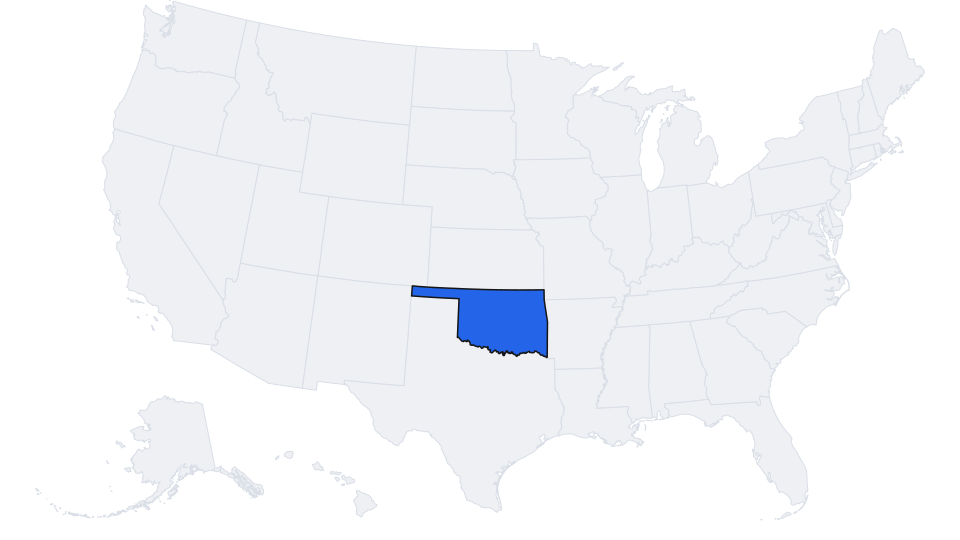
Map of the United States with Oklahoma highlighted
Tax mechanics

Payroll tax in Oklahoma

State income tax

Applies

Oklahoma uses a six-bracket progressive income tax in 2025 with a top marginal rate of 4.75% applied above $7,200 of taxable income for single filers. HB 2764, signed in 2025, flattens to three brackets and lowers the top rate to 4.5% beginning tax year 2026. The employee pre-tax stack is therefore federal marginal plus 7.65% FICA plus 4.5%-4.75% Oklahoma - about 30-40 cents of savings per Section 125 dollar for a mid-bracket household. Matchbook recomputes marginal stacks per household at the 2026 rate.

Oklahoma Unemployment Insurance Contribution

Wage base $28,200 (2025), $27,000 (2024)

Rate range: 0.3%-9.2% for experienced employers in 2025; new employer rate 1.5%. SB 911 (2025) lowered the share of the state average annual wage used to set the adjusted wage base.

With a wage base near $28K, Section 125 salary reductions produce meaningful employer UI savings only for part-time or seasonal workers - salaried employees cross the base within the first quarter. Matchbook reports the UI line per employee based on projected YTD wages rather than quoting a flat aggregate percentage.

Employer FICA

7.65% / 1.45% split

Employer FICA is 7.65% on wages up to the Social Security wage base ($176,100 in 2025; projected about $183,600 in 2026) and 1.45% above it. This is the largest and most consistent employer savings lever on Oklahoma Section 125 and Section 132(f) elections.

Employer credits and levers

State and federal credits worth stacking

Credits that most broker ROI decks omit. Matchbook surfaces these in the employer report.

Oklahoma Quality Jobs Program (and 21st Century Quality Jobs)

Quarterly cash rebate up to 5% of new taxable payroll for up to 10 years; $2.5M new-payroll threshold within three years. 21st Century variant pays up to 10% for knowledge-based industries. Small Employer Quality Jobs serves firms with 500 or fewer employees at up to 5% for up to seven years.

Source →

Oklahoma Investment/New Jobs Tax Credit

Five-year state tax credit equal to the greater of 1% of investment in new depreciable property or $500 per new manufacturing/processing/aircraft-maintenance job. Doubles to 2% or $1,000 per job in Enterprise Zones or for investments above $40M. Minimum investment $50,000; investment credits carry forward indefinitely, jobs credits 15 years.

Source →

Oklahoma Film Enhancement Rebate (Filmed in Oklahoma Act)

20%-38% cash rebate on qualified in-state production spend, $30M annual cap with set-asides by project size. Extra 2% for Oklahoma-recorded music. Effective July 1, 2025 the Act requires Oklahoma income tax withholding. A new Bringing Sitcoms Home from Hollywood Pilot Program adds a $10M annual fund for live-audience TV beginning November 1, 2025.

Source →

Federal IRC Section 45F (employer-provided childcare)

Federal employer-provided childcare credit: 25% with a $150K cap in 2025; rising to 40% with a $500K cap in 2026 and 50% with a $600K cap for small employers. Oklahoma has no stand-alone state childcare employer credit, so Matchbook models 45F as the primary onsite-care lever for OK CFOs.

Source →

Household programs

State programs that change what your employees should elect

Matchbook coordinates these against DCFSA, FSA, and HSA elections at the household level.

Preschool

Oklahoma Universal Pre-K (Early Childhood Four-Year-Old Program)

Oklahoma has offered universal, free, voluntary public Pre-K for all four-year-olds since 1998, rooted in the 1990 HB 1017 education reform. About 70% of Oklahoma 4-year-olds enroll. Most classrooms run a full school day, with certified teachers paid on the K-12 scale. Oklahoma is one of only three states (with Florida and Vermont) to run true statewide universal Pre-K.

Matchbook: For a full-day Pre-K family, the correct DCFSA election is usually wrap-around care plus summer only, not the full-year center cost. For families whose center is not a Pre-K site, the election should cover the full day. Matchbook's Oklahoma build asks which site type the child attends and recalibrates DCFSA by wrap-around hours - this is the headline Oklahoma feature.

Source →

Childcare subsidy

Oklahoma DHS Child Care Subsidy Program

Subsidized licensed child care for income-qualifying working or in-school families with children from birth to age 13 (age 19 with a disability). Eligibility tied to State Median Income; as of 2025 entry sits at up to 85% SMI per federal CCDF ceiling, with a planned return to 55% SMI at entry on July 1, 2026 per OKDHS.

Matchbook: DHS subsidy reduces out-of-pocket care cost and therefore the right DCFSA election. Matchbook screens Oklahoma households against the Appendix C-4 copayment chart before recommending DCFSA contribution amounts.

Source →

Health programs

Coverage coordination checkpoints

SoonerCare (Oklahoma Medicaid and CHIP)

Adults under 65 qualify up to 138% FPL (Medicaid expansion effective July 2021). Children qualify up to 210% FPL inclusive of CHIP. Pregnant women qualify up to 210% FPL with 12 months of guaranteed postpartum coverage. Children keep coverage for 12 continuous months regardless of mid-year income changes.

Matchbook: Employees declining employer dependent coverage should be screened against SoonerCare/CHIP thresholds before Matchbook defaults to the family tier, especially given the ACA enhanced premium tax credit expiration at end of 2025.

Source →

ACA Marketplace (FFM, transitioning to SBM-FP)

Oklahoma uses the federally facilitated Marketplace (HealthCare.gov) for 2026 enrollment. Per 2025 state legislation, Oklahoma transitions to an SBM-FP on May 1, 2026 and to a fully state-run exchange for plan year 2028. Employer affordability threshold 9.96% for 2026; enhanced premium tax credits expired at end of 2025, so premiums rise for 2026.

Matchbook: If employer family coverage exceeds 9.96% of household income, Matchbook surfaces the Marketplace dependent subsidy path, and flags the mid-2026 SBM-FP cutover in Oklahoma-specific communications.

Source →

Retirement and wealth

State-level retirement and wealth context

Oklahoma STABLE (ABLE 529A)

Oklahoma's Section 529A program for disabled beneficiaries. 2025 federal annual contribution limit $19,000 with up to $15,060 additional ABLE-to-Work contributions. Oklahoma offers a state income tax deduction for STABLE contributions up to $10,000 single / $20,000 joint per year.

Matchbook: When SSI asset limits are in play, Matchbook routes disability-related spend to STABLE before taxable accounts, and stacks the Oklahoma state deduction in the household savings projection.

Source →

Oklahoma 529 (OCSP)

State income tax deduction for contributions up to $10,000 single / $20,000 joint per year, with a five-year carryforward for contributions exceeding the annual cap. Qualified uses include K-12 tuition, apprenticeships, and student loan repayment per federal 529 rules.

Matchbook: Unlike Florida, Oklahoma has a real in-state 529 deduction. Matchbook tilts Oklahoma households toward OCSP for at least the deduction cap before evaluating out-of-state plans on fees or investments.

Source →

Section 132(f) commuter

Pre-tax commuter reality in Oklahoma

2026 IRC Section 132(f) cap is $340 per month for transit and $340 per month for qualified parking (up from $325 in 2025). Public Law 119-21 (2025) repealed the qualified bicycle commuting reimbursement and removed the nondiscrimination rule on salary-reduction parking for tax years beginning after 2025.

Parking and state credits

Parking: Oklahoma City and Tulsa CBD parking typically sits well under the $340 monthly cap, so employees rarely forfeit the parking benefit; Matchbook suppresses the 'parking cap exceeded' warning for most Oklahoma addresses.

State credit: None - Oklahoma has no state-level commuter tax credit.

Disaster readiness

Oklahoma disaster-relief playbook

IRC Section 139 qualified disaster relief payments are not W-2 wages: no FICA, no FUTA, no federal income tax withholding, and the employer gets a full deduction. Oklahoma draws frequent federal disaster declarations for tornadoes, ice storms, and flooding - including DR-4776 (April-May 2024), DR-4791 (May 2024), DR-4866 (May 2025 wildfires), and the March 2025 declaration for the November 2024 tornado outbreak.

  • Pre-drafted Section 139 policy template so Oklahoma employers can disburse tax-free relief within 48 hours of a federal declaration - tornado season runs April through June.
  • Post-tornado Section 125 election-change guidance: a storm alone is not a listed change-in-status event under Treas. Reg. 1.125-4 - it qualifies only when it triggers a change in residence, employment, or cost-of-coverage.
  • FEMA Individual Assistance interaction: Section 139 payments generally stack with FEMA IA, but Matchbook flags duplication risks in the disbursement log.
  • Oklahoma-specific employer disaster leave review - Oklahoma has no statutory paid disaster leave, so employer policy is the governing rule.
Matchbook for Oklahoma

What we ship specifically for Oklahoma employers

  • Universal Pre-K-aware DCFSA recommender - headline Oklahoma feature. Ask whether the 4-year-old attends a public Pre-K site or a private center, then recalibrate the DCFSA election to wrap-around and summer care only where applicable.
  • Shallow-progressive state tax calibration in the employee savings engine - recompute marginal stacks per household at 2025 (4.75%) and 2026 (4.5%) top rates; do not copy-paste California or New York assumptions.
  • Quality Jobs and 21st Century Quality Jobs payroll-match screener in the employer ROI report - flags cases where new-payroll growth above $2.5M threshold makes the rebate the dominant employer lever, not Section 125 FICA.
  • DHS Child Care Subsidy eligibility and Appendix C-4 copayment ingestion for the DCFSA recommender.
  • IRC Section 139 tornado and ice-storm playbook template with a pre-drafted employer policy and post-event Section 125 election-change guidance.
  • SoonerCare and CHIP 210% FPL screener at open enrollment, with ACA FFM-to-SBM-FP transition messaging for the May 1, 2026 cutover.
  • Oklahoma 529 (OCSP) and STABLE state-deduction stacking in the household savings projection, up to the $10K/$20K cap.
  • Benefits graph ingests: OTC withholding tables and bracket updates (HB 2764), OESC UI contribution rates (SB 911), Oklahoma Commerce Quality Jobs rebate rosters, OKDHS Appendix C-4, OKFilm rebate allocations, and FEMA DR numbers for Oklahoma.

Pilot Matchbook with a Oklahoma-aware engine.

Talk to us about a 30-day pilot calibrated to Oklahoma payroll, programs, and disaster rules.