State playbook - Ohio

Matchbook, tuned for Ohio payroll, municipal taxes, and Lake Erie storms.

Ohio compressed its personal income tax to two brackets topping out at 3.5%, but layered on roughly 600 municipal income taxes (Columbus 2.5%, Cleveland 2.5%, Cincinnati 1.8%) that vary the real pre-tax savings stack by ZIP code. Matchbook resolves each employee's combined state plus local marginal rate before sizing FSA, HSA, and Section 132(f) elections.

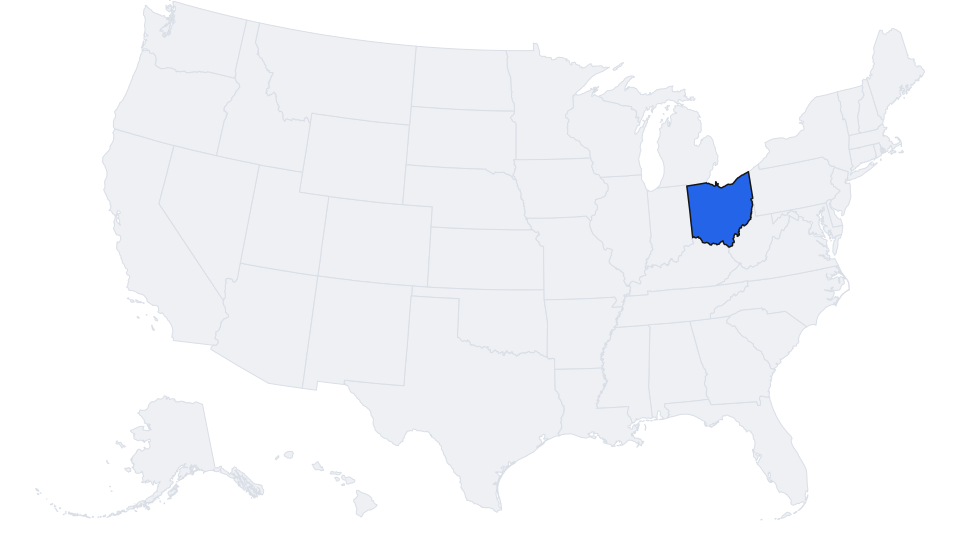
Map of the United States with Ohio highlighted
Tax mechanics

Payroll tax in Ohio

State income tax

Applies

Ohio collapsed to two brackets for TY2025: 2.75% on taxable income $26,051-$100,000 and 3.5% above $100,000. Income up to $26,050 is exempt. On top of the state rate, most Ohio employees owe a municipal income tax where they work and often a partial tax where they live - Columbus 2.5%, Cleveland 2.5%, Cincinnati 1.8%, Toledo 2.25%, Akron 2.5%, Dayton 2.5%. A Columbus resident-worker in the 3.5% state bracket has a combined marginal rate of about 6.0% before federal. Matchbook resolves work-location and residence codes through the Ohio Business Gateway / CCA / RITA tables rather than assuming a flat state rate.

Ohio Unemployment Compensation Tax

Wage base $9,000 (2025); $9,000 projected for 2026

Rate range: 0.4%-10.1% total (including mutualized rate); new non-construction employer rate 2.7%; new construction rate tied to the construction industry average

Ohio's $9,000 SUI wage base is low, so Section 125 salary reductions produce meaningful employer SUI savings only for part-time or seasonal employees who have not yet crossed $9K YTD. Matchbook suppresses the SUI savings line for salaried Ohio employees after Q1 and reports the 7.65% FICA match plus the combined state-plus-local income-tax savings as the primary employer and employee wins.

Employer FICA

7.65% / 1.45% split

Employer FICA is 7.65% on wages up to the Social Security wage base ($176,100 in 2025; projected about $183,600 in 2026) and 1.45% above it. Matchbook models this per employee rather than quoting a flat rate.

Employer credits and levers

State and federal credits worth stacking

Credits that most broker ROI decks omit. Matchbook surfaces these in the employer report.

JobsOhio economic development incentives

JobsOhio (the state's private economic development corporation) administers discretionary grants and loans - JobsOhio Economic Development Grant, Workforce Grant, Growth Fund loans, Revitalization program - tied to job creation, payroll commitments, and capital investment. Used heavily by employers opening or expanding Ohio operations.

Source →

Ohio Job Creation Tax Credit (JCTC)

Refundable, performance-based tax credit against the Commercial Activity Tax (CAT) or personal income tax for creating at least 10 new full-time jobs within three years at or above 150% of federal minimum wage. Administered by the Ohio Tax Credit Authority.

Source →

Ohio Research and Development Investment Tax Credit

Nonrefundable credit equal to 7% of qualified R&D expenses above a three-year average, applied against the Commercial Activity Tax. Unused credit carries forward up to seven years.

Source →

Ohio Work Opportunity Tax Credit (WOTC) coordination

Ohio Department of Job and Family Services certifies federal WOTC eligibility for targeted groups (veterans, long-term unemployed, SNAP recipients, ex-felons). Credit of up to $2,400-$9,600 per qualifying hire at the federal level.

Source →

Household programs

State programs that change what your employees should elect

Matchbook coordinates these against DCFSA, FSA, and HSA elections at the household level.

Childcare subsidy

Ohio Publicly Funded Child Care (PFCC)

Ohio's child care voucher program. Initial eligibility at or below 145% FPL; continuing eligibility up to 300% FPL after HB 33. Administered by ODJFS through county departments; serves children under 13 (or under 18 with special needs).

Matchbook: PFCC reduces out-of-pocket dependent-care cost and therefore reduces the right DCFSA election. Matchbook asks Ohio employees whether they qualify before recommending DCFSA contribution levels and flags the 300% FPL continuing-eligibility cliff.

Source →

Preschool

Ohio Early Childhood Education and Publicly Funded Preschool

State-funded preschool for eligible 3- and 4-year-olds up to 200% FPL, delivered through the Ohio Department of Children and Youth and local grantees. Part-day program; wrap-around care remains DCFSA-eligible.

Matchbook: The correct DCFSA election for an Ohio ECE family is the full-day center cost minus the state-funded hours, not zero. Matchbook models this split explicitly.

Source →

Health programs

Coverage coordination checkpoints

Healthy Start / Healthy Families (Ohio Medicaid and CHIP)

Ohio delivers CHIP through Medicaid expansion (Healthy Start) up to 206% FPL for children and 200% FPL for pregnant women. No separate CHIP premium for most families. Administered by Ohio Department of Medicaid.

Matchbook: Employees declining dependent coverage on the employer plan should be screened against Healthy Start thresholds before Matchbook defaults to the family tier.

Source →

Ohio Medicaid - post-unwind recovery

Ohio disenrolled roughly 500,000 Medicaid members during unwinding, a significant share procedurally. Open enrollment is the right touchpoint to recover procedurally-disenrolled dependents onto employer coverage or Healthy Start.

Matchbook: Matchbook's Ohio screener flags households that may have lost Medicaid for reasons unrelated to eligibility and offers the enrollment path.

Source →

ACA Marketplace (Federally Facilitated Marketplace)

Ohio uses the federal exchange (HealthCare.gov). 2026 employer-affordability threshold is 9.96% of household income. Enhanced premium tax credits expired at the end of 2025, so Ohio 2026 premiums see notable increases. Family-glitch fix still applies.

Matchbook: If employer family coverage exceeds 9.96% of household income, Matchbook surfaces the Marketplace dependent subsidy path - especially material in Ohio after the enhanced PTC expiration.

Source →

Retirement and wealth

State-level retirement and wealth context

STABLE Account (Ohio, national ABLE hub)

Ohio Treasurer's STABLE Account is Ohio's Section 529A program and the host platform used by more than a dozen other states' ABLE programs - effectively the national ABLE hub. 2025 contribution limit $19,000; employed beneficiaries may add up to $15,060 more (ABLE to Work). $100K SSI asset-disregard cap; Ohio balance cap $541,000.

Matchbook: FSA or HSA dollars reimburse medical expenses; STABLE covers broader qualified disability expenses. When SSI asset limits are in play, Matchbook routes disability-related spend to STABLE first. Because STABLE is the platform behind many other states' ABLE programs, Matchbook surfaces it for out-of-state employees whose home state hosts on STABLE.

Source →

Ohio CollegeAdvantage 529

Ohio taxpayers may deduct up to $4,000 per beneficiary per year from Ohio taxable income for contributions to Ohio's 529 Direct or BlackRock CollegeAdvantage plans, with unlimited carryforward of excess contributions.

Matchbook: Ohio's per-beneficiary stackable deduction rewards households funding multiple 529s. Matchbook models the $4,000-per-child deduction against the combined state-plus-local marginal rate when sizing 529 contributions.

Source →

Section 132(f) commuter

Pre-tax commuter reality in Ohio

2025 IRC Section 132(f) cap is $325 per month for transit and $325 per month for qualified parking.

Parking and state credits

Parking: Downtown Columbus, Cleveland, and Cincinnati CBD parking frequently approaches but rarely exceeds the $325 monthly cap; Akron, Dayton, and Toledo parking usually sits well below the cap.

State credit: None - Ohio has no state-level commuter tax credit, but Section 132(f) reductions shield employee wages from state income tax and applicable municipal income taxes (Columbus 2.5%, Cleveland 2.5%, Cincinnati 1.8%), producing a larger real win than the federal-only stack in no-income-tax states.

Disaster readiness

Ohio disaster-relief playbook

IRC Section 139 qualified disaster relief payments are not W-2 wages: no FICA, no FUTA, no federal income tax withholding, and the employer gets a full deduction. Triggered by a federal disaster declaration. Ohio has received multiple FEMA declarations in recent years for tornados, severe storms, straight-line winds, and flooding - including the March 2024 Logan County / Indian Lake tornadoes (DR-4777) and 2022 severe storms.

  • Pre-drafted Section 139 policy template so employers can disburse tax-free relief within 48 hours of a federal declaration.
  • Post-tornado Section 125 election-change guidance: a severe-weather event alone is not a listed change-in-status event under Treas. Reg. 1.125-4 - it qualifies only when it triggers a change in residence, employment, or cost-of-coverage.
  • FEMA Individual Assistance interaction: IRS Section 139 payments generally stack with FEMA IA, but Matchbook flags duplication risks in the disbursement log.
  • Ohio employer disaster leave review (Ohio has no statutory paid disaster leave, so employer policy is the governing rule).
Matchbook for Ohio

What we ship specifically for Ohio employers

  • Combined state-plus-municipal marginal-rate engine - resolve each Ohio employee's work-location and residence codes through RITA / CCA / municipal tables and recompute FSA, HSA, and 132(f) savings per ZIP code rather than quoting a flat 3.5% state rate.
  • Suppress the Ohio UC Tax savings line for salaried workers after Q1 in the employer FICA and SUI report - the $9,000 wage base makes it misleading.
  • JobsOhio and Job Creation Tax Credit stacking calculator in the employer ROI report for Ohio employers with expansion or R&D plans.
  • Ohio PFCC and publicly funded preschool wrap-around logic in the DCFSA recommender, ingesting ODJFS and Department of Children and Youth eligibility rules; flag the 300% FPL continuing-eligibility cliff.
  • IRC Section 139 tornado and severe-storm playbook template with a pre-drafted employer policy and post-event Section 125 election-change guidance.
  • Healthy Start and Medicaid redetermination screener at open enrollment to recover procedurally-disenrolled dependents.
  • STABLE Account surfacing for both Ohio residents and out-of-state employees whose home-state ABLE program runs on STABLE; model the $4,000-per-beneficiary CollegeAdvantage deduction against combined state-plus-local marginal rate.
  • Benefits graph ingests: Ohio Department of Taxation bracket and municipal tables, ODJFS UC rate notices, Ohio Development Services Agency credit allocations, Department of Children and Youth preschool eligibility, FEMA DR numbers for Ohio, and FFM 2026 rate filings.

Pilot Matchbook with a Ohio-aware engine.

Talk to us about a 30-day pilot calibrated to Ohio payroll, programs, and disaster rules.