State playbook - North Dakota

Matchbook, tuned for North Dakota payroll, programs, and prairie disasters.

North Dakota's 2023 bracket collapse to 0%/1.95%/2.5% turned a progressive state into one of the flattest, lowest-marginal income tax stacks in the country. That compresses the employee pre-tax savings math, widens the relative value of federal-only levers, and makes SUI wage-base timing, Workforce Recruitment and Research credits, and IRC 139 disaster relief disproportionately valuable for ND employers.

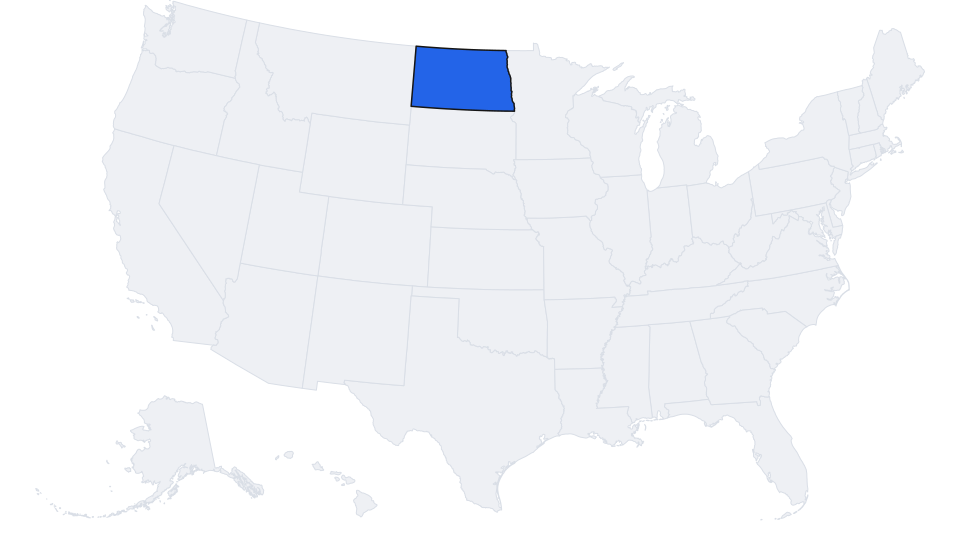
Map of the United States with North Dakota highlighted
Tax mechanics

Payroll tax in North Dakota

State income tax

Applies

North Dakota has three post-2023 brackets: 0% up to roughly $48,475 single / $80,950 joint, 1.95% to about $225,975 single / $275,100 joint, and 2.5% above that (2025 thresholds, indexed). Most rank-and-file ND employees sit in the 0% state bracket, so their pre-tax savings stack is essentially federal plus FICA - identical to a no-income-tax state. Matchbook calibrates ND under-election guardrails with a per-employee marginal lookup rather than a flat state rate, because the state layer is 0 for many employees and only 1.95%-2.5% for the rest.

North Dakota Job Service SUI (Unemployment Insurance)

Wage base $43,800 (2025); $45,100 projected for 2026

Rate range: Positive-balance employers 0.08%-1.74%; negative-balance 6.09%-9.69%; new non-construction employer about 1.02%; new construction employer about 9.69% in 2025

The ND SUI wage base is near the national median and well above Florida's $7K floor, so Section 125 salary reductions produce real employer SUI savings for mid-wage workers through roughly the first two-thirds of the year. Matchbook models the per-employee RateAssigned x (wage-base minus YTD wages) rather than quoting a blended SUI-savings rate.

Employer FICA

7.65% / 1.45% split

Employer FICA is 7.65% on wages up to the Social Security wage base ($176,100 in 2025; projected about $183,600 in 2026) and 1.45% above it. Matchbook models this per employee rather than quoting a flat rate.

Employer credits and levers

State and federal credits worth stacking

Credits that most broker ROI decks omit. Matchbook surfaces these in the employer report.

ND Workforce Recruitment Credit

Income tax credit for ND employers that hire an employee for a hard-to-fill position the employer has had open for at least six months. Credit equals 5% of the first 12 months of compensation, claimed in the second year of employment. Unused credit carries forward up to four years.

Source →

ND Research Expense Credit

State credit for qualified research expenses in North Dakota. 25% on the first $100,000 of excess QREs and 8% above that. First-year taxpayers may also elect a three-year alternative. Unused credit carries forward up to 15 years; partial refundability and transferability apply for certain small employers.

Source →

ND Angel Investor Investment Credit

45% income tax credit (up to $45,000 per investor per year) for qualifying investments in certified ND angel funds investing in early-stage ND businesses. Used as a retention and recruiting lever by ND tech and agtech employers who want equity-aligned talent.

Source →

ND Internship Employment Credit

Income tax credit equal to 10% of compensation paid to a qualifying college intern employed in North Dakota, capped at five interns at any one time and a lifetime maximum of $3,000 per employer. Pairs well with the Workforce Recruitment credit for hard-to-fill pipelines.

Source →

Federal IRC Section 45F (stacks with ND employer levers)

Federal employer-provided childcare credit. 25% credit with $150K cap in 2025; rises to 40% with $500K cap in 2026, and 50% with $600K cap for small employers. Relevant where an ND employer sponsors a licensed child care facility in a region flagged as a ND child care desert.

Source →

Household programs

State programs that change what your employees should elect

Matchbook coordinates these against DCFSA, FSA, and HSA elections at the household level.

Childcare subsidy

ND Child Care Assistance Program (CCAP)

Income-based child care subsidy administered by ND HHS. 2024 expansion raised entry eligibility to 85% State Median Income and introduced tiered family copays; providers are paid at updated market-rate survey levels.

Matchbook: CCAP reduces the right DCFSA election for qualifying ND families. Matchbook asks ND employees about CCAP enrollment and SMI band before recommending DCFSA contribution levels, because layering the full $7,500 DCFSA on top of heavy CCAP subsidy wastes pre-tax capacity.

Source →

Preschool

ND Head Start and Early Head Start

Federally funded, ND-administered Head Start for 3-5 year olds and Early Head Start for 0-3 and prenatal families at or below 100% FPL, with categorical eligibility for families receiving TANF or SSI. North Dakota has no state universal pre-K, so Head Start plus CCAP are the primary non-employer preschool levers.

Matchbook: Because ND lacks universal pre-K, Matchbook does not assume any state-funded preschool hours in the DCFSA recommender for ND employees. The DCFSA model defaults to full-day care cost unless the employee confirms Head Start enrollment.

Source →

Health programs

Coverage coordination checkpoints

ND Healthy Steps (CHIP)

Separate CHIP program covering uninsured ND children up to 175% FPL. Minimal or no premiums; modest copays. Administered through ND HHS in coordination with ND Medicaid.

Matchbook: Employees declining dependent coverage on the employer plan should be screened against Healthy Steps thresholds before Matchbook defaults to the family tier. Pairs with the Marketplace dependent path for families between 175% and 400% FPL.

Source →

ND Medicaid - expansion and redetermination

ND operates traditional Medicaid and Medicaid Expansion (adults up to 138% FPL). Redetermination restart since 2023 has procedurally disenrolled thousands of North Dakotans; open enrollment is the right touchpoint to recover coverage.

Matchbook: Matchbook's ND screener flags households that may have lost Medicaid for reasons unrelated to eligibility and routes them to employer coverage, Healthy Steps, or the FFM path.

Source →

ACA Marketplace (Federally Facilitated Marketplace)

North Dakota uses the federal exchange at healthcare.gov. 2026 employer-affordability threshold is 9.96% of household income. Enhanced premium tax credits expired at the end of 2025; ND 2026 individual-market rate filings show material increases. Family-glitch fix still applies.

Matchbook: If employer family coverage exceeds 9.96% of household income, Matchbook surfaces the Marketplace dependent subsidy path - especially material in ND after the enhanced PTC expiration and given the state's small-group market concentration.

Source →

Retirement and wealth

State-level retirement and wealth context

ABLE ND

North Dakota's Section 529A program for disabled beneficiaries, administered through the ND Department of Human Services in partnership with the National ABLE Alliance. 2025 contribution limit $19,000; employed beneficiaries may add up to $15,060 more. $500K balance cap applies; $100K SSI asset-exclusion cap.

Matchbook: FSA or HSA dollars reimburse medical expenses; ABLE covers broader qualified disability expenses. When SSI asset limits are in play, Matchbook routes disability-related spend to ABLE ND first.

Source →

BND College SAVE 529

North Dakota's 529 college savings plan, administered by Bank of North Dakota with Ascensus. ND offers a state income tax deduction up to $5,000 single / $10,000 joint per year for contributions. At the new 1.95%-2.5% bracket, the maximum annual state tax benefit is roughly $195-$250.

Matchbook: Because ND's top marginal rate is only 2.5%, the home-state 529 tilt is real but small. Matchbook compares College SAVE's deduction value against out-of-state 529 fund-cost differences before recommending the home-state plan.

Source →

Section 132(f) commuter

Pre-tax commuter reality in North Dakota

2025 IRC Section 132(f) cap is $325 per month for transit and $325 per month for qualified parking.

Parking and state credits

Parking: Downtown Bismarck, Fargo, and Grand Forks parking almost always sits well below the $325 cap, so the qualified-parking lever is limited. Transit pass elections in Fargo-Moorhead (MATBUS U-Pass / employer-paid passes) are the more material 132(f) lever for ND.

State credit: None - North Dakota has no state-level commuter tax credit.

Disaster readiness

North Dakota disaster-relief playbook

IRC Section 139 qualified disaster relief payments are not W-2 wages: no FICA, no FUTA, no federal income tax withholding, and the employer gets a full deduction. Triggered by a federal disaster declaration, which North Dakota recurrently receives for Red River and Missouri River flooding, severe winter storms and blizzards, and straight-line wind / tornado events.

  • Pre-drafted Section 139 policy template so ND employers can disburse tax-free relief within 48 hours of a federal declaration - particularly relevant during spring flood season along the Red River Valley.
  • Winter storm and blizzard playbook: Section 139 covers unreimbursed transportation, lodging, and heating costs when a federal declaration is issued, including the multi-day closures typical of ND blizzard events.
  • Post-flood Section 125 election-change guidance: a disaster alone is not a listed change-in-status event under Treas. Reg. 1.125-4 - it qualifies only when it triggers a change in residence, employment, or cost-of-coverage.
  • FEMA Individual Assistance interaction: IRS Section 139 payments generally stack with FEMA IA, but Matchbook flags duplication risks in the disbursement log for ND Red River flood events.
  • ND-specific employer disaster leave review (ND has no statutory paid disaster leave, so employer policy is the governing rule).
Matchbook for North Dakota

What we ship specifically for North Dakota employers

  • Low-marginal calibration in the employee savings engine - recompute ND marginal stacks at 0%/1.95%/2.5% per employee rather than a flat state rate, and widen DCFSA and FSA under-election guardrails for the large share of ND employees in the 0% bracket.
  • Workforce Recruitment plus Internship credit stacking for ND employers with hard-to-fill roles, surfaced in the employer ROI report alongside federal WOTC.
  • Research Expense credit claim support for ND agtech, energy, and software employers - 25% on the first $100K of excess QREs is one of the most generous state R&D credits per dollar in the region.
  • CCAP SMI-band screener in the DCFSA recommender, ingesting ND HHS tiered copay schedules rather than assuming full-price dependent care.
  • Suppress or down-weight the home-state 529 tilt in College SAVE recommendations when the employee is in the 0% or 1.95% ND bracket - the deduction value is too small to override fund-cost differences.
  • IRC Section 139 playbook template tuned to Red River flooding and ND blizzard declarations, with a pre-drafted employer policy and post-event Section 125 election-change guidance.
  • Healthy Steps and Medicaid redetermination screener at open enrollment to recover procedurally-disenrolled dependents.
  • Benefits graph ingests: ND Office of State Tax Commissioner credit guidance, ND Job Service SUI rate notices, ND HHS CCAP and Healthy Steps eligibility, FEMA DR numbers for ND, and FFM 2026 rate filings.

Pilot Matchbook with a North Dakota-aware engine.

Talk to us about a 30-day pilot calibrated to North Dakota payroll, programs, and disaster rules.