State playbook - New Mexico

Matchbook, tuned for New Mexico payroll, programs, and wildfires.

New Mexico layers a progressive state income tax (top bracket 5.9%) on top of the federal and FICA stack, runs one of the country's first truly free universal child care programs (ECECD copay waiver through 400% FPL), and sits inside an active federal disaster footprint (Hermits Peak-Calf Canyon, 2024 South Fork and Salt, Roswell floods) - all levers most broker ROI decks miss.

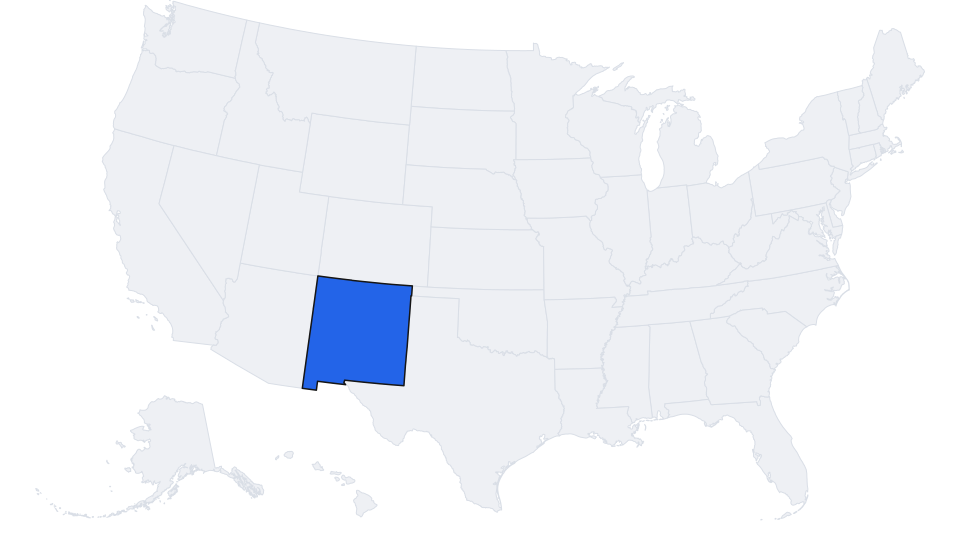
Map of the United States with New Mexico highlighted
Tax mechanics

Payroll tax in New Mexico

State income tax

Applies

New Mexico has a progressive personal income tax with six brackets from 1.5% to 5.9%. The 5.9% top rate applies to taxable income above about $210,000 single / $315,000 MFJ. Section 125 salary reductions reduce New Mexico taxable wages, so the employee pre-tax stack in New Mexico is federal marginal + FICA 7.65% + NM marginal (up to 5.9%). A $3,300 healthcare FSA election saves roughly $1,250 for a 22% federal bracket New Mexico employee taxed at 4.9% state, versus about $1,050 in a no-tax state. Matchbook models NM's bracket structure rather than applying a flat state rate.

New Mexico State Unemployment Insurance (SUI)

Wage base $33,200 (2025); $33,400 (2026 projected)

Rate range: 0.33%-6.40% experience-rated; new non-construction employer uses industry average (min 1.0%); construction rate set separately

New Mexico's SUI wage base is one of the highest in the US - an order of magnitude above Florida's $7,000 - so Section 125 and 132(f) salary reductions generate real employer SUI savings well into the year for most employees. Matchbook reports the NM SUI savings line for employees whose YTD wages remain under $33,200, and then flips it to FICA-only savings once they cross the base. For a $60K employee electing a $3,300 FSA at a 2% experience rate, that is an extra ~$66 per employee per year on top of the FICA match.

Employer FICA

7.65% / 1.45% split

Employer FICA is 7.65% on wages up to the Social Security wage base ($176,100 in 2025; projected about $183,600 in 2026) and 1.45% above it. Matchbook models this per employee rather than quoting a flat rate.

Employer credits and levers

State and federal credits worth stacking

Credits that most broker ROI decks omit. Matchbook surfaces these in the employer report.

New Mexico Employer-Provided Child Care Facility Credit

New Mexico corporate income tax credit equal to 30% of eligible expenses for operating a child care facility for employees' children, capped at $30,000 per taxable year. Non-refundable with a 3-year carryforward. Stacks with federal IRC Section 45F.

Source →

Federal IRC Section 45F (stacks with NM child care credit)

Federal employer-provided childcare credit. 25% credit with $150K cap in 2025; rises to 40% with $500K cap in 2026, and 50% with $600K cap for small employers. Matchbook surfaces the combined NM plus federal modeled benefit when an employer evaluates on-site or sponsored care.

Source →

New Mexico Angel Investment Credit

Up to 25% credit (max $62,500 per investment, two investments per year) for a qualified accredited investor making an equity investment in a New Mexico high-technology or manufacturing business. Useful for founder-owners running employer entities who also angel-invest; Matchbook flags it in the CFO report.

Source →

New Mexico Job Mentorship Tax Credit

Credit against personal or corporate income tax equal to 50% of gross wages (up to 320 hours per student, capped at $12,000 per employer per year) paid to qualified students participating in a career preparation education program. Relevant for NM employers with internship pipelines.

Source →

Household programs

State programs that change what your employees should elect

Matchbook coordinates these against DCFSA, FSA, and HSA elections at the household level.

Childcare subsidy

New Mexico Free Universal Child Care (ECECD copay waiver)

Since May 2023, New Mexico waives all child care assistance copays for families at or below 400% of the federal poverty level - roughly $124,000 for a family of four - funded by the Early Childhood Education and Care Department and the Early Childhood Trust Fund. In 2024 NM became the first state to establish a constitutional right to early childhood education. This is the single most consequential household program in the country for DCFSA logic.

Matchbook: For any NM household qualifying for the ECECD copay waiver, the correct DCFSA election is typically $0. Matchbook's NM screener asks about household income relative to 400% FPL before recommending any DCFSA contribution and defaults DCFSA to zero when the waiver applies. For households between 400% FPL and the market rate, Matchbook models the residual gap only.

Source →

Preschool

New Mexico PreK

Free voluntary PreK for 3- and 4-year-olds through ECECD and PED, mixed-delivery across public schools, Head Start, and licensed child care. Expanded toward universal access with New Mexico's 2022 constitutional amendment and 2024 right-to-early-childhood amendment.

Matchbook: NM PreK wrap-around care is DCFSA-eligible only for the hours outside the PreK schedule. Matchbook models full-day center cost minus PreK-funded hours, then checks whether the residual is already covered by the ECECD waiver before recommending a DCFSA election.

Source →

Leave

New Mexico Paid Sick Leave (Healthy Workplaces Act)

Statewide mandatory paid sick leave since July 1, 2022. Employees accrue 1 hour per 30 hours worked, up to 64 hours per year, usable for employee or family member illness, preventive care, and safe leave. Applies to all private employers regardless of size.

Matchbook: Matchbook's NM employer report does not double-count PTO against the mandatory HWA accrual and flags stacked leave designs (PTO + HWA + FMLA) during open enrollment.

Source →

Health programs

Coverage coordination checkpoints

New Mexico Turquoise Care (Medicaid) and CHIP

Turquoise Care is New Mexico's Medicaid managed care program (launched July 2024, replacing Centennial Care). Covers about 830,000 New Mexicans. CHIP covers children up to 305% FPL; pregnant-person coverage up to 255% FPL.

Matchbook: Employees declining dependent coverage on the employer plan in NM should be screened against Turquoise Care and CHIP thresholds before Matchbook defaults to the family tier. NM's CHIP ceiling is notably higher than the federal minimum.

Source →

beWellnm (state-based ACA exchange)

New Mexico's state-based Marketplace with a state premium subsidy on top of federal APTC (Health Care Affordability Fund). 2026 employer-affordability threshold is 9.96% of household income; family-glitch fix applies. Enhanced federal PTC expired at end of 2025, but NM's state subsidy and Native American Premium Assistance Program partially cushion 2026 premium increases.

Matchbook: If employer family coverage exceeds 9.96% of household income, Matchbook surfaces beWellnm as the dependent subsidy path and layers NM's state subsidy on top of federal APTC in the employee affordability model.

Source →

Retirement and wealth

State-level retirement and wealth context

ABLE New Mexico

New Mexico's Section 529A program for disabled beneficiaries, administered via the national ABLE Alliance. 2025 contribution limit $19,000; employed beneficiaries may add up to $15,060 more. $500K cap under NM rules; $100K SSI asset exclusion.

Matchbook: FSA and HSA dollars reimburse medical expenses; ABLE covers broader qualified disability expenses. For NM households at or near SSI asset limits, Matchbook routes disability-related spend to ABLE NM first.

Source →

The Education Plan (New Mexico 529)

New Mexico offers an uncapped state income tax deduction for contributions to The Education Plan (NM's direct-sold 529) - one of only a handful of US states with no contribution deduction ceiling. Contributions by any NM taxpayer deduct at up to the 5.9% top marginal rate.

Matchbook: Matchbook's college-savings recommender tilts strongly toward The Education Plan for NM residents because of the uncapped state deduction. For a top-bracket NM household, this is roughly 5.9 cents of state tax saved per dollar contributed.

Source →

Section 132(f) commuter

Pre-tax commuter reality in New Mexico

2025 IRC Section 132(f) cap is $325 per month for transit and $325 per month for qualified parking.

Parking and state credits

Parking: Albuquerque and Santa Fe CBD parking typically sits below the $325 monthly parking cap; Rail Runner monthly passes are well under the transit cap, so the bigger lever for NM employers is employee enrollment rather than cap pressure.

State credit: None - New Mexico has no state-level commuter tax credit.

Disaster readiness

New Mexico disaster-relief playbook

IRC Section 139 qualified disaster relief payments are not W-2 wages: no FICA, no FUTA, no federal income tax withholding, and the employer gets a full deduction. Triggered by a federal disaster declaration, which recent New Mexico events have repeatedly qualified for: Hermits Peak-Calf Canyon Fire (2022, the largest wildfire in state history), 2024 South Fork and Salt Fires with post-fire flooding in Ruidoso, and 2024 Roswell-area flooding.

  • Pre-drafted Section 139 policy template so NM employers can disburse tax-free relief within 48 hours of a federal declaration - especially relevant during wildfire season (April-August) and monsoon-driven post-burn flooding (July-September).
  • Hermits Peak-Calf Canyon Fire Assistance Act interaction: FEMA-administered federal compensation for HPCC claimants is generally not taxable; Matchbook flags stacking rules so Section 139 payments do not duplicate federally compensated losses.
  • Post-event Section 125 election-change guidance: a wildfire or flood alone is not a listed change-in-status event under Treas. Reg. 1.125-4 - it qualifies only when it triggers a change in residence, employment, or cost-of-coverage.
  • New Mexico Healthy Workplaces Act safe leave interaction: HWA hours can be used for state-declared emergencies affecting the employee or family; Matchbook reconciles HWA usage against Section 139 cash relief in the employer disbursement log.
  • FEMA Individual Assistance interaction for NM declarations (e.g., DR-4652 Hermits Peak, DR-4795 South Fork/Salt): Section 139 payments generally stack with FEMA IA, but Matchbook flags duplication risks.
Matchbook for New Mexico

What we ship specifically for New Mexico employers

  • Progressive-state calibration in the employee savings engine - apply NM's bracket structure (1.5%-5.9%) rather than a flat rate when recomputing the marginal stack for each employee.
  • Headline finding for NM: default DCFSA to $0 for households below 400% FPL because the ECECD copay waiver already produces free child care. Matchbook's NM screener asks income before recommending DCFSA, which is the opposite default of most broker tools.
  • NM Employer-Provided Child Care Credit (30%, $30K cap) plus federal IRC Section 45F stacking calculator in the employer ROI report.
  • Surface NM SUI savings line (wage base ~$33,200) for under-base employees - this is real money unlike low-wage-base states; auto-flip to FICA-only above the base.
  • The Education Plan auto-tilt in the college-savings recommender - NM's uncapped 529 deduction is one of the most generous in the US for high-bracket households.
  • beWellnm plus state subsidy plus federal APTC stack in the dependent-coverage affordability model - critical post-enhanced-PTC-expiration.
  • IRC Section 139 wildfire and post-burn flood playbook template, including Hermits Peak-Calf Canyon Fire Assistance Act duplication checks.
  • Turquoise Care and CHIP screener at open enrollment (NM CHIP ceiling is 305% FPL - well above the federal minimum - so the recovery population is meaningfully larger than a broker template assumes).
  • Benefits graph ingests: NM TRD credit allocations, NM DWS SUI rate notices, ECECD copay-waiver eligibility tables, FEMA DR numbers for NM, and beWellnm 2026 rate filings.

Pilot Matchbook with a New Mexico-aware engine.

Talk to us about a 30-day pilot calibrated to New Mexico payroll, programs, and disaster rules.