State playbook - New Jersey

Matchbook, tuned for New Jersey payroll, TDI/FLI, and nor'easters.

New Jersey combines a progressive income tax up to 10.75%, a uniquely dense stack of wage-based employee contributions (TDI, FLI, WF/SWF, SUI), Bay Area-caliber transit networks, and storm exposure from Sandy-class coastal events. Every one of these levers shifts the right Section 125, 132(f), 529, and disaster-relief election for an NJ household.

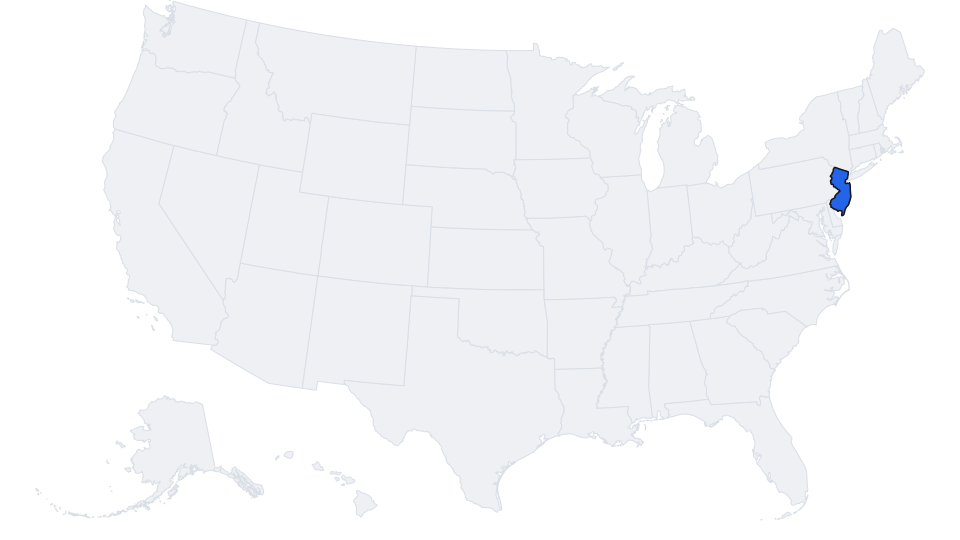
Map of the United States with New Jersey highlighted
Tax mechanics

Payroll tax in New Jersey

State income tax

Applies

New Jersey runs a progressive Gross Income Tax with seven brackets, topping out at 10.75% on income over $1M. Combined with 7.65% FICA, a high-earning NJ employee can stack federal marginal plus 10.75% state plus FICA against each pre-tax dollar - a $3,300 healthcare FSA election for a 32% federal bracket NJ household saves roughly $1,670 in year-one taxes, among the richest Section 125 economics in the country. Matchbook widens recommended FSA, DCFSA, HSA, and 132(f) elections for NJ employees relative to no-tax states because every dollar of salary reduction is worth more.

New Jersey Unemployment Insurance (plus TDI, FLI, WF/SWF)

Wage base $43,300 (2025) employee UI/TDI/FLI taxable wage base; $46,500 (2025) employer UI/WF/HCS wage base

Rate range: Employer UI 0.4%-5.4% (new-employer rate 2.8%), plus WF/SWF 0.0425%, plus TDI and FLI employer charges assessed separately; employee UI 0.3825%, TDI 0.23%, FLI 0.33%, WF 0.0425% in 2025

Section 125 salary reductions lower NJ taxable wages for UI, TDI, FLI, and WF, so every pre-tax dollar trims four employee-side percentages plus the employer-side percentages until the employee crosses the $43,300 base. Matchbook models each contribution band separately in the NJ employer ROI report rather than rolling them into a single SUI line - the combined effective haircut on the first ~$43K of wages is materially larger than the headline UI rate.

Employer FICA

7.65% / 1.45% split

Employer FICA is 7.65% on wages up to the Social Security wage base ($176,100 in 2025; projected about $183,600 in 2026) and 1.45% above it. Matchbook models this per employee rather than quoting a flat rate and layers NJ wage-based contributions on top.

Employer credits and levers

State and federal credits worth stacking

Credits that most broker ROI decks omit. Matchbook surfaces these in the employer report.

NJ Emerge Program

Post-Grow NJ job-creation credit administered by NJEDA. Base awards of $500-$8,000 per job per year for up to seven years, with bonuses for targeted industries, distressed municipalities, and transit-oriented sites. Requires minimum capital investment and net-benefit test. Material for NJ employers adding headcount.

Source →

NJ Aspire Program

Gap-financing tax credit for commercial, mixed-use, and residential real-estate projects, successor to ERG. Award up to 45% of eligible project costs (60% in government-restricted municipalities). Stacks with Emerge when an employer is also building or anchoring a project site.

Source →

Garden State Film and Digital Media Tax Credit

30%-35% transferable tax credit for qualified film and digital-media production expenses in New Jersey, with studio-partner designations available through 2039. Relevant for NJ employers in production, post, VFX, animation, and interactive media.

Source →

Federal IRC Section 45F (stacks with NJ childcare incentives)

Federal employer-provided childcare credit. 25% credit with $150K cap in 2025; rises to 40% with $500K cap in 2026, and 50% with $600K cap for small employers. Matchbook surfaces modeled benefit when an NJ employer evaluates on-site or contracted childcare.

Source →

Household programs

State programs that change what your employees should elect

Matchbook coordinates these against DCFSA, FSA, and HSA elections at the household level.

Childcare subsidy

NJ Child Care Subsidy Program

Income-tested subsidy administered by NJ Department of Human Services through Child Care Resource and Referral agencies. Generally serves families up to 200% FPL at entry, with copay scales. Pairs with Work First NJ childcare for TANF-adjacent households.

Matchbook: Subsidy reduces out-of-pocket dependent-care cost and therefore the right DCFSA election. Matchbook asks NJ employees whether they qualify before recommending DCFSA contribution levels and models the copay remainder as the DCFSA-eligible base.

Source →

Preschool

NJ Preschool Expansion Aid (moving to universal)

State-funded free preschool for 3- and 4-year-olds, expanding district-by-district under the Murphy administration's universal-pre-K commitment with additional districts funded each FY. Full-day in participating districts, with wrap-around summer and before/after-care often still out of pocket.

Matchbook: Wrap-around care outside the preschool day remains DCFSA-eligible. The correct NJ DCFSA election for a preschool-expansion family is center or before-and-after cost minus state-funded hours, not zero. Matchbook models this split explicitly per district.

Source →

Paid leave

NJ Earned Sick Leave, TDI, and Family Leave Insurance (PFML coordination)

NJ mandates up to 40 hours of Earned Sick Leave per year, Temporary Disability Insurance (up to 26 weeks wage replacement at 85% of wages, capped weekly), and Family Leave Insurance (up to 12 consecutive or 56 intermittent days at 85% of wages, capped weekly). 2025 TDI employee rate 0.23%, FLI 0.33%, both on $165,400 base; employer TDI charged on the $43,300 base.

Matchbook: PFML coordination is the most under-modeled lever in NJ benefits. Matchbook layers TDI and FLI wage replacement against employer short-term disability, parental leave top-up, and HSA/FSA cash-flow timing so employees don't over-elect voluntary STD when TDI already covers 85%, and so employers don't double-pay against FLI.

Source →

Health programs

Coverage coordination checkpoints

NJ FamilyCare (Medicaid and CHIP)

Single-door enrollment for NJ Medicaid and CHIP. Children covered to 355% FPL; pregnant people and parents to higher thresholds than most states. Post-unwind redeterminations continue through 2025-2026.

Matchbook: Employees declining dependent coverage on the employer plan should be screened against NJ FamilyCare thresholds before Matchbook defaults to the family tier - NJ's 355% FPL ceiling for kids is one of the most generous in the country.

Source →

Get Covered New Jersey (state-based Marketplace)

NJ runs its own state-based exchange with a state-funded premium subsidy (NJ Health Plan Savings) stacked on top of federal APTC. Enhanced federal PTCs expired end of 2025, but NJ state subsidies continue, softening the 2026 premium hit relative to FFM states.

Matchbook: If employer family coverage exceeds the ACA affordability threshold (9.96% of household income for 2026), Matchbook surfaces the Get Covered NJ dependent subsidy path including the stacked NJ Health Plan Savings - usually a better household outcome than the employer family tier for mid-income NJ workers.

Source →

Retirement and wealth

State-level retirement and wealth context

NJ ABLE

NJ's Section 529A program for disabled beneficiaries, administered through the national ABLE Alliance. 2025 contribution limit $19,000; employed beneficiaries may add up to $15,060 more. $305,000 account cap; $100K SSI asset exclusion.

Matchbook: FSA or HSA dollars reimburse medical expenses; ABLE covers broader qualified disability expenses. When SSI asset limits are in play for an NJ household, Matchbook routes disability-related spend to NJ ABLE first.

Source →

NJBEST 529 (NJ deduction)

Beginning with tax year 2022, NJ allows a Gross Income Tax deduction of up to $10,000 per taxpayer per year for NJBEST contributions, limited to households with gross income of $200,000 or less. Also includes a $750 NJBEST scholarship and matching-grant program for qualifying first-time contributors.

Matchbook: The $10K NJ deduction is capped at $200K household income, so Matchbook evaluates the NJBEST tilt per household rather than universally. For households above the cap, we treat 529 as state-tax-neutral and compare NJBEST against out-of-state plans on fees and investment lineup alone.

Source →

Section 132(f) commuter

Pre-tax commuter reality in New Jersey

2025 IRC Section 132(f) cap is $325 per month for transit and $325 per month for qualified parking. Many NJ Transit monthly rail passes from northern NJ into NYC exceed $325, so the full cap is typically utilized.

Parking and state credits

Parking: Hoboken, Jersey City waterfront, and Newark CBD parking routinely exceed the $325 monthly cap; park-and-ride lots at NJ Transit and PATH stations are usually under the cap. Matchbook models the transit-plus-parking stack per commute pattern.

State credit: No standalone NJ commuter tax credit, but NJ conforms to federal Section 132(f) exclusion and NJ employers can offer the pre-tax benefit on transit and parking with full NJ Gross Income Tax, UI, TDI, FLI, and WF savings stacked on top of federal.

Disaster readiness

New Jersey disaster-relief playbook

IRC Section 139 qualified disaster relief payments are not W-2 wages: no FICA, no FUTA, no federal income tax withholding, and the employer gets a full deduction. NJ has had repeated federal disaster declarations in the last decade for Superstorm Sandy (DR-4086), Tropical Storm Ida (DR-4614), and multiple nor'easter and severe-storm events - all triggers for Section 139.

  • Pre-drafted Section 139 policy template so NJ employers can disburse tax-free relief within 48 hours of a federal declaration (coastal hurricane, nor'easter flooding, or inland severe storm).
  • Post-storm Section 125 election-change guidance: a storm alone is not a listed change-in-status event under Treas. Reg. 1.125-4 - it qualifies only when it triggers a change in residence, employment, dependent care availability, or cost-of-coverage.
  • FEMA Individual Assistance interaction: IRS Section 139 payments generally stack with FEMA IA, but Matchbook flags duplication risks in the disbursement log.
  • NJ TDI and FLI interaction review: storm-related medical or caregiving absences may qualify for wage replacement in parallel with Section 139 employer payments, which are distinct and non-taxable.
  • NJ-specific employer storm leave review: no statutory paid storm leave, but NJ Earned Sick Leave and FLI may apply depending on the trigger, so employer policy must be written to coordinate.
Matchbook for New Jersey

What we ship specifically for New Jersey employers

  • High-state-tax calibration in the employee savings engine - recompute marginal stacks at NJ's 5.525%-10.75% rates plus TDI, FLI, UI, and WF employee shares, and widen FSA, DCFSA, HSA, and 132(f) guardrails for NJ households.
  • NJ TDI and FLI coordination layer in the PFML report so employees don't over-elect voluntary STD and employers don't double-pay against FLI.
  • NJBEST 529 deduction screener gated by the $200K household income cap, with out-of-state 529 comparison for above-cap households.
  • NJ Preschool Expansion and Child Care Subsidy wrap-around logic in the DCFSA recommender, per district, with PEA district-list ingest.
  • IRC Section 139 nor'easter and coastal-storm playbook template with a pre-drafted employer policy and post-storm Section 125 election-change guidance tuned for NJ triggers (Sandy, Ida, future coastal events).
  • NJ FamilyCare and Get Covered NJ subsidy screener at open enrollment, using NJ's 355% FPL CHIP threshold and NJ Health Plan Savings on top of federal APTC.
  • Benefits graph ingests: NJ DOL UI/TDI/FLI rate notices, NJEDA Emerge/Aspire/Film award data, NJ DOE Preschool Expansion district list, Get Covered NJ rate filings, and FEMA DR numbers for New Jersey.

Pilot Matchbook with a New Jersey-aware engine.

Talk to us about a 30-day pilot calibrated to New Jersey payroll, programs, and disaster rules.