State playbook - Montana

Matchbook, tuned for Montana payroll, programs, and wildfires.

Montana simplified its personal income tax to two brackets (4.7% and 5.9% in 2025, dropping to 4.7% and 5.65% in 2026 under HB 337), sits on a meaningful $47,300 SUI wage base, and pairs a generous Achieve Montana 529 deduction with zero-fare transit in Missoula and Bozeman and a long wildfire and flood disaster history - changes the entire Section 125, Section 132(f), and Section 139 stack for Montana households and CFOs.

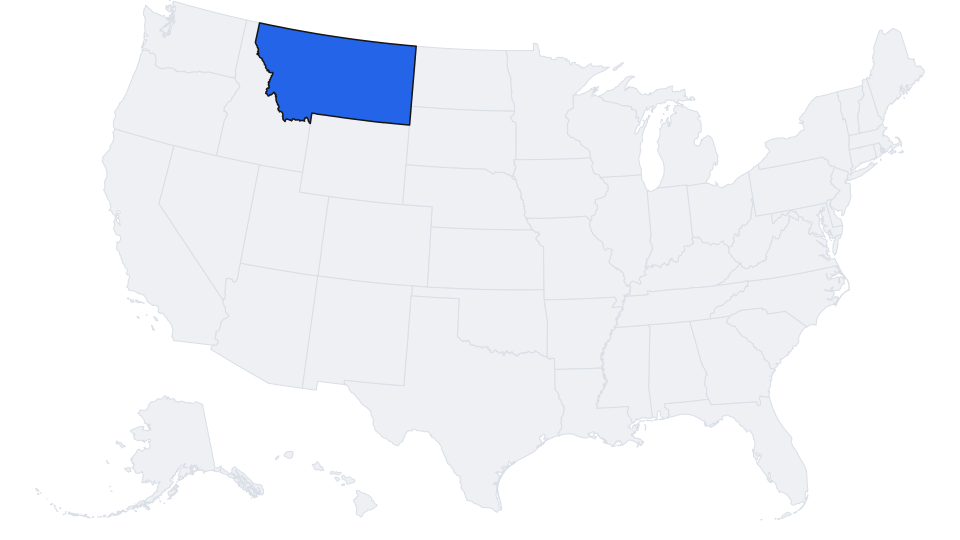
Map of the United States with Montana highlighted
Tax mechanics

Payroll tax in Montana

State income tax

Applies

Montana SB 399 collapsed the pre-2024 seven-bracket structure into two brackets. For tax year 2025 the rates are 4.7% and 5.9% (top bracket above $21,100 single / $42,200 joint). HB 337 (signed 2025) widens the lower bracket and lowers the top rate to 5.65% in 2026 and 5.4% in 2027, and doubles the Montana EITC to 20% of the federal credit. Section 125 and 132(f) salary reductions avoid both Montana state tax and federal tax, so a top-bracket Montana employee saves roughly federal marginal + 7.65% FICA + 5.9% (2025) / 5.65% (2026) per pre-tax dollar.

Montana Unemployment Insurance Contribution

Wage base $47,300 (2026); $45,100 (2025)

Rate range: 2026 uses Schedule 1; positive-rated employers 0.00%-1.22%, negative-rated employers 2.72%-5.92%; new-employer rate around 1.18% (industry-average). HB 210 (2025) added an automatic trigger to cut SUI rates when the trust fund balance exceeds 2.8% of total wages.

Montana's $47,300 wage base is one of the highest in the Mountain West, so Section 125 salary reductions produce real employer UI savings for hourly and part-year workers - not just FICA. Matchbook models per-employee UI savings against the actual experience rate from the DLI rate notice rather than quoting the headline range.

Employer FICA

7.65% / 1.45% split

Employer FICA is 7.65% on wages up to the Social Security wage base ($176,100 in 2025; projected about $183,600 in 2026) and 1.45% above it. Matchbook models this per employee rather than quoting a flat rate.

Employer credits and levers

State and federal credits worth stacking

Credits that most broker ROI decks omit. Matchbook surfaces these in the employer report.

Montana Jobs Growth Incentive Tax Credit

Nonrefundable Montana income tax credit equal to 50% of employer-paid FICA taxes for qualifying net new Montana employees. Available tax years 2022-2028. Administered by Montana DLI (Credit Certificate required) and claimed on the Montana return. 10-year carryforward.

Source →

Montana Apprenticeship Tax Credit

$750 per new registered apprentice hired, $1,500 per new registered veteran apprentice, for Montana employers registered with the Montana Registered Apprenticeship Unit. Claimed in the year the apprentice is hired.

Source →

Montana Trades Education and Training Credit (M-TEC / Form TETC)

50% of qualifying trades education and training expenses, capped at $2,000 per employee and $25,000 per employer per year. Statewide program cap around $1M per year. Employee must work in Montana for at least 6 months of the year of the training.

Source →

Federal IRC Section 45F (employer-provided childcare)

Federal employer childcare credit. 25% credit with $150K cap in 2025; rises to 40% with $500K cap in 2026 and 50% with $600K cap for small employers. Montana does not layer a state childcare credit, so 45F stands alone on the employer side.

Source →

Household programs

State programs that change what your employees should elect

Matchbook coordinates these against DCFSA, FSA, and HSA elections at the household level.

Childcare subsidy

Best Beginnings Child Care Scholarship

Montana's CCDF-funded childcare scholarship. HB 648 (2023) expanded eligibility from 150% to 185% of the Federal Poverty Level; family co-pays capped at 9% of household income. Covers licensed centers, family homes, and Family, Friend, and Neighbor (FFN) care.

Matchbook: Best Beginnings reduces out-of-pocket dependent-care cost and therefore reduces the right DCFSA election. Matchbook's Montana screener checks 185% FPL eligibility and the 9% co-pay cap before recommending DCFSA contribution levels.

Source →

Children's health coverage

Healthy Montana Kids (HMK) - CHIP

Montana CHIP covers uninsured children up to age 19 with household income up to approximately 261% FPL. HMK Plus (children's Medicaid) covers up to 143% FPL. Administered by DPHHS.

Matchbook: Employees declining dependent coverage on the employer plan should be screened against HMK thresholds before Matchbook defaults to the family medical tier - especially for Montana households in the 150%-261% FPL band where HMK is free or near-free.

Source →

Health programs

Coverage coordination checkpoints

Montana Medicaid

Adult Medicaid expansion continues through June 30, 2025 under HB 245 (2025 session) - extended without a sunset. Eligibility at or below 138% FPL for adults. Redeterminations continue post-unwind.

Matchbook: Matchbook's Montana screener flags households that may have lost Medicaid procedurally during redetermination and offers the HMK, Marketplace, or employer-plan recovery path at open enrollment.

Source →

ACA Marketplace (Federally Facilitated Marketplace)

Montana uses HealthCare.gov. 2026 enrollment fell about 5-6% year over year to ~73,255 after the enhanced premium tax credits expired at the end of 2025. 2026 employer-affordability threshold is 9.96% of household income. Family-glitch fix still applies.

Matchbook: If employer family coverage exceeds 9.96% of household income, Matchbook surfaces the Marketplace dependent subsidy path. After PTC expiration, net Marketplace premiums in Montana rose materially - Matchbook refreshes its Montana break-even tables at each open enrollment.

Source →

Retirement and wealth

State-level retirement and wealth context

Achieve Montana 529

Montana's direct-sold 529 plan. Beginning tax year 2025 (HB 845), the Montana state income tax deduction rose to $4,500 per filer / $9,000 for joint filers, inflation-adjusted thereafter. Deduction available for contributions to accounts whose beneficiary is the taxpayer, spouse, or a Montana-resident child or stepchild.

Matchbook: At Montana's top marginal rate (5.9% in 2025 / 5.65% in 2026), a $9,000 joint deduction is worth about $508-$531 in state tax savings. Matchbook tilts Montana households toward Achieve Montana (not an out-of-state 529) when the deduction is unused, and models the tilt against fee differentials.

Source →

Montana ABLE (uABLE / 529A)

Section 529A program for Montanans disabled before age 26. 2025 annual contribution limit $19,000; ABLE to Work adds up to $15,060 more. Montana state income tax deduction of $3,000 per filer for contributions to own, spouse's, or child's account.

Matchbook: FSA or HSA dollars reimburse medical expenses; ABLE covers broader qualified disability expenses. When SSI asset limits are in play, Matchbook routes disability-related spend to ABLE first and captures the $3,000 Montana deduction.

Source →

Section 132(f) commuter

Pre-tax commuter reality in Montana

2025 IRC Section 132(f) cap is $325 per month for transit and $325 per month for qualified parking.

Parking and state credits

Parking: Mountain Line (Missoula) and Streamline (Bozeman) are both zero-fare systems, so the transit half of Section 132(f) is effectively unused for bus-only commuters in those markets. The parking half of Section 132(f) is the meaningful Montana lever - downtown Missoula, Bozeman, and Billings parking permits are pre-tax eligible. Vanpool arrangements (common for the Bakken commute in eastern Montana and for rural tech employers) also qualify under 132(f).

State credit: None - Montana has no state-level commuter tax credit.

Disaster readiness

Montana disaster-relief playbook

IRC Section 139 qualified disaster relief payments are not W-2 wages: no FICA, no FUTA, no federal income tax withholding, no Montana state income tax withholding, and the employer gets a full deduction. Triggered by a federal disaster declaration - Montana has had multiple qualifying declarations including DR-4801-MT (2024 wildfires / severe storms), DR-4813-MT (2024 straight-line winds), DR-4901-MT (2025-2026 severe storms and flooding), and the December 2025 emergency declaration.

  • Pre-drafted Section 139 policy template so Montana employers can disburse tax-free wildfire, smoke-evacuation, or winter-storm relief within 48 hours of a federal declaration.
  • Wildfire-specific payment categories (air purifiers, N95 respirators, temporary lodging during evacuation, generator fuel) that qualify under Section 139 when tied to a declared disaster.
  • Post-event Section 125 election-change guidance: a wildfire or flood alone is not a listed change-in-status event under Treas. Reg. 1.125-4 - it qualifies only when it triggers a change in residence, employment, or cost-of-coverage.
  • FEMA Individual Assistance interaction: IRS Section 139 payments generally stack with FEMA IA, but Matchbook flags duplication risks in the disbursement log.
  • Montana has no statutory paid disaster leave; employer policy is the governing rule, which Matchbook templates alongside the 139 policy.
Matchbook for Montana

What we ship specifically for Montana employers

  • Two-bracket calibration in the employee savings engine - recompute marginal stacks at Montana's 4.7% / 5.9% (2025) and 4.7% / 5.65% (2026) rates, with the 20% state EITC layered in for 2026 household projections.
  • $47,300 UI wage base modeling in the employer ROI report - unlike low-wage-base states, Montana Section 125 salary reductions produce real employer UI savings for hourly and part-year workers.
  • Achieve Montana 529 tilt with the HB 845 deduction ($4,500 / $9,000) in the household college-savings recommender, benchmarked against fee differentials of out-of-state plans.
  • Best Beginnings eligibility screener (185% FPL, 9% co-pay cap) integrated into DCFSA election guidance.
  • HMK and Medicaid redetermination screener at open enrollment to recover procedurally-disenrolled children onto HMK, Medicaid, or employer coverage.
  • Zero-fare transit calibration for Missoula (Mountain Line) and Bozeman (Streamline) - Matchbook suppresses the transit half of 132(f) for bus-only commuters and emphasizes qualified parking and vanpool.
  • IRC Section 139 wildfire, smoke-evacuation, and winter-storm playbook with a pre-drafted Montana employer policy and post-event Section 125 election-change guidance.
  • Jobs Growth Incentive Tax Credit and Apprenticeship / M-TEC stacking calculator in the employer ROI report for Montana employers adding headcount or training.
  • Benefits graph ingests: Montana DOR HB 337 and HB 845 guidance, Montana DLI UI rate notices, DPHHS Best Beginnings and HMK eligibility, FEMA DR numbers for Montana, and FFM 2026 rate filings.

Pilot Matchbook with a Montana-aware engine.

Talk to us about a 30-day pilot calibrated to Montana payroll, programs, and disaster rules.