State playbook - Minnesota

Matchbook, tuned for Minnesota payroll, MinnesotaCare, and the 2026 Paid Leave launch.

Minnesota stacks one of the highest pre-tax savings yields in the country (top bracket 9.85%), layers a unique basic-health program (MinnesotaCare) above Medicaid, and introduces mandatory Paid Family and Medical Leave on January 1, 2026 - a payroll, eligibility, and benefits-design event that most broker ROI decks miss.

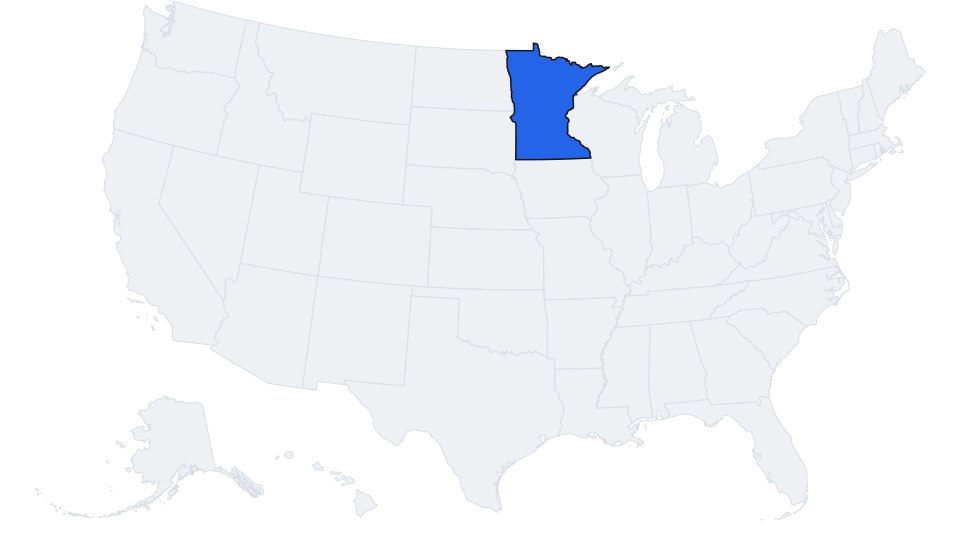
Map of the United States with Minnesota highlighted
Tax mechanics

Payroll tax in Minnesota

State income tax

Applies

Minnesota uses four progressive brackets for tax year 2025: 5.35%, 6.80%, 7.85%, and 9.85% (top bracket starts at about $193,240 single / $321,450 MFJ after inflation indexing). A $3,300 healthcare FSA election saves about $1,575 for a 22% federal bracket Minnesota employee in the 7.85% state bracket - roughly 50% more than the same election in a no-tax state. Matchbook widens FSA, DCFSA, HSA, and 401(k) under-election guardrails for Minnesota households because the marginal dollar saved is high.

Minnesota Unemployment Insurance

Wage base $43,000 (2025); $44,000 (2026, indexed to 60% of state average annual wage)

Rate range: Base rates 0.10%-9.00% plus a 0.10% workforce development assessment and an additional assessment (14.0% of the base rate in 2025). New non-construction employers pay a rate equal to the average for their industry or 1.0%, whichever is higher.

With a $43K-$44K wage base, Section 125 salary reductions generate real employer UI savings on a meaningful share of payroll - unlike low-base states. Matchbook models UI savings per employee using industry-specific rates pulled from MN DEED notices, rather than a flat rate, and stacks them with the 7.65% FICA match in the employer ROI report.

Employer FICA

7.65% / 1.45% split

Employer FICA is 7.65% on wages up to the Social Security wage base ($176,100 in 2025; projected about $183,600 in 2026) and 1.45% above it. Matchbook models this per employee rather than quoting a flat rate.

Employer credits and levers

State and federal credits worth stacking

Credits that most broker ROI decks omit. Matchbook surfaces these in the employer report.

Minnesota Research Credit

Nonrefundable credit against corporate franchise or individual income tax: 10% of the first $2M of qualifying Minnesota R&D expenses over a base amount, and 4% above $2M. C corporations can carry unused credit forward 15 years. Matchbook flags this alongside the federal IRC Section 41 credit so employers do not leave the state layer on the table.

Source →

Greater Minnesota Job Expansion Program

DEED program providing sales-tax refunds for up to seven years to qualifying businesses that expand employment and investment outside the Twin Cities metro. Certification is required before expansion begins. Relevant to CFO-side ROI modeling when an employer is siting a facility expansion concurrent with a benefits refresh.

Source →

Minnesota Data Center Sales Tax Exemption

20-year sales-tax exemption on qualifying computers, software, cooling, energy, and related equipment for data centers meeting 25,000+ sq ft and $30M investment thresholds. A capital-side lever Matchbook surfaces for Minnesota employers in tech, financial services, and health systems operating qualifying infrastructure.

Source →

Federal IRC Section 45F (employer-provided childcare)

25% credit with $150K cap in 2025; rises to 40% with $500K cap in 2026, and 50% with $600K cap for small employers under the OBBBA. Minnesota has no state-level on-site childcare credit that stacks, so Matchbook surfaces the federal lever on its own for MN employers.

Source →

Household programs

State programs that change what your employees should elect

Matchbook coordinates these against DCFSA, FSA, and HSA elections at the household level.

Minnesota Child Care Assistance Program (CCAP)

Subsidized childcare for income-qualifying families through MFIP, Transition Year, and Basic Sliding Fee tracks. Entry eligibility is generally at or below 47% State Median Income with exit at 67% SMI; parent co-pays are tiered by income.

Matchbook: CCAP reduces out-of-pocket dependent-care cost and therefore reduces the right DCFSA election. Matchbook asks Minnesota employees whether they qualify - and whether they are on the Basic Sliding Fee waitlist - before recommending DCFSA contribution levels.

Source →

Minnesota Voluntary Pre-K and School Readiness Plus

State-funded preschool seats for 4-year-olds administered through public school districts and charter schools. Funding was made permanent in the 2023 education finance bill, with roughly 12,360 combined VPK and SR Plus seats statewide.

Matchbook: VPK and SR Plus typically cover a partial school day, so wrap-around care remains DCFSA-eligible. The correct DCFSA election is full-day center cost minus the publicly funded hours, not zero. Matchbook models this split explicitly for Minnesota families.

Source →

Paid leave

Minnesota Paid Family and Medical Leave (launches January 1, 2026)

Up to 20 weeks combined annual benefit (up to 12 weeks family + up to 12 weeks medical, capped at 20). 2026 total premium is 0.88% of wages on the Social Security wage base, split roughly 50/50 employee/employer for employers without an approved private plan; small employers (under 30 employees) pay a reduced employer share. Benefits are wage-replacement on a progressive schedule up to a weekly max tied to state average weekly wage.

Matchbook: Matchbook rebuilds the Minnesota leave stack for 2026: PFML interacts with employer STD, LTD, accrued PTO, ADA leave, and FMLA. Under-electing voluntary STD buy-up in 2026 can leave a gap above the PFML weekly cap for high earners; over-electing wastes premium. Matchbook models the integration and flags employers whose private-plan substitution filing is economically attractive.

Source →

Health programs

Coverage coordination checkpoints

MinnesotaCare (state basic health program)

Minnesota's Section 1331 Basic Health Program for residents roughly 138%-200% FPL who are not Medicaid-eligible. Premiums are sliding-scale and typically far below subsidized Marketplace coverage. Unique among states - only Minnesota, New York, Oregon, and (pending) a handful of others operate BHPs.

Matchbook: This is the most-missed lever in Minnesota benefits design. A lower-wage dependent declining employer family coverage may land on MinnesotaCare for a fraction of Marketplace cost. Matchbook's Minnesota screener checks MinnesotaCare eligibility before defaulting any household to the employer family tier or the Marketplace.

Source →

Minnesota Medical Assistance (Medicaid)

Minnesota's Medicaid program covers adults up to 138% FPL, children up to 283% FPL (among the most generous in the nation), and pregnant individuals. Post-unwind redetermination continues through 2026.

Matchbook: Employees declining dependent coverage on the employer plan should be screened against Medical Assistance and MinnesotaCare thresholds before Matchbook defaults to the family tier. Children up to 283% FPL is a materially higher ceiling than most states.

Source →

MNsure (state-based ACA exchange)

Minnesota runs its own exchange. 2026 employer-affordability threshold is 9.96% of household income. Enhanced premium tax credits expired at the end of 2025; MNsure 2026 rate filings show meaningful premium increases, though MinnesotaCare absorbs much of the lower-income marketplace population that other states push to subsidized QHPs.

Matchbook: If employer family coverage exceeds 9.96% of household income, Matchbook surfaces the MNsure dependent subsidy path and tests MinnesotaCare eligibility first, since MinnesotaCare is usually cheaper than a subsidized QHP for eligible households.

Source →

Retirement and wealth

State-level retirement and wealth context

Minnesota ABLE Plan

Minnesota's Section 529A program for disabled beneficiaries. 2025 contribution limit $19,000; employed beneficiaries may add up to $15,060 more under ABLE to Work. $100K SSI asset-exclusion cap.

Matchbook: FSA or HSA dollars reimburse medical expenses; ABLE covers broader qualified disability expenses. When SSI asset limits are in play, Matchbook routes disability-related spend to ABLE first.

Source →

Minnesota 529 College Savings Plan

Minnesota offers taxpayers a choice: a nonrefundable credit of up to $500 (phased out by income) OR a subtraction of up to $1,500 single / $3,000 MFJ for 529 contributions. Unlike most states, the credit/subtraction applies to contributions to any state's 529 plan, not just Minnesota's.

Matchbook: Matchbook models the credit-vs-subtraction choice per household - the credit is more valuable for lower-AGI families and the subtraction for higher earners in the 9.85% bracket. Matchbook does not force Minnesota residents into the in-state plan, since the tax benefit is plan-agnostic.

Source →

Section 132(f) commuter

Pre-tax commuter reality in Minnesota

2025 IRC Section 132(f) cap is $325 per month for transit and $325 per month for qualified parking; 2026 cap projected at $340 per month.

Parking and state credits

Parking: Downtown Minneapolis and Saint Paul CBD parking frequently approaches or exceeds the $325 monthly cap; Rochester, Duluth, and suburban park-and-ride parking usually sits well below the cap.

State credit: None - Minnesota has no standalone state-level commuter tax credit, but Metro Transit Metropass is a structured employer group pass that stacks with Section 132(f) pre-tax treatment.

Disaster readiness

Minnesota disaster-relief playbook

IRC Section 139 qualified disaster relief payments are not W-2 wages: no FICA, no FUTA, no federal income tax withholding, and the employer gets a full deduction. Triggered by a federal disaster declaration - recent Minnesota qualifying events include the 2024 June severe storms and flooding (DR-4797), tornadoes, derechos, and prior-year blizzards and ice storms.

  • Pre-drafted Section 139 policy template so employers can disburse tax-free relief within 48 hours of a federal declaration.
  • Cold-weather event scope: Section 139 covers federally declared blizzards, ice storms, and severe-cold events that cause home heating failures, not routine winter weather.
  • Post-event Section 125 election-change guidance: a storm alone is not a listed change-in-status event under Treas. Reg. 1.125-4 - it qualifies only when it triggers a change in residence, employment, or cost-of-coverage.
  • FEMA Individual Assistance interaction: IRS Section 139 payments generally stack with FEMA IA, but Matchbook flags duplication risks in the disbursement log.
  • Minnesota Earned Sick and Safe Time (ESST) interaction: ESST hours apply to weather-related school and childcare closures for covered employees, independent of any Section 139 cash relief.
Matchbook for Minnesota

What we ship specifically for Minnesota employers

  • Progressive-tax calibration in the employee savings engine - recompute marginal stacks at 5.35%-9.85% state and widen FSA, DCFSA, HSA, and 401(k) under-election guardrails for Minnesota households.
  • Paid Leave (PFML) 2026 ramp module: premium withholding setup, employer-share modeling, private-plan substitution ROI, and coordination with STD, LTD, PTO, FMLA, and ADA leave.
  • MinnesotaCare screener before defaulting any lower-wage household to employer family coverage or a subsidized MNsure QHP - the most-missed lever in Minnesota benefits design.
  • Medical Assistance redetermination screener at open enrollment to recover procedurally-disenrolled dependents onto employer coverage, MinnesotaCare, or MA.
  • Minnesota Research Credit stacking calculator on top of federal IRC Section 41 for R&D-heavy Minnesota employers.
  • CCAP and VPK/SR Plus wrap-around logic in the DCFSA recommender, ingesting DHS and MDE eligibility rules and waitlist state.
  • Minnesota 529 credit-vs-subtraction optimizer per household, with plan-agnostic contribution routing.
  • IRC Section 139 severe-weather playbook template with pre-drafted policy and ESST coordination guidance.
  • Benefits graph ingests: MN DOR tax tables and credits, MN DEED UI rate notices and GMJEP certifications, MN DHS CCAP and MinnesotaCare eligibility, MDE VPK/SR Plus allocations, paidleave.mn.gov premium and benefit tables, FEMA DR numbers for Minnesota, and MNsure 2026 rate filings.

Pilot Matchbook with a Minnesota-aware engine.

Talk to us about a 30-day pilot calibrated to Minnesota payroll, programs, and disaster rules.