State playbook - Michigan

Matchbook, tuned for Michigan payroll, city income taxes, and universal pre-K.

Michigan stacks a 4.25% flat state tax on top of 24 city income taxes (Detroit at 2.4% resident, Grand Rapids at 1.5%, others at 1.0%), gives employers a $9,500 SUI wage base with rates climbing to 12.2% in 2026, and layers new levers - the 2025 refundable R&D credit, MI Tri-Share, universal GSRP pre-K, and IRC Section 139 for Great Lakes disaster events - that most broker ROI decks miss.

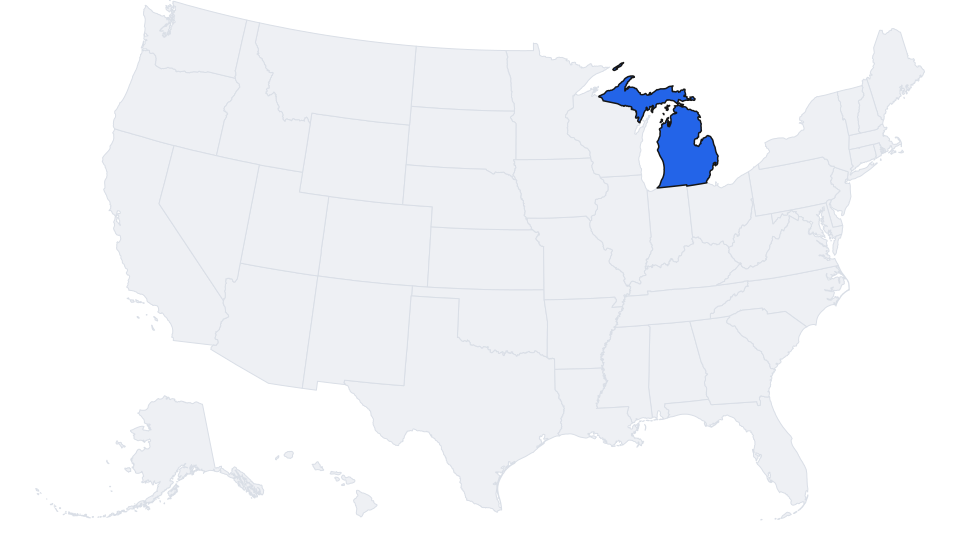
Map of the United States with Michigan highlighted
Tax mechanics

Payroll tax in Michigan

State income tax

Applies

Michigan has a flat 4.25% personal income tax confirmed by Treasury for tax year 2026. On top of that, 24 cities impose local income tax - Detroit (2.4% resident, 1.2% nonresident), Grand Rapids (1.5% resident, 0.75% nonresident), Highland Park (2.0% / 1.0%), Saginaw (1.5% / 0.75%), and 20 standard-rate cities at 1.0% resident / 0.5% nonresident. Section 125 and Section 132(f) pre-tax elections reduce state AGI and, for most cities, the city tax base too. A $3,300 healthcare FSA election for a 22% federal bracket Detroit resident saves roughly $1,280 (federal + FICA + 4.25% MI + 2.4% Detroit) versus $1,050 for the same Florida employee. Matchbook models state plus city marginal rates per employee home and work address.

Michigan Unemployment Insurance Tax

Wage base $9,500 for most employers in 2026; $9,000 for qualifying contributing employers (trust-fund-balance trigger)

Rate range: 0.06%-12.2% for experienced employers in 2026 (up from 0.06%-10.3% in 2025); new employer rate 2.7%

Michigan's wage base is over an order of magnitude higher than Florida's $7,000 and the upper rate jumped to 12.2% for 2026. For a construction or hospitality employer on the high end of the rate schedule, every dollar of Section 125 salary reduction produces a meaningful SUI win through the first $9,500 of each employee's YTD wages. Matchbook's Michigan employer ROI report surfaces this explicitly for employers above 3% assigned rate and suppresses it for those already at the 0.06% floor above the wage base.

Employer FICA

7.65% / 1.45% split

Employer FICA is 7.65% on wages up to the Social Security wage base ($176,100 in 2025; projected about $183,600 in 2026) and 1.45% above it. Matchbook models this per employee rather than quoting a flat rate.

Employer credits and levers

State and federal credits worth stacking

Credits that most broker ROI decks omit. Matchbook surfaces these in the employer report.

Michigan R&D Tax Credit (Public Acts 186 and 187 of 2024)

Refundable Michigan R&D credit effective for tax years beginning on or after January 1, 2025. Applies against the Corporate Income Tax and against withholding tax for flow-through entities. $100M annual statewide cap with statutory proration. First tentative-claim deadline April 1, 2026; subsequent years due March 15. Increases the effective value of headcount-driven benefits (retirement match, HSA seed, qualified education assistance) that scale with R&D payroll.

Source →

Michigan Business Development Program (MBDP)

Performance-based grants from the Michigan Strategic Fund via MEDC. Requires at least 50 qualified new jobs statewide, or 25 in a rural county or Innovation Industry project. Maximum $10M per project. Matchbook surfaces MBDP alongside benefits spend because grant milestones typically require wage and benefits attestations that the benefits graph already produces.

Source →

MI Tri-Share Child Care (plus MI Care-Share add-on, Nov 2025)

State-employer-employee three-way cost split for licensed child care. 2025 expansion raised income eligibility to 400% FPL (about $128,600 for a family of four). MI Care-Share, launched November 2025, lets employers extend the 1/3 employer share to all staff regardless of income. Currently about 290 Michigan employers and 900-plus families enrolled.

Source →

Federal IRC Section 45F (stacks with MI Tri-Share)

Federal employer-provided childcare credit. 25% credit with $150K cap in 2025; rises to 40% with $500K cap in 2026, and 50% with $600K cap for small employers. Matchbook models MI Tri-Share state-share dollars as direct cost offset while treating the employer 1/3 share as eligible spend for Section 45F, yielding a stacked effective subsidy above 60% for qualifying small Michigan employers.

Source →

Household programs

State programs that change what your employees should elect

Matchbook coordinates these against DCFSA, FSA, and HSA elections at the household level.

Preschool

Great Start Readiness Program (GSRP) - universal pre-K for 4-year-olds

For the 2025-26 school year, GSRP income cap was removed - free pre-K now open to all Michigan families with a 4-year-old, with at least 10% of slots reserved for highest-need households. Prior cap was 400% FPL (about $128,000 for family of four in 2024-25). Program typically delivers a partial-day school-year schedule with wrap-around still needed for working parents.

Matchbook: The correct Michigan DCFSA election for a GSRP family is the full-day center cost minus the GSRP-funded hours, not zero. Matchbook's Michigan DCFSA recommender ingests GSRP slot type (half-day school-year, full-day school-year, blended) and models wrap-around cost accordingly.

Source →

Childcare subsidy

Child Development and Care (CDC) Subsidy

Michigan's primary child care subsidy. September 2024 updates expanded income eligibility scale and lifted scholarship rates by 15%. Requires parent to be working, in training, or in approved treatment. No asset test. Administered through MDHHS with MI Bridges application.

Matchbook: CDC reduces out-of-pocket dependent-care cost and therefore reduces the right DCFSA election. Matchbook asks Michigan employees whether they qualify before recommending DCFSA contribution levels, and flags the GSRP + CDC combination for income-qualified families with both preschool-age and younger children.

Source →

Health programs

Coverage coordination checkpoints

MIChild (CHIP)

Children's health coverage for families above Medicaid thresholds up to 217% FPL, with a nominal monthly premium (~$10). Full benefits including vision, dental, and behavioral health. Birth through age 18.

Matchbook: Employees declining dependent coverage on the employer plan should be screened against MIChild thresholds before Matchbook defaults to the family tier. The screener asks modified adjusted gross household income and family size and returns a MIChild or Medicaid-for-Kids routing recommendation.

Source →

Healthy Michigan Plan (Medicaid expansion)

Medicaid expansion for adults 19-64 up to 138% FPL, no asset test. MI Health Account fees and Healthy Behaviors Requirement both discontinued January 2024. Enrollment dropped from 1M+ in April 2023 to about 728K by June 2024 through unwinding. Post-unwind recovery is ongoing - Michigan disenrolled over 883K people by March 2024, mostly procedurally.

Matchbook: Matchbook's Michigan screener flags households that may have lost Healthy Michigan Plan coverage for procedural reasons (missed paperwork) rather than eligibility changes, and surfaces the re-enrollment path alongside the employer plan option during open enrollment.

Source →

Michigan ACA Marketplace (Federally Facilitated Marketplace)

Michigan uses HealthCare.gov. For 2026, insurer count drops from 10 to 7, leaving 200,000+ enrollees needing new plans. Blue Cross PPO plans rising 24.0% and Blue Care Network 23.2% on average as enhanced premium tax credits expired at end of 2025. 2026 employer-affordability threshold is 9.96% of household income.

Matchbook: If employer family coverage exceeds 9.96% of household income, Matchbook surfaces the Marketplace dependent subsidy path. For 2026 Michigan, Matchbook also flags households on the three departing carriers so they do not lose coverage through inaction at renewal.

Source →

Retirement and wealth

State-level retirement and wealth context

MiABLE (Section 529A)

Michigan's ABLE program for disabled beneficiaries. Federal 2025 contribution limit $19,000 plus $15,060 ABLE-to-Work add-on for employed beneficiaries. Michigan allows state income tax deduction of up to $5,000 single / $10,000 joint for contributions to MiABLE.

Matchbook: FSA or HSA dollars reimburse medical expenses; MiABLE covers broader qualified disability expenses with a Michigan state-income-tax deduction on top. When SSI asset limits are in play, Matchbook routes disability-related spend to MiABLE first, then layers the $5K/$10K state deduction into the household's Michigan tax projection.

Source →

MESP (Michigan Education Savings Program - 529)

Michigan 529 deduction of up to $5,000 single / $10,000 joint from Michigan AGI per year. $500,000 per-beneficiary aggregate cap. Rollovers from another 529 are not deductible. Qualified withdrawals in-year reduce the deductible contribution amount.

Matchbook: Unlike Florida (no state tax, no 529 deduction), Michigan residents see a real 4.25% state plus 1-2.4% city marginal benefit on MESP contributions. Matchbook's Michigan college-savings module prefers MESP over out-of-state 529s at equal fees because the home-state deduction adds 5-7% effective return in year one.

Source →

Section 132(f) commuter

Pre-tax commuter reality in Michigan

2026 IRC Section 132(f) cap is $340 per month for transit and $340 per month for qualified parking, up from $325 in 2025.

Parking and state credits

Parking: Detroit CBD monthly parking often runs $200-$300, usually under the $340 cap; Ann Arbor downtown frequently approaches the cap. Grand Rapids, Lansing, and most outstate CBDs sit well below it. Section 132(f) elections also reduce the Detroit 2.4% city income tax base for resident Detroiters, adding a lever not present in no-city-tax Michigan locations.

State credit: None - Michigan has no state-level commuter tax credit, but 132(f) elections reduce state AGI (4.25%) and, for Detroit/Grand Rapids/Highland Park/Saginaw and the 1% cities, the city income tax base as well.

Disaster readiness

Michigan disaster-relief playbook

IRC Section 139 qualified disaster relief payments are not W-2 wages: no FICA, no FUTA, no federal income tax withholding, no Michigan or city income tax withholding, and the employer gets a full deduction. Triggered by a federal disaster declaration. Recent Michigan declarations include DR-4757 (August 2023 severe storms, tornadoes, and flooding - nine southeast Michigan counties, declared Feb 2024) and DR-4880 (March 2025 northern Michigan ice storm, declared July 2025).

  • Pre-drafted Section 139 policy template so employers can disburse tax-free relief within 48 hours of a federal declaration - covers tornados, severe storms, ice storms, and lake-effect events that recur across the Michigan calendar.
  • Post-storm Section 125 election-change guidance: a storm alone is not a listed change-in-status event under Treas. Reg. 1.125-4 - it qualifies only when it triggers a change in residence, employment, or cost-of-coverage.
  • Michigan-specific payroll withholding neutralization: Section 139 payments bypass state 4.25% and the resident city income tax too, so the tax-free stack in Detroit reaches roughly 14 percentage points higher than a same-dollar bonus.
  • FEMA Individual Assistance interaction: IRS Section 139 payments generally stack with FEMA IA, but Matchbook flags duplication risks in the disbursement log. Note FEMA denied Michigan's appeal for additional IA on the March 2025 ice storm - employer Section 139 may be the primary relief lever in declined counties.
Matchbook for Michigan

What we ship specifically for Michigan employers

  • Per-employee state-plus-city marginal rate engine - recompute Section 125 and 132(f) stacks using home and work address to capture the Detroit 2.4% / Grand Rapids 1.5% / standard-1% / outside-city-0% variation across Michigan payrolls.
  • Michigan R&D credit (2025 PA 186/187) calculator in the employer ROI report for Michigan CIT filers and flow-through entities, with the March 15 / April 1 tentative-claim deadline on the compliance calendar.
  • MI Tri-Share + MI Care-Share + Section 45F stacking model for employers evaluating child-care benefits - potential 60%+ effective subsidy for small Michigan employers when fully stacked.
  • GSRP universal pre-K logic in the DCFSA recommender, ingesting local ISD slot type (half-day school-year, full-day school-year, blended) to model wrap-around cost explicitly.
  • Michigan SUI 2026 rate-hike (ceiling to 12.2%) factored into employer ROI - the Section 125 wage-base savings line is now material for mid-rate and high-rate employers, unlike Florida.
  • MIChild and Healthy Michigan Plan redetermination screener at open enrollment to recover procedurally-disenrolled dependents - Michigan procedural disenrollments exceeded 600K through unwinding.
  • 2026 Marketplace carrier-exit flags for Michigan households on the three departing ACA carriers, routed to HealthCare.gov renewal paths during open enrollment.
  • IRC Section 139 playbook template tuned for Great Lakes disaster types (tornados, severe thunderstorms, ice and lake-effect winter storms) with pre-drafted Michigan employer policy and post-event Section 125 election-change guidance.
  • Benefits graph ingests: Michigan Treasury CIT and R&D credit notices, Michigan UIA rate determinations (Form UIA 1771), MiLEAP GSRP and CDC eligibility, MDHHS Medicaid/MIChild enrollment data, FEMA DR numbers for Michigan, and HealthCare.gov 2026 Michigan rate filings.

Pilot Matchbook with a Michigan-aware engine.

Talk to us about a 30-day pilot calibrated to Michigan payroll, programs, and disaster rules.