State playbook - Massachusetts

Matchbook, tuned for Massachusetts payroll, PFML, and the millionaire surtax.

Massachusetts layers a flat 5% tax on wages plus a 4% surtax on income above $1M, making the pre-tax stack materially larger for high earners than most flat-tax states. Add statewide PFML (employee and employer contributions), a low $15,000 SUI wage base that still produces real employer savings, EMAC and UHI surcharges, and the nation's oldest universal-coverage framework - and the right open-enrollment model looks nothing like Florida or Texas.

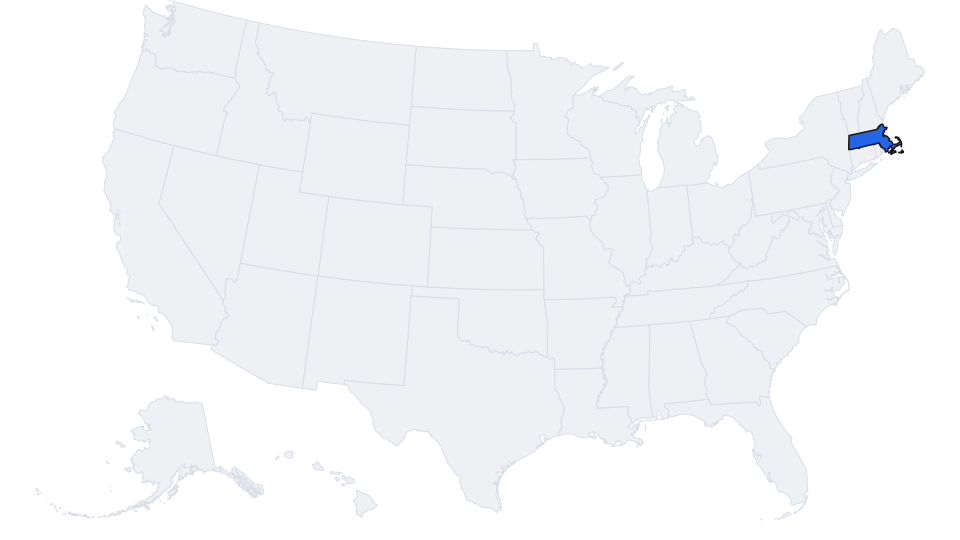
Map of the United States with Massachusetts highlighted
Tax mechanics

Payroll tax in Massachusetts

State income tax

Applies

Massachusetts imposes a flat 5.00% personal income tax on most wage income, plus a 4% surtax on taxable income above $1,000,000 (the voter-approved Fair Share Amendment / 'millionaire tax', indexed annually; the 2025 threshold is $1,083,150). For a high earner in the surtax band, every pre-tax dollar of Section 125 or 132(f) election saves 9% state plus federal marginal plus 7.65% FICA - the surtax nearly doubles the state savings line. Matchbook runs a per-employee marginal rate that recognizes the surtax band rather than quoting a flat 5%.

Massachusetts Unemployment Insurance (UI)

Wage base $15,000 (2025-2026)

Rate range: 0.73%-11.13% experience-rated in 2025; new non-construction employer rate 1.45%; plus EMAC (up to 0.34%) and Workforce Training Fund (0.056%)

MA's $15,000 UI wage base is modest but non-trivial. For a typical salaried workforce, Section 125 salary reductions produce real employer UI savings on the first quarter of wages only. Matchbook computes per-employee crossover dates against the $15K base and shows the UI-savings line only for the portion of pre-tax reductions that fall below YTD $15K - avoiding the Florida-style overstatement some ROI decks produce. The EMAC (Employer Medical Assistance Contribution) and UHI (Unemployment Health Insurance / COVID recovery assessment) surcharges are modeled separately because they ride on the same wage base.

Employer FICA

7.65% / 1.45% split

Employer FICA is 7.65% on wages up to the Social Security wage base ($176,100 in 2025; projected about $183,600 in 2026) and 1.45% above it. In Massachusetts the employer also pays 0.42% PFML medical-leave contribution on wages up to the Social Security base (for employers with 25+ covered individuals), which interacts with pre-tax elections and is modeled per employee rather than as a flat add-on.

Employer credits and levers

State and federal credits worth stacking

Credits that most broker ROI decks omit. Matchbook surfaces these in the employer report.

Massachusetts Life Sciences Tax Incentive Program

Refundable and transferable MA corporate excise credits administered by the Massachusetts Life Sciences Center. Program authorization was expanded to $1.5B over 10 years under the 2024 Mass Leads Act. Includes a jobs credit, investment tax credit, and research credit for certified life-sciences companies committing to net new MA jobs.

Source →

Economic Development Incentive Program (EDIP)

MA corporate excise credit for certified expansion projects creating net new jobs, awarded by the Economic Assistance Coordinating Council. Typical awards are 10% of qualified capital investment, up to project-specific caps. Refundable for Gateway Cities projects.

Source →

Massachusetts Film Tax Credit

25% payroll credit and 25% production credit for qualifying film and TV production, made permanent in 2021. Transferable and partially refundable (90% of face value). Material for MA-based production payrolls and a CFO-level lever alongside benefits spend.

Source →

Federal IRC Section 45F (employer-provided childcare)

Federal credit: 25% with $150K cap in 2025; rises to 40% with $500K cap in 2026, and 50% with $600K cap for small employers. No MA-specific childcare credit stacks, but the federal lever is often underused by MA employers who assume PFML and the state's health reform already exhaust the benefits toolbox.

Source →

Household programs

State programs that change what your employees should elect

Matchbook coordinates these against DCFSA, FSA, and HSA elections at the household level.

Paid leave

Massachusetts Paid Family and Medical Leave (PFML)

Statewide program funded by a 0.88% total contribution on wages up to the Social Security wage base in 2025 (0.70% medical leave split between employer and employee for 25+ employers; 0.18% family leave, employee-only by default). Benefits cap at $1,170.64 per week in 2025 with up to 12 weeks family and 20 weeks medical (26 weeks combined). Employers with 25+ covered individuals pay the employer share; under 25 contribute only withheld employee shares.

Matchbook: PFML benefits are generally taxable at the federal level, not taxable for MA income tax, and do not stop employer health-plan continuation. Matchbook coordinates PFML with short-term disability elections (PFML usually replaces STD for most leave triggers in MA), flags the 7-day waiting period, and suppresses duplicate STD recommendations for MA employees whose employer already funds PFML at the statutory minimum.

Source →

Paid leave

Boston Paid Sick Leave / MA Earned Sick Time

Statewide MA Earned Sick Time Law provides up to 40 hours per year (paid for employers with 11+ employees). Boston follows the state baseline and enforces through the city's Office of Labor Compliance. Sick time is separate from PFML and stacks with it for qualifying reasons.

Matchbook: Matchbook's MA leave stack explicitly orders Earned Sick Time first (short absences), then PFML (serious health condition / bonding / military), then employer STD/LTD - preventing the common error of using PFML for a 2-day flu.

Source →

Childcare

Common Start / C3 childcare stabilization

C3 (Commonwealth Cares for Children) operating grants were made permanent in the FY24 budget and continue to stabilize MA early education providers. Income-eligible Child Care Financial Assistance (CCFA) subsidies run through EEC. Common Start is the active advocacy framework to extend subsidies to more middle-income families.

Matchbook: Matchbook screens MA employees against CCFA income eligibility before sizing the DCFSA election - for eligible families, the correct DCFSA contribution is typically smaller than the $5,000 federal ceiling because CCFA covers most of the invoice.

Source →

Health programs

Coverage coordination checkpoints

MassHealth (Medicaid and CHIP)

The 2006 Massachusetts health reform (the RomneyCare framework later modeled by the ACA) preserved MassHealth as an unusually broad Medicaid/CHIP program, now covering roughly one in three residents. CHIP eligibility for children runs to 300% FPL. Post-unwinding MassHealth retained a higher coverage share than most states.

Matchbook: MA employees declining dependent coverage on the employer plan should be screened against MassHealth CommonHealth and CHIP thresholds (300% FPL for kids) before Matchbook defaults to the family tier. MA's 'no wrong door' policy means Matchbook can route the household through MA Health Connector and land them in MassHealth automatically if eligible.

Source →

ConnectorCare and MA Health Connector

Massachusetts operates its own state-based exchange (MA Health Connector) and layers state-funded ConnectorCare subsidies on top of federal ACA premium tax credits for residents up to 500% FPL (expanded in 2024 and continued). Lowest-tier ConnectorCare plans can be $0 premium at the lowest income bands.

Matchbook: If employer family coverage exceeds 9.96% of household income (2026 affordability threshold), MA is one of the few states where the dependent path through the exchange can be cheaper than the employer family tier even at middle incomes - because ConnectorCare state subsidies kick in below the federal PTC floor. Matchbook models ConnectorCare explicitly rather than treating MA like an FFM state.

Source →

Health Safety Net (HSN)

MA's uncompensated care pool funded in part by the EMAC surcharge. Covers medically necessary services for low-income uninsured and underinsured MA residents at acute hospitals and community health centers. Not insurance, but a last-dollar safety net specific to Massachusetts.

Matchbook: Matchbook does not treat HSN as a substitute for insurance in the employee-side recommendation, but flags it in the employer ROI view because EMAC (up to 0.34% on UI-taxable wages) funds it and directly affects the employer cost of uncovered workforce.

Source →

Retirement and wealth

State-level retirement and wealth context

Attainable Savings Plan (MA ABLE)

Massachusetts ABLE program (attainABLE, branded Attainable) administered in partnership with Fidelity. 2025 contribution limit $19,000; employed beneficiaries may add up to $15,060 more via ABLE to Work. Federal $100K SSI exclusion and $500K program-balance cap apply.

Matchbook: FSA or HSA dollars reimburse medical expenses; ABLE covers broader qualified disability expenses. MA contributions are not state-tax-deductible (unlike the 529 U.Fund), so Matchbook routes disability-related spend to Attainable for flexibility reasons and to U.Fund for the state deduction.

Source →

U.Fund / U.Plan 529

Massachusetts offers a state income tax deduction of up to $1,000 single / $2,000 joint per year for contributions to the U.Fund College Investing Plan or U.Plan Prepaid Tuition Program. At MA's 5% flat rate this is up to $100 of state tax savings per household per year (more if part of the contribution is by a filer in the 9% surtax band).

Matchbook: Matchbook applies a MA home-state tilt for 529 contributions up to the $2,000 joint cap, then treats additional contributions as plan-agnostic. For filers in the 4% surtax band, the state deduction saves 9 cents on the dollar - Matchbook surfaces this explicitly.

Source →

Section 132(f) commuter

Pre-tax commuter reality in Massachusetts

2025 IRC Section 132(f) cap is $325 per month for transit and $325 per month for qualified parking. MBTA monthly LinkPass ($90) and commuter rail zone passes (up to $461 for Zone 10) both fit comfortably under the cap.

Parking and state credits

Parking: Downtown Boston, Cambridge (Kendall), and Seaport parking routinely exceed the $325 monthly cap; Worcester, Springfield, and suburban commuter-rail station parking usually sits well below.

State credit: Massachusetts allows a personal income tax deduction for commuter transit pass and qualifying expenses above the federal Section 132(f) pre-tax amount, up to $750 per individual ($1,500 joint). Matchbook surfaces this as a post-132(f) top-up, distinct from the federal exclusion.

Disaster readiness

Massachusetts disaster-relief playbook

IRC Section 139 qualified disaster relief payments are not W-2 wages: no FICA, no FUTA, no federal income tax withholding, and the employer gets a full deduction. Triggered by a federal disaster declaration. Massachusetts federal declarations have historically included severe winter storms, nor'easters, coastal flooding, and hurricane remnants (e.g., DR-4379, DR-4496, DR-4651).

  • Pre-drafted Section 139 policy template so MA employers can disburse tax-free relief within 48 hours of a federal declaration (nor'easter or coastal-flood triggered).
  • Post-storm Section 125 election-change guidance: a winter storm alone is not a listed change-in-status event under Treas. Reg. 1.125-4 - it qualifies only when it triggers a change in residence, employment, or cost-of-coverage.
  • PFML interaction: PFML is not a substitute for Section 139 relief, but Matchbook flags employees who may be eligible for both (e.g., serious health condition caused by storm plus uninsured property loss).
  • FEMA Individual Assistance interaction: Section 139 payments generally stack with FEMA IA, but Matchbook flags duplication risks in the disbursement log.
  • MA Earned Sick Time coordination: storm closures that do not meet the statutory sick-time triggers should not be charged against the 40-hour bank; Matchbook's MA policy template keeps them separate.
Matchbook for Massachusetts

What we ship specifically for Massachusetts employers

  • Millionaire-surtax aware marginal-rate engine: Matchbook recomputes the employee pre-tax stack at 9% state (5% flat plus 4% surtax) for wages above the indexed $1M threshold, not a flat 5%, so high-earner ROI reports are accurate.
  • PFML coordination module: suppress duplicate short-term disability recommendations for MA employees already covered at the statutory PFML contribution, and sequence MA Earned Sick Time first for short absences.
  • EMAC and UHI surcharges modeled separately from base UI in the employer report, so MA CFOs see what pre-tax elections actually move versus what they do not.
  • ConnectorCare-aware affordability screener: when employer family coverage exceeds 9.96% of household income, Matchbook routes MA dependents through MA Health Connector with state ConnectorCare subsidies layered on the federal PTC rather than treating MA as a federal-exchange state.
  • MassHealth and CHIP 300% FPL screener at open enrollment - MA's thresholds are materially higher than most states and drive real re-routing of dependent elections.
  • U.Fund 529 home-state deduction applied up to the $2,000 joint cap, with surtax-band filers flagged for 9% effective state savings rather than 5%.
  • MA-specific commuter top-up: $750 single / $1,500 joint deduction applied above the federal Section 132(f) exclusion so employees claim both layers.
  • Nor'easter Section 139 playbook template with pre-drafted MA employer policy and post-storm Section 125 change-in-status guidance.
  • Benefits graph ingests: MA DOR surtax filings, MA DUA UI rate notices and EMAC/UHI schedules, MA DFML PFML contribution rates, EEC CCFA eligibility, MA Health Connector ConnectorCare plan data, MEFA U.Fund limits, and FEMA DR numbers for Massachusetts.

Pilot Matchbook with a Massachusetts-aware engine.

Talk to us about a 30-day pilot calibrated to Massachusetts payroll, programs, and disaster rules.