State playbook - Maine

Matchbook, tuned for Maine payroll, PFML, and nor'easters.

Maine stacks a 7.15% top marginal rate on top of FICA, layers in a 1% PFML premium starting January 2025 with benefits landing May 2026, and provides state credits (25% child care, doubled for quality providers) plus a $1,000 NextGen 529 deduction that most broker ROI decks miss. PTDZ and ETIF closed to new entrants on December 31, 2024 - only pre-certified employers still see those benefits.

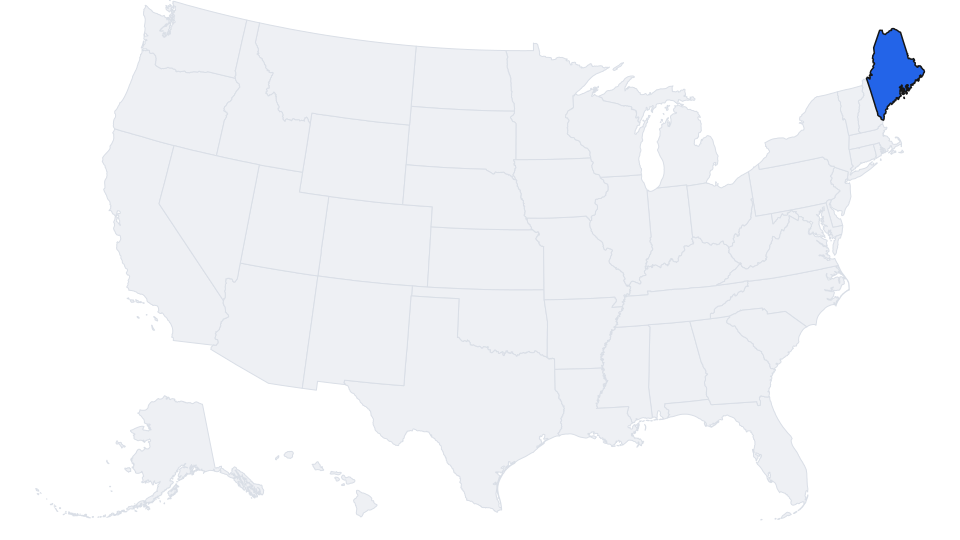
Map of the United States with Maine highlighted
Tax mechanics

Payroll tax in Maine

State income tax

Applies

Maine is a progressive state: 5.8% on income up to about $26,050 single, 6.75% to $61,599, and 7.15% above $61,600 for 2026. Pre-tax salary reductions (Section 125, 401(k), Section 132(f)) reduce both Maine taxable income and federal taxable income, so a $3,300 healthcare FSA election saves about $1,286 for a 22% federal plus 7.15% Maine employee versus about $1,050 for the same Florida employee. Matchbook's employee savings engine applies Maine marginal rates by bracket rather than a flat top-rate assumption.

Maine Unemployment Insurance

Wage base $12,000 (2026)

Rate range: 0.30%-6.27% under Schedule A for 2026; new employer rate 2.41%; average tax per fully-taxable employee about $267.60 per year

Maine's UI wage base is $12,000 - higher than Florida's $7,000 but still low enough that most salaried employees cross it in Q1. Section 125 salary reductions produce employer UI savings only for employees still under the wage base at election time (seasonal, part-time, or newly hired). Matchbook scopes the Maine UI savings line to those employees and excludes it for anyone projected to exceed $12K YTD before year-end.

Employer FICA

7.65% / 1.45% split

Employer FICA is 7.65% on wages up to the Social Security wage base ($176,100 in 2025; projected about $183,600 in 2026) and 1.45% above it. Maine PFML premium (1% of wages up to the SS wage base) is separate and is NOT reduced by Section 125 elections - IRS Rev. Rul. 2025-4 and Maine DOL guidance confirm PFML contributions are included in W-2 gross wages. Matchbook models FICA per employee and excludes PFML from Section 125 savings math.

Employer credits and levers

State and federal credits worth stacking

Credits that most broker ROI decks omit. Matchbook surfaces these in the employer report.

Pine Tree Development Zone (PTDZ) - closed to new applicants

PTDZ closed for new applications on December 31, 2024. Pre-certified employers continue to receive corporate tax credits, sales and use tax exemptions, 3.6% employee income tax reimbursements, and reduced electricity rates through the remainder of their 10-year benefit periods. Available in all Maine counties except Cumberland and York.

Source →

Employment Tax Increment Financing (ETIF) - closed to new applicants

ETIF also closed December 31, 2024. A qualified business certified before January 1, 2025 may receive a refund of up to 80% of its benefit base (generally 4.5% of gross wages paid to qualified employees above baseline) for the remaining years of a 10-year benefit period. Annual ETIF compliance report due March 15.

Source →

Maine Employer-Provided Dependent Care Credit (stacks with federal IRC 45F)

Maine's employer-provided dependent care assistance credit supplements the federal Section 45F credit for qualified on-site or sponsored child care. Matchbook surfaces the combined Maine plus federal modeled benefit when a Maine employer evaluates dependent care facility investment. Federal 45F is 25% with $150K cap in 2025, rising to 40% ($500K cap; 50% and $600K for small employers) in 2026.

Source →

Federal IRC Section 45F (stacks with Maine credit)

Federal employer-provided childcare credit. 25% credit with $150K cap in 2025; rises to 40% with $500K cap in 2026, and 50% with $600K cap for small employers.

Source →

Household programs

State programs that change what your employees should elect

Matchbook coordinates these against DCFSA, FSA, and HSA elections at the household level.

Childcare subsidy

Child Care Affordability Program (CCAP, formerly CCSP)

Maine DHHS subsidy for children ages 6 weeks to 13 (up to 19 for special needs or court-supervised) when parents work, study, or train. Family fee capped at 10% of gross income across all children. Income-based eligibility administered by Maine DHHS Office of Child and Family Services.

Matchbook: CCAP reduces out-of-pocket dependent-care spend and therefore reduces the right DCFSA election. Matchbook asks Maine employees whether they are CCAP-enrolled before recommending DCFSA contribution levels.

Source →

Preschool

Maine Public Preschool (Public Pre-K)

Locally-run public pre-K for children who turn 4 by October 15. About 91% of Maine SAUs offered public Pre-K in 2025-2026; 64% of Maine 4-year-olds enrolled. State goal is universal access by 2026-2027. Hours vary by district, so wrap-around care is typically still DCFSA-eligible.

Matchbook: The correct DCFSA election for a Pre-K family is the full-day center cost minus the Pre-K-funded hours, not zero. Matchbook models the split at the SAU level where district schedules are available.

Source →

Paid leave

Maine Paid Family and Medical Leave (PFML)

Mandatory state program. Contributions began January 1, 2025 at 1% of wages up to the Social Security wage base ($176,100 in 2025); employers with 15 or more employees split 50/50 with the employee, smaller employers owe no employer share but may withhold 0.5% from employees. Benefits of up to 12 weeks start May 1, 2026 for medical, parental, family care, military family, and safe leave. Applications open April 2026.

Matchbook: PFML contributions are NOT Section 125-eligible (Maine DOL guidance and IRS Rev. Rul. 2025-4). Matchbook excludes PFML from pre-tax calculators, models the employer's 0.5% match as a net-new payroll cost, and flags PFML benefit interaction with employer short-term disability and parental leave policies so employers do not double-fund leave in May 2026.

Source →

Health programs

Coverage coordination checkpoints

MaineCare and CubCare (Medicaid/CHIP)

Maine merged its separate CHIP program (CubCare) into a Medicaid expansion effective March 1, 2023. Children under 21 covered up to 305% FPL; pregnant individuals up to 214% FPL; adults under 65 up to 138% FPL. No premium, no waiting period. A federal law change in Fall 2026 will end coverage for some non-citizens (children and pregnant individuals retain coverage regardless).

Matchbook: Employees declining dependent coverage on the employer plan should be screened against MaineCare and CubCare thresholds before Matchbook defaults to the family tier. The 305% FPL child threshold is unusually generous and often more favorable than employer dependent coverage.

Source →

CoverME.gov (Maine state-based exchange)

Maine runs its own state-based ACA Marketplace. 2026 weighted-average rate increase of 23.9% after the enhanced Premium Tax Credits expired December 31, 2025. About 74% of enrollees still receive APTCs in 2026 (down from 85% in 2025); nearly 60% chose Bronze plans for 2026. 2026 employer-affordability threshold is 9.96% of household income.

Matchbook: If employer family coverage exceeds 9.96% of household income, Matchbook surfaces the CoverME.gov dependent subsidy path with 2026 net-premium illustrations that reflect EPTC expiration, so families do not assume the 2025 subsidy level.

Source →

Retirement and wealth

State-level retirement and wealth context

ABLE ME (Maine Section 529A)

Maine's ABLE program, administered by Bangor Savings Bank. Transactional checking account with $25 minimum, no annual fee, FDIC insured. 2025 contribution limit $19,000; employed beneficiaries may add up to $15,060 more. Effective January 1, 2026 the ABLE Age Adjustment Act raises the disability-onset eligibility age from 26 to 46, adding a large new cohort of eligible Maine beneficiaries.

Matchbook: When SSI asset limits are in play, Matchbook routes disability-related spend to ABLE ME first. The 2026 age-46 expansion is a specific open-enrollment screener Matchbook runs for Maine employees who previously aged out.

Source →

NextGen 529 and Maine 529 deduction

Maine allows a state income tax deduction of up to $1,000 per year for contributions to any Section 529 plan (including NextGen 529 and out-of-state plans). Income caps: federal AGI at or below $100,000 single / $200,000 joint or head of household. Separate deduction per beneficiary. At Maine's 7.15% top rate, a $1,000 deduction is worth up to $71.50 in state tax per beneficiary.

Matchbook: Matchbook flags the $1,000 per-beneficiary deduction for Maine households under the AGI caps, and does not over-weight NextGen 529 for higher-AGI households that lose the deduction entirely.

Source →

Section 132(f) commuter

Pre-tax commuter reality in Maine

2025 IRC Section 132(f) cap is $325 per month for transit and $325 per month for qualified parking; the 2026 inflation-adjusted cap increases from this base.

Parking and state credits

Parking: Portland CBD monthly parking frequently approaches the $325 cap; Bangor, Augusta, and Lewiston parking usually sits well below it. Downeaster commuters from Brunswick, Freeport, Saco, and Wells can combine rail fare (Discover Maine Rail Pass at $19 for 10 one-way trips) with parking under one pre-tax envelope.

State credit: None - Maine has no state-level commuter tax credit on top of Section 132(f).

Disaster readiness

Maine disaster-relief playbook

IRC Section 139 qualified disaster relief payments are not W-2 wages: no FICA, no FUTA, no federal income tax withholding, and the employer gets a full deduction. Triggered by a federal disaster declaration, which Maine has qualified for repeatedly - DR-4754-ME (January 2024 storms), the December 2023 windstorm and flooding PA declaration, and the April 2024 nor'easter PA declaration for Cumberland and York counties.

  • Pre-drafted Section 139 policy template so employers can disburse tax-free relief within 48 hours of a federal declaration - tuned for winter storm, nor'easter, and flooding scenarios.
  • Post-storm Section 125 election-change guidance: a nor'easter or ice storm alone is not a listed change-in-status event under Treas. Reg. 1.125-4 - it qualifies only when it triggers a change in residence, employment, or cost-of-coverage.
  • FEMA Individual Assistance interaction: Section 139 payments generally stack with FEMA IA, but Matchbook flags duplication risks in the disbursement log (especially relevant for coastal Maine households that also receive Maine Flood resources).
  • Maine-specific employer disaster leave review: Maine has no statutory paid disaster leave separate from PFML, and PFML 'safe leave' does not cover weather events - employer policy is the governing rule until May 2026 and remains governing for weather absences after.
Matchbook for Maine

What we ship specifically for Maine employers

  • Progressive-rate calibration in the employee savings engine: apply Maine brackets (5.8% / 6.75% / 7.15%) per employee rather than a flat top-rate assumption, so marginal savings per pre-tax dollar are accurate at each wage level.
  • PFML 2025-to-2026 ramp handling: exclude PFML from Section 125 pre-tax math, model the employer 0.5% as a net-new payroll cost, and run a benefits-overlap audit for May 2026 benefit launch against employer STD, parental leave, and PTO policies.
  • UI-savings scoping: suppress the Section 125 UI savings line for Maine employees projected above the $12,000 UI wage base, surface it for seasonal and part-time employees still under base.
  • NextGen 529 deduction screener with $100K/$200K AGI gates and per-beneficiary attribution, so multi-child Maine households capture the full available deduction.
  • MaineCare / CubCare 305% FPL child screener at open enrollment to recover dependents who would be better-served on state coverage than employer family tier.
  • CoverME.gov 2026 net-premium calculator after EPTC expiration so family-glitch households don't assume 2025 subsidy levels.
  • ABLE ME January 2026 age-46 expansion screener for previously-ineligible employees and dependents.
  • IRC Section 139 winter storm and nor'easter playbook template with pre-drafted employer policy and FEMA DR cross-reference for Maine counties.
  • PTDZ and ETIF pre-2025 certification check: confirm which existing employer clients still hold active 10-year benefit periods and surface the remaining refund window in the CFO ROI report.
  • Benefits graph ingests: Maine Revenue Services rate schedules, MDOL UI Schedule A rate notices, Maine Paid Leave contribution remittance data, CoverME.gov 2026 rate filings, FEMA DR numbers for Maine counties, and Maine DHHS CCAP income guideline updates.

Pilot Matchbook with a Maine-aware engine.

Talk to us about a 30-day pilot calibrated to Maine payroll, programs, and disaster rules.