State playbook - Kentucky

Matchbook, tuned for Kentucky payroll, kynect, and the ECCAP match.

Kentucky's flat income tax stepped from 4.0% in 2025 to 3.5% on January 1, 2026, which compresses but does not erase the Section 125 state tax stack. Local occupational license taxes (up to 2.25% in Lexington-Fayette, 2.2% in Louisville Metro) ride on top. Employer levers include the Employee Child Care Assistance Partnership (state match of employer childcare contributions), KBI/KEIA/KRA economic development credits, and the kynect state-based exchange for household coordination.

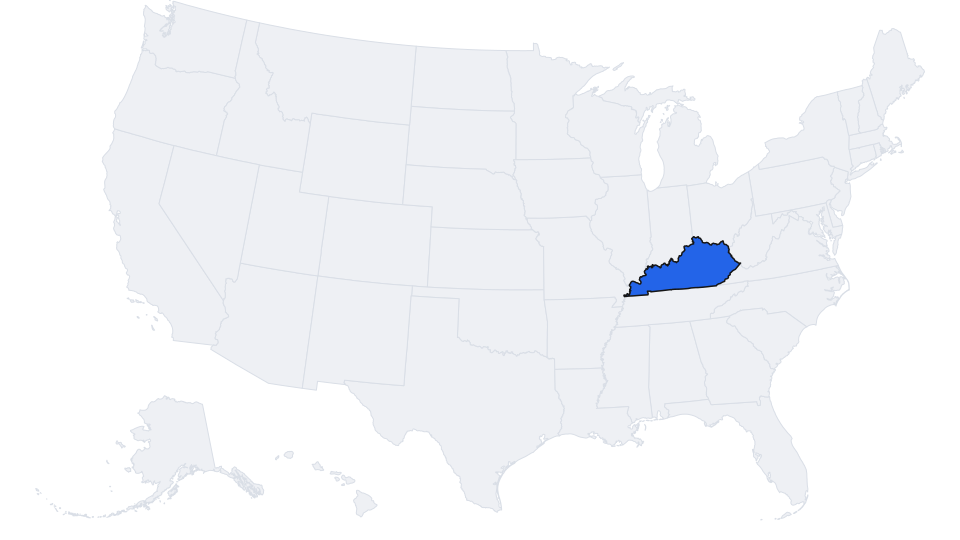
Map of the United States with Kentucky highlighted
Tax mechanics

Payroll tax in Kentucky

State income tax

Applies

Kentucky has a single flat individual income tax rate: 4.0% in 2025, stepping down to 3.5% effective January 1, 2026 under HB1 (2025 session). Section 125 salary reductions stack federal marginal plus 7.65% FICA plus 3.5% state (2026) plus the employee's local occupational license tax (typically 0.5%-2.5%) - so a Louisville Metro employee at 2.2% OLF and 22% federal sees roughly 35.35% all-in on a Section 125 dollar in 2026. Matchbook's savings engine recomputes the stack by ZIP because local occupational tax varies by city and county.

Kentucky Unemployment Insurance

Wage base $11,700 (2025); $12,000 (2026)

Rate range: Schedule A in 2026: 0.30%-2.40% for positive-rated employers, 6.50%-9.00% for negative-rated; new employer rate 2.70%

Kentucky's UI wage base is modest, so Section 125 salary reductions produce employer UI savings only for the first few thousand dollars of wages per employee. For salaried employees above the base (most full-time workers after Q1), the employer payroll-tax win narrows to the 7.65% FICA match plus, where applicable, the 6.0% FUTA match on the first $7,000. Matchbook's Kentucky employer ROI report suppresses the post-base UI line and calls it out explicitly.

Employer FICA

7.65% / 1.45% split

Employer FICA is 7.65% on wages up to the Social Security wage base ($176,100 in 2025; projected about $183,600 in 2026) and 1.45% above it. Matchbook models this per employee rather than quoting a flat rate.

Employer credits and levers

State and federal credits worth stacking

Credits that most broker ROI decks omit. Matchbook surfaces these in the employer report.

Employee Child Care Assistance Partnership (ECCAP)

Kentucky's signature employer childcare lever, established by HB499 (2022). State matches employer contributions made directly to an employee's licensed childcare provider - the state pays the provider up to 100% (minimum 50%) of the employer's contribution. $2M in matching funds per state fiscal year; provider must be a Kentucky All STARS participant. Administered by the Division of Child Care through the KICCS portal.

Source →

Kentucky Business Investment (KBI) Program

KEDFA-administered income tax credit and wage assessment for new or expanded manufacturing, headquarters, agribusiness, non-retail service and technology, and specified other projects. Up to 100% of Kentucky corporate income tax liability and up to 4.5% of taxable wages, claimed for up to 15 years; enhanced incentive counties available. Recent statutory tweaks allow crediting Kentucky-resident employees regardless of project-county residence if their wages are expensed to the project.

Source →

Kentucky Enterprise Initiative Act (KEIA)

Sales and use tax refund on building and construction materials, R&D equipment, data processing equipment, and flight simulation equipment for approved projects. Minimum eligible investment $500,000. Stacks with KBI for qualifying new-build or major-expansion projects.

Source →

Kentucky Reinvestment Act (KRA)

Corporate income tax credit for existing Kentucky manufacturers, agribusiness, non-retail service/technology, headquarters and other eligible operations reinvesting in plant and equipment. Minimum $2.5M for owned facilities, $1M for leased. Up to 100% of CIT liability from the project, up to 10 years. Approved companies must retain at least 85% of baseline employment.

Source →

Federal IRC Section 45F (stacks with ECCAP)

Federal employer-provided childcare credit. 25% credit with $150K cap in 2025; rises to 40% with $500K cap in 2026, and 50% with $600K cap for small employers. Matchbook's Kentucky ROI report stacks ECCAP state-match dollars on top of the federal Section 45F credit and the FICA match on pre-tax DCFSA salary reductions.

Source →

Household programs

State programs that change what your employees should elect

Matchbook coordinates these against DCFSA, FSA, and HSA elections at the household level.

Childcare subsidy

Kentucky Child Care Assistance Program (CCAP)

Sliding-scale subsidy administered by the Division of Child Care. Entry eligibility at or below 200% FPL; redetermination at or below 85% State Median Income. Work/training activity requirement (generally 20+ hours per week). Applied via KICCS portal or local DCBS office.

Matchbook: CCAP reduces out-of-pocket dependent-care cost and therefore reduces the right DCFSA election. Matchbook asks Kentucky employees whether they qualify and whether their employer participates in ECCAP before recommending DCFSA contribution levels - a family with both CCAP and ECCAP support can have a DCFSA closer to zero than headline income would suggest.

Source →

Preschool

Kentucky Pre-K For All / State-funded Preschool

State-funded preschool for all 4-year-olds in households at or below 160% FPL and for all 3- and 4-year-olds with identified disabilities regardless of income. Part-day program in most districts - wrap-around care remains DCFSA-eligible. A bipartisan advisory committee recommended phased expansion toward broader pre-K in October 2025.

Matchbook: The correct DCFSA election for a Kentucky preschool family is full-day-equivalent center cost minus the state-funded hours, not zero. Matchbook models this split and does not zero out DCFSA when a child is enrolled in public pre-K.

Source →

Health programs

Coverage coordination checkpoints

Kentucky Children's Health Insurance Program (KCHIP)

Free or low-cost children's health coverage for families at or below 218% FPL (with MAGI methodology). Children must be under 19, uninsured for at least six months, and not otherwise Medicaid-eligible. Kentucky was the first state to implement automatic (ex parte) Medicaid renewal for children.

Matchbook: Matchbook ships a KCHIP screener for Kentucky: employees declining dependent coverage or weighing the family tier on the employer plan are screened against KCHIP and kynect subsidy thresholds before Matchbook defaults to family-tier enrollment. This is the Kentucky-specific version of the dependent-coverage decision tree.

Source →

Kentucky Medicaid - post-unwind recovery

Kentucky conducted continuous-coverage unwinding renewals from May 2023 through April 2024; procedural disenrollments were significant and the Kentucky Health Benefit Exchange tracks demographic impacts. Address-on-file accuracy in kynect is the single biggest lever for retention.

Matchbook: Matchbook's Kentucky screener flags households that may have lost Medicaid for procedural reasons (returned mail, missed renewal) and offers the kynect re-enrollment path, KCHIP for children, or employer-plan mid-year enrollment depending on the facts.

Source →

kynect - Kentucky State-Based Exchange

Kentucky runs its own ACA marketplace (kynect), not HealthCare.gov. For 2026, kynect offers three carriers (down from four in 2025), and average premiums rose $181-$200 per month driven by expiration of the enhanced federal PTC at end of 2025 plus loss of eligibility for households above 400% FPL. The 2026 employer-affordability threshold is 9.96% of household income.

Matchbook: If employer family coverage exceeds 9.96% of household income, Matchbook surfaces the kynect dependent subsidy path - but with calibrated expectations for 2026 because the enhanced PTC expired. For Kentucky, the screener also distinguishes kynect from HealthCare.gov since the URL and application flow differ.

Source →

Retirement and wealth

State-level retirement and wealth context

STABLE Kentucky (ABLE)

Kentucky's Section 529A program, partnered with the STABLE Account national plan and administered through the State Treasurer. 2025 contribution limit $19,000 (projected $20,000 for 2026); employed beneficiaries may add up to $15,650 more. $100K SSI protection cap. ABLE Age Adjustment Act raises the age-of-onset from 26 to 46 effective January 1, 2026.

Matchbook: FSA or HSA dollars reimburse medical expenses; STABLE Kentucky covers broader qualified disability expenses. When SSI asset limits are in play, Matchbook routes disability-related spend to STABLE first. The 2026 age-46 onset change materially expands the eligible Kentucky employee population - Matchbook re-screens at open enrollment.

Source →

KY Saves 529

Kentucky's 529 college savings plan, administered by KHEAA. Earnings grow federal and Kentucky tax-deferred; qualified withdrawals are state and federal tax-free. Kentucky does NOT offer a state income tax deduction or credit for contributions, so there is no home-state tilt for contribution routing.

Matchbook: Matchbook does not over-weight KY Saves 529 for Kentucky employees when evaluating household college-savings strategy. Because there is no state deduction, the Kentucky 529 decision reduces to plan fees and investment options, which Matchbook compares head-to-head against out-of-state plans.

Source →

Section 132(f) commuter

Pre-tax commuter reality in Kentucky

2025 IRC Section 132(f) cap is $325 per month for transit and $325 per month for qualified parking.

Parking and state credits

Parking: Downtown Louisville and Lexington monthly parking frequently sits below the $325 cap; Cincinnati-adjacent Northern Kentucky commuters crossing to Cincinnati CBD garages more often approach the cap.

State credit: None - Kentucky has no state-level commuter tax credit. However, Section 132(f) salary reductions reduce Kentucky taxable wages AND most local occupational license tax bases, so the all-in Kentucky employee savings rate is higher than the federal-only view.

Disaster readiness

Kentucky disaster-relief playbook

IRC Section 139 qualified disaster relief payments are not W-2 wages: no FICA, no FUTA, no federal income tax withholding, and the employer gets a full deduction. Kentucky has triggered Section 139 repeatedly: the December 2021 Western Kentucky tornadoes (DR-4630), the July 2022 Eastern Kentucky floods (DR-4663), February 2025 severe storms and flooding (DR-4860/4864), and May 2025 severe storms and tornadoes (DR-4875).

  • Pre-drafted Section 139 policy template so employers can disburse tax-free relief within 48 hours of a federal declaration - Kentucky's declaration cadence is frequent enough to justify keeping it on the shelf.
  • Post-disaster Section 125 election-change guidance: a tornado or flood alone is not a listed change-in-status event under Treas. Reg. 1.125-4 - it qualifies only when it triggers a change in residence, employment, or cost-of-coverage.
  • FEMA Individual Assistance interaction: IRS Section 139 payments generally stack with FEMA IA, but Matchbook flags duplication risks in the disbursement log.
  • Kentucky has no statutory paid disaster leave, so employer policy is the governing rule. Matchbook reviews the policy against recent declaration counties (Caldwell, Fulton, Graves, Hopkins, Marshall, Muhlenberg, Taylor, Warren for DR-4630; Laurel, Pulaski, Russell, Trigg, Union added for DR-4875).
Matchbook for Kentucky

What we ship specifically for Kentucky employers

  • Re-pointing the Matchbook state tax engine for the January 1, 2026 flat-rate step from 4.0% to 3.5% - savings-stack guardrails tighten marginally but materially for lower-bracket Kentucky households.
  • Local occupational license tax layer in the employee savings engine by ZIP - Louisville Metro, Lexington-Fayette, Covington, Bowling Green, Paducah all have distinct rates and Section 125 treatment.
  • ECCAP plus federal IRC Section 45F stacking calculator in the employer ROI report - Kentucky's state match on employer childcare contributions is the single most under-used employer lever.
  • KCHIP screener at open enrollment for Kentucky employees weighing employer dependent coverage - KCHIP's 218% FPL threshold catches many two-earner households that default to the family tier.
  • kynect (not HealthCare.gov) routing logic for Kentucky employees on the Marketplace path, including post-enhanced-PTC 2026 affordability calibration.
  • CCAP plus ECCAP plus public pre-K wrap-around logic in the DCFSA recommender.
  • STABLE Kentucky re-screen for the January 1, 2026 age-46 ABLE onset expansion.
  • IRC Section 139 tornado/flood playbook template with a pre-drafted employer policy and post-event Section 125 election-change guidance - Kentucky's declaration cadence justifies keeping it live.
  • Benefits graph ingests: Kentucky DOR income tax rate notices, OET Schedule A rate notices, KEDFA credit authorizations, CHFS ECCAP program status, KHBE kynect rate filings, FEMA DR numbers for Kentucky.

Pilot Matchbook with a Kentucky-aware engine.

Talk to us about a 30-day pilot calibrated to Kentucky payroll, programs, and disaster rules.