State playbook - Indiana

Matchbook, tuned for Indiana payroll, programs, and 529 credits.

Indiana stacks a flat 3.0% state income tax (phasing down to 2.9% by 2027) on top of FICA, layers county income taxes, and offers a rare Indiana-only lever - a 20% refundable CollegeChoice 529 tax credit up to $1,500 - that rewires how Hoosier employees should allocate between FSAs, HSAs, and 529s.

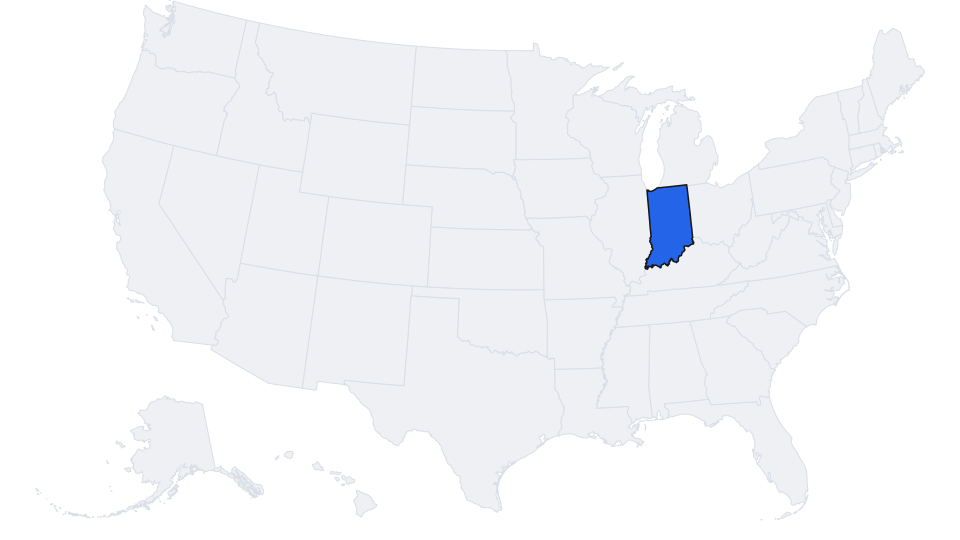
Map of the United States with Indiana highlighted
Tax mechanics

Payroll tax in Indiana

State income tax

Applies

Indiana is a flat tax state: 3.00% in 2025 and 2026, scheduled to step down to 2.95% in 2026 and 2.90% in 2027 under HEA 1001 (2023). All 92 Indiana counties also impose a local income tax (LIT) ranging from about 0.50% to 3.38% in 2025, stacking on top of state tax. A $3,300 healthcare FSA election saves about $1,185 for a 22% federal bracket Indianapolis employee (Marion County LIT 2.02%) versus about $1,050 for the same Florida employee. Matchbook computes the stacked federal + state + county marginal rate per employee when sizing pre-tax elections.

Indiana Unemployment Insurance (DWD)

Wage base $9,500 (2025 and 2026)

Rate range: 0.50%-7.40% on Merit Rate Schedule E for 2025; new non-construction employer rate 2.50%; new construction employer rate 2.53%

Indiana's $9,500 UI wage base is modestly higher than Florida's $7,000 but still well below full-year salaried wages, so Section 125 salary reductions produce only partial-year employer UI savings. Matchbook prorates the UI savings line in the Indiana employer ROI report by the share of each employee's pre-tax election that lands before they cross $9,500 YTD. The 7.65% FICA match on Section 125 and Section 132(f) elections remains the dominant employer payroll-tax win.

Employer FICA

7.65% / 1.45% split

Employer FICA is 7.65% on wages up to the Social Security wage base ($176,100 in 2025; projected about $183,600 in 2026) and 1.45% above it. Matchbook models this per employee rather than quoting a flat rate.

Employer credits and levers

State and federal credits worth stacking

Credits that most broker ROI decks omit. Matchbook surfaces these in the employer report.

Indiana EDGE (Economic Development for a Growing Economy)

Refundable corporate income tax credit calculated as a percentage of incremental Indiana state payroll withholding from net-new jobs. Administered by the Indiana Economic Development Corporation (IEDC); requires a performance agreement and job-creation and wage thresholds. Common lever for expansions of 25+ jobs paying above county average wage.

Source →

Hoosier Business Investment (HBI) Tax Credit

Non-refundable Indiana income tax credit up to 10% of qualified capital investment in Indiana (equipment, building improvements, IT infrastructure). Carryforward up to 9 years. Stacks with EDGE for expansion projects and pairs naturally with on-site childcare capex evaluated against federal IRC Section 45F.

Source →

Venture Capital Investment (VCI) Tax Credit

Indiana income tax credit up to 25% (or 30% for minority- or women-owned qualified Indiana businesses) of a qualified investment, capped at $1M per investor per qualified business. Reformed under HEA 1102 (2022) to allow transferability. Relevant for Indiana-headquartered employers raising growth capital alongside benefits redesign.

Source →

Federal IRC Section 45F (stacks with Indiana HBI for on-site care)

Federal employer-provided childcare credit. 25% credit with $150K cap in 2025; rises to 40% with $500K cap in 2026, and 50% with $600K cap for small employers under OBBBA. Matchbook surfaces the combined Indiana HBI capex credit plus federal 45F operating credit when an Indiana employer evaluates on-site care.

Source →

Household programs

State programs that change what your employees should elect

Matchbook coordinates these against DCFSA, FSA, and HSA elections at the household level.

Preschool

On My Way Pre-K

Indiana's state-funded pre-K program for income-eligible 4-year-olds (at or below 150% FPL) in all 92 counties. HEA 1001 (2023) and subsequent appropriations expanded slots; family work/school/training requirement applies. Does not cover wrap-around care.

Matchbook: The correct DCFSA election for a Hoosier On My Way Pre-K family is full-day center cost minus the state-funded hours, not zero. Matchbook models this split and checks eligibility against the 150% FPL threshold before sizing the DCFSA.

Source →

Childcare subsidy

Child Care and Development Fund (CCDF)

Federally-funded, state-administered childcare voucher for families typically up to 127% FPL at entry and 85% State Median Income at redetermination. Administered by FSSA's Office of Early Childhood and Out-of-School Learning. Copay sliding scale by income.

Matchbook: CCDF vouchers reduce out-of-pocket dependent-care cost and therefore reduce the right DCFSA election. Matchbook asks Indiana employees whether they qualify or already receive a voucher before recommending DCFSA contribution levels.

Source →

Health programs

Coverage coordination checkpoints

Hoosier Healthwise (CHIP and Children's Medicaid)

Indiana's combined Medicaid and CHIP program for children under 19 and pregnant women. Children covered up to 250% FPL; Package C (CHIP) applies at 158%-250% FPL with small monthly premiums. Administered by FSSA.

Matchbook: Employees declining dependent coverage on the employer plan should be screened against Hoosier Healthwise thresholds before Matchbook defaults to the family tier - particularly relevant for Indiana employers whose family-tier contribution fails the 2026 affordability test at 9.96%.

Source →

Healthy Indiana Plan (HIP)

Indiana's Section 1115 Medicaid expansion for adults 19-64 up to 138% FPL, with POWER account contributions. Work reporting requirement reinstated under HEA 1001 (2025) pending CMS approval.

Matchbook: Low-wage Indiana employees declining employer coverage may be HIP-eligible rather than Marketplace-subsidy-eligible. Matchbook's Indiana screener routes households below 138% FPL to HIP first.

Source →

ACA Marketplace (Federally Facilitated Marketplace)

Indiana uses the federal exchange (healthcare.gov); no state-based exchange. 2026 employer-affordability threshold is 9.96% of household income. Enhanced premium tax credits expired at the end of 2025, so Indiana 2026 premiums see material increases. Family-glitch fix still applies.

Matchbook: If employer family coverage exceeds 9.96% of household income, Matchbook surfaces the Marketplace dependent-subsidy path - especially material in Indiana after the enhanced PTC expiration.

Source →

Paid family and medical leave

Indiana has no state paid family and medical leave program. Federal FMLA (unpaid, 12 weeks) is the floor; employer-paid parental and medical leave plus voluntary disability coverage are the only paid layers available to Hoosier employees.

Matchbook: Matchbook does not model a state PFML premium in the Indiana employer ROI report and actively recommends voluntary short-term disability and hospital-indemnity riders to close the PFML gap for Hoosier households.

Source →

Retirement and wealth

State-level retirement and wealth context

INvestABLE Indiana

Indiana's Section 529A ABLE program for disabled beneficiaries. 2025 annual contribution limit $19,000; employed beneficiaries may add up to $15,060 more under ABLE to Work. $450K Indiana balance cap; $100K SSI asset-exclusion cap.

Matchbook: FSA or HSA dollars reimburse medical expenses; INvestABLE Indiana covers broader qualified disability expenses. When SSI asset limits are in play, Matchbook routes disability-related spend to ABLE first.

Source →

CollegeChoice 529 - Indiana tax credit (state-specific lever)

Indiana is unusual: it offers a tax CREDIT, not a deduction, equal to 20% of CollegeChoice 529 contributions up to $7,500, for a maximum $1,500 Indiana income tax credit per year per taxpayer (IC 6-3-3-12). Credit is non-refundable but carries forward. Only contributions to an Indiana CollegeChoice 529 plan qualify - out-of-state 529s do not.

Matchbook: For a Hoosier household saving for college, $7,500 into CollegeChoice 529 yields a $1,500 Indiana credit - a 20% guaranteed return before any market performance. Matchbook ranks CollegeChoice 529 above out-of-state 529s and, for households near the DCFSA cap, shifts marginal education savings into CollegeChoice 529 to capture the credit. The credit stacks with federal tax-free growth.

Source →

Section 132(f) commuter

Pre-tax commuter reality in Indiana

2025 IRC Section 132(f) cap is $325 per month for transit and $325 per month for qualified parking; 2026 projected approximately $340 per month.

Parking and state credits

Parking: Downtown Indianapolis monthly parking typically runs $150-$275, sitting below the $325 cap; the binding Section 132(f) constraint for most Hoosier commuters is transit pass plus parking combined, not either individually.

State credit: None - Indiana has no state-level commuter tax credit. The §132(f) pre-tax exclusion is the only lever, and it stacks with Indiana's 3.00% flat state tax plus county LIT, making commuter benefits measurably more valuable in high-LIT counties.

Disaster readiness

Indiana disaster-relief playbook

IRC Section 139 qualified disaster relief payments are not W-2 wages: no FICA, no FUTA, no federal income tax withholding, and the employer gets a full deduction. Triggered by a federal disaster declaration. Indiana recurrently qualifies - tornadoes (including the March 2025 and May 2024 outbreaks), severe storms and flooding, and winter ice storms have driven multiple FEMA DR declarations in recent years.

  • Pre-drafted Section 139 policy template so Indiana employers can disburse tax-free relief within 48 hours of a federal declaration.
  • Post-storm Section 125 election-change guidance: a tornado or flood alone is not a listed change-in-status event under Treas. Reg. 1.125-4 - it qualifies only when it triggers a change in residence, employment, or cost-of-coverage.
  • FEMA Individual Assistance interaction: IRS Section 139 payments generally stack with FEMA IA, but Matchbook flags duplication risks in the disbursement log.
  • Indiana-specific employer disaster leave review (Indiana has no statutory paid disaster leave, so employer policy is the governing rule). County LIT withholding should be suspended on Section 139 payments alongside federal and state.
Matchbook for Indiana

What we ship specifically for Indiana employers

  • Stacked marginal-rate calibration in the employee savings engine - recompute pre-tax stacks at Indiana flat 3.00% plus county LIT (0.50%-3.38%) for every Hoosier household, not a single state rate.
  • CollegeChoice 529 credit optimizer: for any Indiana household with college-savings goals, route the first $7,500 of annual education savings to CollegeChoice 529 to capture the $1,500 Indiana credit before any out-of-state 529 contribution.
  • Indiana EDGE plus HBI plus federal Section 45F stacking calculator in the employer ROI report - high leverage for Indiana employers evaluating on-site or sponsored childcare as part of an expansion project.
  • Prorate the UI savings line in the Indiana employer FICA and SUI report at the $9,500 wage base, per employee, rather than applying it against full-year wages.
  • On My Way Pre-K and CCDF wrap-around logic in the DCFSA recommender, ingesting FSSA eligibility rules per county.
  • Hoosier Healthwise, HIP, and Marketplace screener at open enrollment to route dependents to the correct coverage tier after the 2025 enhanced PTC expiration.
  • IRC Section 139 tornado and winter-storm playbook template with a pre-drafted employer policy and post-disaster Section 125 election-change guidance.
  • Benefits graph ingests: IEDC EDGE and HBI award data, DWD UI rate schedule and wage-base notices, Indiana DOR flat-tax rate schedule, county LIT rates by year, FSSA On My Way Pre-K and CCDF eligibility, CollegeChoice 529 credit rules, and FEMA DR numbers for Indiana.

Pilot Matchbook with a Indiana-aware engine.

Talk to us about a 30-day pilot calibrated to Indiana payroll, programs, and disaster rules.