State playbook - Illinois

Matchbook, tuned for Illinois payroll, Chicago transit mandates, and Smart Start pre-K.

Illinois layers a 4.95% flat income tax on top of FICA for a clean pre-tax stack, pairs a mid-size SUI wage base with a Fund Building Rate, and adds a hard compliance line most brokers miss: the Transportation Benefits Program Act that forces Chicago-area employers at 50+ full-timers to offer pre-tax transit. Matchbook aligns Section 125, Section 132(f), EDGE, Blue Collar Jobs Act, Smart Start coordination, and IRC 139 disaster relief into one state-aware configuration.

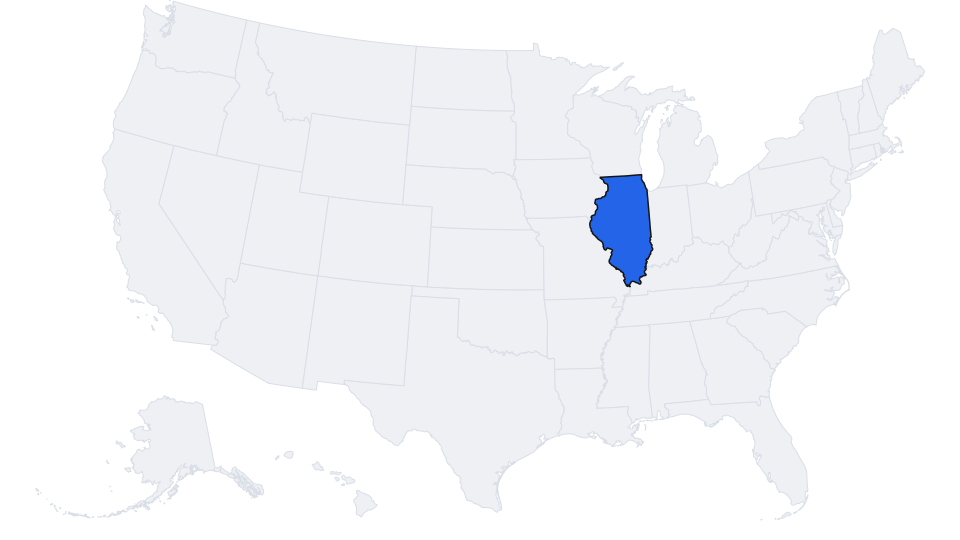
Map of the United States with Illinois highlighted
Tax mechanics

Payroll tax in Illinois

State income tax

Applies

Illinois has a flat 4.95% individual income tax (unchanged since 2017), with a 2025 personal exemption of $2,850. The Illinois pre-tax stack is federal marginal rate plus 7.65% FICA plus 4.95% state flat - so a $3,300 healthcare FSA election saves about $1,222 for a 22% federal bracket Illinois employee (22% + 7.65% + 4.95% = 37.6%). Because the state is flat, every dollar of Section 125 salary reduction yields a predictable 4.95% state-tax win regardless of earnings, which simplifies Matchbook's Illinois employee recommendations.

Illinois Unemployment Insurance (IDES contribution)

Wage base $13,916 (2025); $13,271 (2026)

Rate range: 0.75%-7.85% in 2025; 0.75%-7.05% in 2026. New employer rate is 3.175% in 2026. 2026 Fund Building Rate is 0.550% and the State Experience Factor is 102%.

Illinois's mid-size UI wage base means Section 125 salary reductions produce a real employer SUI savings line for hourly and part-time workers who stay below the base through mid-year, but zero incremental SUI savings for salaried workers who clear $13,916 in YTD wages within the first few pay periods. Matchbook's Illinois employer ROI report computes SUI savings per employee rather than using an average rate, and flags the 0.55% Fund Building Rate separately because it does not vary by experience.

Employer FICA

7.65% / 1.45% split

Employer FICA is 7.65% on wages up to the Social Security wage base ($176,100 in 2025; projected about $183,600 in 2026) and 1.45% above it. The 7.65% federal match on Section 125 and Section 132(f) elections is the largest and most reliable employer payroll-tax win in Illinois - materially larger than the SUI line for any salaried workforce.

Employer credits and levers

State and federal credits worth stacking

Credits that most broker ROI decks omit. Matchbook surfaces these in the employer report.

Illinois EDGE (Economic Development for a Growing Economy) Tax Credit

Corporate income tax credit against Illinois withholding or income tax for qualifying job creation and capital investment. Credit is typically 50% of income tax withholding on new jobs, 75% in underserved areas, for up to 10 years (15 for large projects). As of February 5, 2025, employees must work in-person at the project a minimum of 14 hours per week to count toward New/Retained Employee requirements. 2025 legislation expanded eligibility beyond startups and manufacturers.

Source →

Illinois Blue Collar Jobs Act (BCJA)

Corporate income tax credit equal to 50% of Illinois income tax withheld on construction wages at eligible projects, or 75% in underserved areas. Capped at $20M per year statewide. Eligibility requires an Enterprise Zone, River Edge Redevelopment Zone, High Impact Business designation, or an EDGE agreement. Stacks with EDGE for companies with agreements.

Source →

Illinois Apprenticeship Education Expense Tax Credit

Illinois income tax credit of $3,500 per qualifying apprentice for tuition, book fees, and lab fees, plus an additional $1,500 if the apprentice or employer's principal place of business is in an underserved area. Program cap $5M per year statewide, first-come-first-served. Separate from Illinois Works Jobs Program Act apprenticeship requirements on prevailing-wage public projects (10% apprentice hours threshold).

Source →

Illinois Employee Child Care Assistance Program Credit (35 ILCS 5/210)

For tax years ending on or after December 31, 2025, Illinois corporate income tax credit equals 50% of start-up costs for an employer-provided child care facility (up from 30%) and 20% of annual operating costs for on-site or off-site care for employees' children (up from 5%). Five-year carryforward. Corporations only - not available to S-corps or shareholders. Stacks with federal IRC Section 45F.

Source →

Federal IRC Section 45F (stacks with Illinois credit)

Federal employer-provided childcare credit. 25% credit with $150K cap in 2025; rises to 40% with $500K cap in 2026, and 50% with $600K cap for small employers. Matchbook surfaces the combined Illinois plus federal modeled benefit when an employer evaluates on-site or sponsored care.

Source →

Invest in Kids Scholarship Tax Credit - SUNSET

The 75% Illinois income tax credit for donations to approved K-12 Scholarship Granting Organizations sunset on December 31, 2023 after lawmakers declined to extend it in fall 2023. Matchbook excludes Invest in Kids from current-year Illinois employer CIT-offset planning but surfaces it historically when reconciling prior-year carryforwards.

Source →

Household programs

State programs that change what your employees should elect

Matchbook coordinates these against DCFSA, FSA, and HSA elections at the household level.

Childcare subsidy

Illinois Child Care Assistance Program (CCAP)

Sliding-scale subsidized childcare administered by IDHS through local CCR&R agencies. 2025 initial eligibility is at or below 225% of the Federal Poverty Level; redetermination eligibility is 275% FPL. Children under 13 (under 19 with documented special needs). Income guidelines re-indexed to current FPL effective July 1 each year.

Matchbook: CCAP reduces out-of-pocket dependent-care cost and therefore the correct DCFSA election. Matchbook asks Illinois employees whether they have applied or qualify for CCAP before recommending DCFSA contribution levels, and models the family co-pay rather than the full provider rate.

Source →

Preschool

Smart Start Illinois (Universal Pre-K by 2027)

Governor Pritzker's FY24-launched initiative to reach universal free preschool for all Illinois 3- and 4-year-olds by 2027. Through FY25 the program added about 11,000 publicly funded preschool seats (5,800 in Year 1, 5,150 in Year 2), with a goal of 20,000 net new seats. Funded via the Early Childhood Block Grant administered by ISBE.

Matchbook: Smart Start slots are typically half-day or school-day, not full-day childcare. The correct DCFSA election for a Smart Start family is full-day center or home-care cost minus the Smart Start-funded hours, not zero. Matchbook models this split explicitly and flags employees in the rollout regions where 2025-2027 seat expansion is happening fastest.

Source →

Children's health coverage

All Kids (Illinois CHIP and children's Medicaid)

Covers medical and dental care for uninsured Illinois children up to age 19. Medicaid-eligible at or below 147% FPL; All Kids premium-free up to 147% FPL and sliding-scale premiums above that, with combined Medicaid-plus-CHIP eligibility extending to 318% FPL historically and 247% FPL under 2026 guidance. Immigration status and family assets do not disqualify.

Matchbook: Employees declining dependent coverage on the employer plan should be screened against All Kids thresholds before Matchbook defaults to the family tier. Illinois's broad immigration-neutral eligibility matters for mixed-status households that would otherwise assume no public option exists.

Source →

Education savings

Illinois Bright Start and Bright Directions 529 plans

Illinois taxpayers deduct up to $10,000 ($20,000 MFJ) per year of contributions to Illinois-sponsored 529 plans (Bright Start, Bright Directions, or College Illinois Prepaid). No income cap on the deduction. Non-qualified withdrawals and rollovers to out-of-state 529 plans trigger recapture of previously deducted contributions into Illinois taxable income.

Matchbook: Matchbook favors Illinois-sponsored 529s for Illinois employees because of the state deduction and the rollover recapture rule - a resident who uses an out-of-state 529 loses the 4.95% state benefit and takes recapture risk on any later rollover back. The deduction is claimed on the IL-1040, not through payroll.

Source →

Disability savings

Illinois ABLE (529A)

Illinois's Section 529A program for qualifying individuals with disabilities. 2025 basic annual contribution limit $19,000 (rising to $20,000 for 2026); employed beneficiaries not in an employer retirement plan may contribute an additional $15,060 (2025 poverty-line figure). $500K balance cap; $100K SSI asset-limit exclusion. Illinois taxpayers deduct up to $10,000 ($20,000 MFJ) per year.

Matchbook: FSA or HSA dollars reimburse medical expenses; ABLE covers broader qualified disability expenses including housing, transportation, and assistive technology. When SSI asset limits are in play, Matchbook routes disability-related spend to ABLE first and claims the Illinois deduction.

Source →
Health programs

Coverage coordination checkpoints

Get Covered Illinois (state-based marketplace, 2026)

Illinois began operating as a full state-based marketplace on January 1, 2026, taking over enrollment from HealthCare.gov for the 2026 plan year. Open enrollment for 2026 coverage ran November 1, 2025 through January 31, 2026, with a special enrollment period through March 31, 2026 for auto-renewed enrollees who had not claimed their Get Covered Illinois account. Seven carriers participate in 2026 (down from 11 in 2025 after Aetna CVS, Health Alliance, and Quartz exits).

Matchbook: If employer family coverage exceeds the 2026 affordability threshold (9.96% of household income), Matchbook surfaces the Get Covered Illinois dependent subsidy path. The state-based marketplace transition means Illinois residents must re-authenticate via Get Covered Illinois rather than HealthCare.gov - Matchbook's open-enrollment playbook links directly to the state portal.

Source →

Illinois Medicaid - post-unwind recovery

Illinois Medicaid continues its post-PHE redetermination cycle. Open enrollment is the right touchpoint to recover procedurally-disenrolled dependents onto employer coverage, All Kids, or Get Covered Illinois.

Matchbook: Matchbook's Illinois screener flags households that may have lost Medicaid procedurally and offers the enrollment path. Employees losing Medicaid for reasons unrelated to eligibility typically qualify for a Marketplace special enrollment period.

Source →

Retirement and wealth

State-level retirement and wealth context

Illinois Secure Choice

State-sponsored IRA auto-enrollment program for Illinois private-sector employers that do not offer a qualified retirement plan. Mandatory participation for employers with 5 or more employees. Matchbook's enrollment engine reads the Secure Choice status of an Illinois employer and suppresses the state IRA recommendation when the employer offers a 401(k) or other qualified plan.

Matchbook: Secure Choice is Roth-only. Matchbook's employee recommendation engine evaluates the Roth-vs-pre-tax fork correctly when a household is enrolled in Secure Choice without an employer 401(k).

Source →

Section 132(f) commuter

Pre-tax commuter reality in Illinois

2025 IRC Section 132(f) cap is $325 per month for transit and $325 per month for qualified parking. 2026 cap rises to $340 per month for each.

Parking and state credits

Parking: Chicago Loop and West Loop monthly parking routinely exceeds the $340 cap; suburban station parking (Metra and Pace park-and-ride) typically sits well below the cap. Matchbook's Illinois parking recommendation defaults to the cap for Chicago CBD employees and to actual cost for suburban employees.

State credit: Illinois does not offer a standalone employer commuter tax credit, but the Transportation Benefits Program Act (Public Act 103-0291, effective January 1, 2024) makes pre-tax transit a compliance requirement for covered employers with 50+ full-time employees within one mile of RTA fixed-route service across 38 designated counties and townships in the Chicago metro. Pre-tax transit must satisfy IRC Section 132(f) limits and be offered starting the employee's first full pay period after 120 days of employment.

Disaster readiness

Illinois disaster-relief playbook

IRC Section 139 qualified disaster relief payments are not W-2 wages: no FICA, no FUTA, no federal income tax withholding, and the employer gets a full deduction. Triggered by a federal disaster declaration. Recent Illinois events qualifying include the July 2024 severe storms, tornadoes, and flooding (DR-4819-IL, declared September 2024) covering Cook County and six other counties; Illinois has a recurring exposure to tornadoes, derechos, winter storms, and urban flooding.

  • Pre-drafted Section 139 policy template so Illinois employers can disburse tax-free relief within 48 hours of a federal declaration - Chicago-area urban flooding and derecho events tend to trigger localized Individual Assistance declarations.
  • Post-storm Section 125 election-change guidance: a disaster alone is not a listed change-in-status event under Treas. Reg. 1.125-4 - it qualifies only when it triggers a change in residence, employment, or cost-of-coverage.
  • FEMA Individual Assistance interaction: IRS Section 139 payments generally stack with FEMA IA, but Matchbook flags duplication risks in the disbursement log.
  • Illinois has no statutory paid disaster leave, so employer policy is the governing rule - Matchbook prompts the HR owner to publish a written disaster-leave policy before open enrollment.
Matchbook for Illinois

What we ship specifically for Illinois employers

  • Chicago Transportation Benefits Program Act compliance check in the Illinois employer ROI report - Matchbook confirms RTA one-mile proximity, 50-full-timer headcount, and 120-day post-hire offering and surfaces Section 132(f) pre-tax transit setup when the employer is in scope.
  • Flat-tax calibration in the employee savings engine - compute all Section 125 and Section 132(f) marginal stacks at federal + 7.65% FICA + 4.95% state for every Illinois employee regardless of earnings.
  • Mid-size UI wage base handling in the Illinois employer SUI savings line - compute per-employee rather than averaged, suppress for salaried workers who clear $13,916 (2025) or $13,271 (2026) in YTD wages early.
  • EDGE and Blue Collar Jobs Act tracker for Illinois employers with agreements - surface the 2025 in-person 14-hour-per-week requirement and the BCJA 50/75% construction-withholding credit alongside standard payroll-tax ROI.
  • Illinois Child Care Assistance Program Credit (35 ILCS 5/210) plus federal IRC Section 45F stacking calculator in the employer ROI report, reflecting the 2025 rate increase to 50% start-up and 20% operating.
  • Smart Start and CCAP coordination logic in the DCFSA recommender, ingesting IDHS CCAP eligibility rules and ISBE Early Childhood Block Grant slot availability by community.
  • All Kids and Illinois Medicaid redetermination screener at open enrollment to recover procedurally-disenrolled dependents and route mixed-status households to All Kids.
  • Bright Start and Bright Directions 529 default for Illinois residents with rollover-recapture warning language in the employee-facing UI.
  • Get Covered Illinois state-based marketplace handoff flow for employees declining employer coverage in 2026 and beyond - replaces the HealthCare.gov handoff used pre-2026.
  • IRC Section 139 Illinois storm playbook template covering tornado, derecho, and urban-flood declarations (DR-4819-IL as the recent reference event).
  • Benefits graph ingests: Illinois DOR 4.95% flat-tax and credit tables, IDES EA-50 annual rate filings, DCEO EDGE and BCJA agreement registries, ISBE Smart Start allocations, IDHS CCAP guidelines, Get Covered Illinois 2026 rate filings, and FEMA DR numbers for Illinois.

Pilot Matchbook with a Illinois-aware engine.

Talk to us about a 30-day pilot calibrated to Illinois payroll, programs, and disaster rules.