State playbook - Idaho

Matchbook, tuned for Idaho payroll, programs, and wildfire season.

Idaho layers a flat 5.695% individual income tax on top of federal plus FICA, keeps a relatively healthy $55,300 SUI wage base that makes Section 125 employer savings real, and runs state-specific levers - Idaho Investment Tax Credit, Idaho Opportunity Scholarship employer match, Your Health Idaho, IDeal 529 deduction, and IRC 139 wildfire relief - that generic broker decks usually miss.

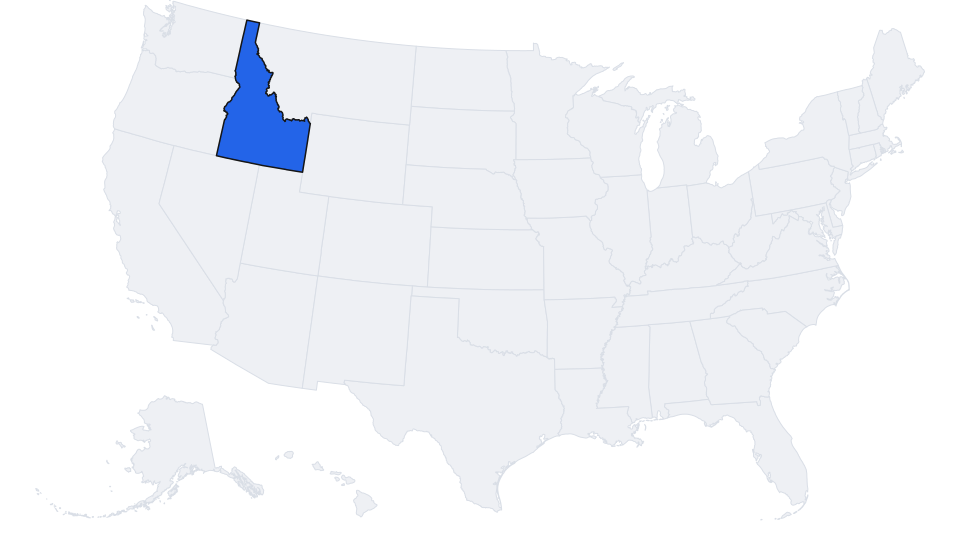
Map of the United States with Idaho highlighted
Tax mechanics

Payroll tax in Idaho

State income tax

Applies

Idaho uses a flat 5.695% individual income tax for tax year 2025 (reduced from 5.8% by HB 40, signed March 2025). The pre-tax stack for an Idaho employee is federal marginal plus 7.65% FICA plus 5.695% state - so a $3,300 healthcare FSA election at a 22% federal bracket saves roughly $1,138 for an Idaho employee versus about $1,050 for the same Florida employee. Matchbook widens the Section 125 contribution guardrails for Idaho because the marginal savings-per-dollar is higher than in no-tax states.

Idaho Unemployment Insurance Tax

Wage base $55,300 (2025); indexed annually

Rate range: 0.281%-5.4% total rate in 2025; standard new employer rate 1.0%; administrative reserve and workforce components included

With a $55,300 wage base, Idaho is one of the states where Section 125 salary reductions produce meaningful employer UI savings below the base - not just FICA. Matchbook's Idaho employer ROI report shows the combined 7.65% FICA plus effective UI rate savings for wages under the UI cap, and steps down to FICA-only above it.

Employer FICA

7.65% / 1.45% split

Employer FICA is 7.65% on wages up to the Social Security wage base ($176,100 in 2025; projected about $183,600 in 2026) and 1.45% above it. Matchbook models this per employee rather than quoting a flat rate.

Employer credits and levers

State and federal credits worth stacking

Credits that most broker ROI decks omit. Matchbook surfaces these in the employer report.

Idaho Investment Tax Credit

3% credit against Idaho corporate or individual income tax for qualified new depreciable tangible personal property used in Idaho. Unused credit carries forward 14 years. A lever worth surfacing alongside benefits planning for Idaho employers deploying capex on facilities, on-site childcare buildout, or wellness infrastructure.

Source →

Idaho Opportunity Scholarship employer match

Employers can match employee contributions to the Idaho Opportunity Scholarship Fund. Contributions qualify for a 50% Idaho income tax credit (up to $500 per individual, $1,000 joint, or 10% of Idaho tax liability for corporations, capped at $5,000). Stacks as an education-adjacent CIT-offset lever alongside the 529 conversation at open enrollment.

Source →

Federal IRC Section 45F (employer-provided childcare)

Federal employer-provided childcare credit. 25% credit with $150K cap in 2025; OBBBA raises it to 40% with $500K cap in 2026, and 50% with $600K cap for small employers. Matchbook surfaces Section 45F alongside the Idaho Investment Tax Credit when an Idaho employer evaluates on-site or sponsored childcare.

Source →

Idaho Broadband Tax Credit

3% Idaho income tax credit on qualifying broadband equipment placed in service in Idaho, stackable with the Investment Tax Credit on the same asset. Relevant for rural Idaho employers building out remote-work or telehealth-capable sites.

Source →

Household programs

State programs that change what your employees should elect

Matchbook coordinates these against DCFSA, FSA, and HSA elections at the household level.

Childcare subsidy

Idaho Child Care Program (ICCP)

State subsidy paying a portion of childcare costs for income-eligible working families, administered by Idaho Department of Health and Welfare. Eligibility generally at or below 130% FPL at entry with higher exit thresholds; parent copay on a sliding scale.

Matchbook: ICCP reduces out-of-pocket dependent-care cost and therefore reduces the correct DCFSA election. Matchbook screens Idaho employees against ICCP thresholds before recommending DCFSA contribution levels.

Source →

Preschool

No universal state pre-K

Idaho has no statewide universal pre-K program. Early childhood support runs through federal Head Start and locally funded collaboratives; 2024 legislation expanded local literacy supports but did not create universal VPK. Dependent-care costs for 3- and 4-year-olds remain largely out-of-pocket.

Matchbook: Idaho DCFSA modeling does not subtract a universal pre-K wrap. Matchbook defaults Idaho families with preschoolers to a higher DCFSA baseline than employees in VPK states like Florida or Oklahoma.

Source →

Health programs

Coverage coordination checkpoints

Idaho Health Plan Coverage (CHIP) and Medicaid for Children

Idaho covers children up to 185% FPL via Medicaid and extends CHIP coverage up to 185% FPL with low monthly premiums. Families above CHIP but below the Marketplace subsidy cliff should be screened at open enrollment.

Matchbook: Employees declining dependent coverage on the employer plan should be screened against Idaho CHIP thresholds before Matchbook defaults to the family tier.

Source →

Your Health Idaho (state-based Marketplace)

Idaho runs its own state-based ACA exchange, Your Health Idaho. 2026 employer-affordability threshold is 9.96% of household income. Enhanced premium tax credits expired at the end of 2025, so 2026 Idaho Marketplace premiums trend up; family-glitch fix still applies.

Matchbook: If employer family coverage exceeds 9.96% of household income, Matchbook routes the Idaho dependent to Your Health Idaho rather than the federal HealthCare.gov flow, because enrollment mechanics and carrier availability differ.

Source →

No state paid family and medical leave

Idaho has no state PFML program and no state disability insurance. Employer-sponsored short-term disability and voluntary paid leave are the only wage-replacement levers during bonding or serious illness.

Matchbook: Matchbook flags voluntary STD and hospital indemnity gaps for Idaho employees more aggressively than in PFML states, because there is no state backstop.

Source →

Retirement and wealth

State-level retirement and wealth context

Idaho ABLE (via STABLE Account partnership)

Idaho residents use the national STABLE Account platform for Section 529A ABLE coverage. 2025 contribution limit $19,000; employed beneficiaries may add up to $15,060 more. $500K balance cap; $100K SSI asset-exclusion cap.

Matchbook: FSA or HSA dollars reimburse medical expenses; ABLE covers broader qualified disability expenses. When SSI asset limits are in play, Matchbook routes Idaho disability-related spend to ABLE first.

Source →

IDeal - Idaho College Savings Program (529)

Idaho taxpayers may deduct up to $6,000 individual / $12,000 joint in IDeal 529 contributions from Idaho taxable income each year. At the 5.695% flat rate, a full joint contribution returns up to about $683 in Idaho tax savings. Unlike many states, the deduction is capped and does not require the contributor to be the account owner.

Matchbook: Matchbook tilts Idaho employees toward IDeal for the first $6,000 / $12,000 of annual 529 contributions to capture the state deduction, then compares alternate-state plans for contributions above the cap.

Source →

Section 132(f) commuter

Pre-tax commuter reality in Idaho

2025 IRC Section 132(f) cap is $325 per month for transit and $325 per month for qualified parking.

Parking and state credits

Parking: Downtown Boise parking typically sits below the $325 monthly cap; most Idaho markets (Idaho Falls, Coeur d'Alene, Pocatello) have parking costs well under the cap, so the 132(f) parking lever is modest outside Boise CBD employers.

State credit: None - Idaho has no state-level commuter tax credit.

Disaster readiness

Idaho disaster-relief playbook

IRC Section 139 qualified disaster relief payments are not W-2 wages: no FICA, no FUTA, no federal income tax withholding, no Idaho withholding, and the employer gets a full deduction. Triggered by a federal disaster declaration, which Idaho regularly qualifies for around wildfires, severe winter storms, and spring flooding.

  • Pre-drafted Section 139 policy template so Idaho employers can disburse tax-free wildfire or flood relief within 48 hours of a federal declaration.
  • Post-event Section 125 election-change guidance: a wildfire or winter storm alone is not a listed change-in-status event under Treas. Reg. 1.125-4 - it qualifies only when it triggers a change in residence, employment, or cost-of-coverage.
  • FEMA Individual Assistance interaction: Section 139 payments generally stack with FEMA IA, but Matchbook flags duplication risks in the disbursement log for Idaho disaster declarations.
  • Idaho-specific employer disaster leave review (Idaho has no statutory paid disaster leave, so employer policy is the governing rule).
Matchbook for Idaho

What we ship specifically for Idaho employers

  • Flat-tax calibration at 5.695% in the employee savings engine - marginal-stack math for Section 125 and 132(f) elections reflects the Idaho layer, widening contribution guardrails versus no-tax states.
  • Idaho Investment Tax Credit and Broadband Credit stacking in the employer ROI report when capex for on-site childcare, clinic, or connectivity is on the table.
  • IDeal 529 cap-aware recommender: tilt the first $6,000 / $12,000 of annual 529 flow into IDeal for the state deduction, then rank alternate-state plans for contributions above the cap.
  • ICCP screener in the DCFSA recommender with no-universal-pre-K defaults for Idaho 3- and 4-year-olds.
  • No-PFML flag in voluntary-benefits modeling: surface STD and hospital indemnity gaps for Idaho employees more aggressively than in PFML states.
  • Your Health Idaho (state-based exchange) routing in the family-glitch and dependent-subsidy flow, distinct from HealthCare.gov mechanics.
  • IRC Section 139 wildfire and winter-storm playbook template with a pre-drafted Idaho employer policy and post-event Section 125 election-change guidance.
  • Benefits graph ingests: Idaho State Tax Commission credit guidance, Idaho Department of Labor UI rate tables, Idaho DHW ICCP eligibility, Your Health Idaho 2026 rate filings, and FEMA DR numbers for Idaho.

Pilot Matchbook with a Idaho-aware engine.

Talk to us about a 30-day pilot calibrated to Idaho payroll, programs, and disaster rules.