State playbook - Florida

Matchbook, tuned for Florida payroll, programs, and hurricanes.

Florida compresses the employee savings stack (no state income tax), caps the employer SUI win (Reemployment Tax wage base is just $7,000), and adds state-specific levers - childcare tax credits, School Readiness, VPK, KidCare, and IRC 139 disaster relief - that most broker ROI decks miss.

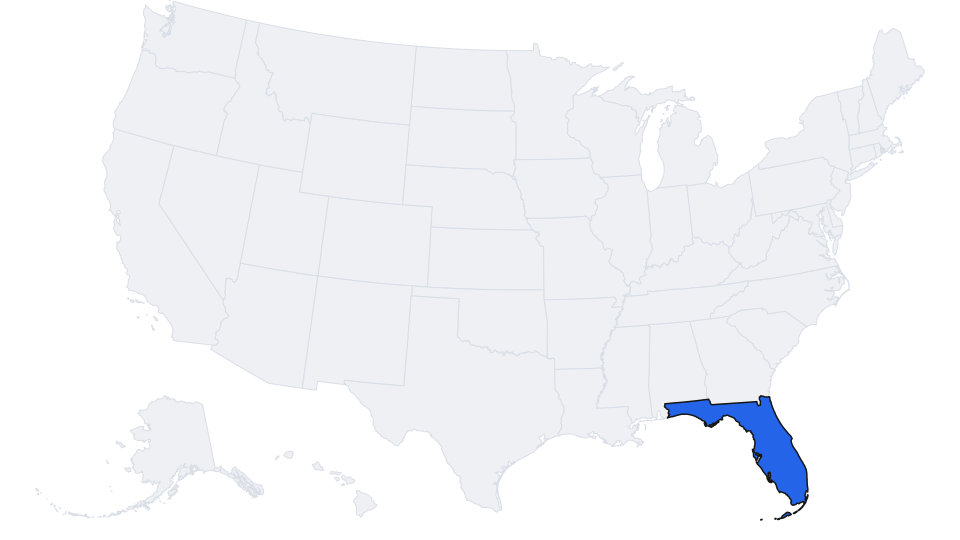
Map of the United States with Florida highlighted
Tax mechanics

Payroll tax in Florida

State income tax

No state income tax

Florida is one of nine states with no personal income tax. Employee pre-tax savings stack is federal marginal rate plus 7.65% FICA only - no state marginal layer. A $3,300 healthcare FSA election saves about $1,050 for a 22% federal bracket Florida employee versus about $1,360 for the same California employee. Matchbook calibrates under-election guardrails tighter for Florida because the marginal cost of forfeiture is unchanged but the savings-per-dollar is lower.

Florida Reemployment Tax

Wage base $7,000 (2026)

Rate range: 0.10%-5.40%; new employer rate 2.70%; about 65% of employers at the 0.10% minimum in 2026

Because the RT wage base is only $7,000, Section 125 salary reductions produce zero employer RT savings for any salaried employee - they cross $7K of YTD wages within weeks. Matchbook suppresses the RT savings line in the Florida employer ROI report for anyone above the base. The only meaningful employer payroll-tax win in Florida is the 7.65% FICA match on Section 125 and Section 132(f) elections.

Employer FICA

7.65% / 1.45% split

Employer FICA is 7.65% on wages up to the Social Security wage base ($176,100 in 2025; projected about $183,600 in 2026) and 1.45% above it. Matchbook models this per employee rather than quoting a flat rate.

Employer credits and levers

State and federal credits worth stacking

Credits that most broker ROI decks omit. Matchbook surfaces these in the employer report.

Florida Child Care Tax Credits Program

Corporate income tax credit for tax years 2024-2026: 50% of startup costs for an eligible on-site childcare facility, $300 per month per enrolled child, or 100% of direct payments to a facility up to $3,600 per child per year. Statewide cap $5M per year. Stacks with federal IRC Section 45F.

Source →

Federal IRC Section 45F (stacks with Florida credit)

Federal employer-provided childcare credit. 25% credit with $150K cap in 2025; rises to 40% with $500K cap in 2026, and 50% with $600K cap for small employers. Matchbook surfaces the combined Florida plus federal modeled benefit when an employer evaluates on-site care.

Source →

Florida Tax Credit Scholarship (Step Up For Students)

Dollar-for-dollar Florida corporate income tax credit for donations to K-12 scholarships. 2024-25 program cap $1.09B. A CIT-offset lever worth flagging alongside the childcare credit for Florida employers with state tax liability.

Source →

Household programs

State programs that change what your employees should elect

Matchbook coordinates these against DCFSA, FSA, and HSA elections at the household level.

Childcare subsidy

School Readiness

Subsidized childcare for income-qualifying families. As of October 1, 2025, eligibility widened from 150% FPL to at or below 55% State Median Income at entry, and at or below 85% SMI at redetermination, expanding eligibility by about 130,000 children.

Matchbook: School Readiness reduces out-of-pocket dependent-care cost and therefore reduces the right DCFSA election. Matchbook asks Florida employees whether they qualify before recommending DCFSA contribution levels.

Source →

Preschool

Voluntary Prekindergarten (VPK)

Universal free program for Florida 4-year-olds: 540 hours school-year or 300 hours summer. Only about three hours per day, so wrap-around care remains DCFSA-eligible.

Matchbook: The correct DCFSA election for a Florida VPK family is the full-day center cost minus the VPK-funded hours, not zero. Matchbook models this split explicitly.

Source →

Health programs

Coverage coordination checkpoints

Florida KidCare (CHIP)

Subsidized children's health coverage for families between 133%-200% FPL at $15-$20 per month. A 300% FPL expansion was approved by CMS in December 2024 but held up by Florida litigation as of October 2025.

Matchbook: Employees declining dependent coverage on the employer plan should be screened against KidCare thresholds before Matchbook defaults to the family tier.

Source →

Florida Medicaid - post-unwind recovery

Florida disenrolled more than 1.3 million people during Medicaid unwinding, about 64% procedurally. Open enrollment is the right touchpoint to recover procedurally-disenrolled dependents onto employer coverage or Florida KidCare.

Matchbook: Matchbook's Florida screener flags households that may have lost Medicaid for reasons unrelated to eligibility and offers the enrollment path.

Source →

ACA Marketplace (Federally Facilitated Marketplace)

Florida uses the federal exchange. 2026 employer-affordability threshold is 9.96% of household income. Enhanced premium tax credits expired at the end of 2025, so Florida 2026 premiums see double-digit increases. Family-glitch fix still applies.

Matchbook: If employer family coverage exceeds 9.96% of household income, Matchbook surfaces the Marketplace dependent subsidy path - especially material in Florida after the enhanced PTC expiration.

Source →

Retirement and wealth

State-level retirement and wealth context

ABLE United

Florida's Section 529A program for disabled beneficiaries. 2025 contribution limit $19,000; employed beneficiaries may add up to $15,060 more. $500K balance cap; $100K SSI cap.

Matchbook: FSA or HSA dollars reimburse medical expenses; ABLE covers broader qualified disability expenses. When SSI asset limits are in play, Matchbook routes disability-related spend to ABLE first.

Source →

Florida Prepaid / Florida 529

No Florida state income tax deduction exists for 529 contributions because Florida has no state income tax. Florida residents can use any state's 529 plan without penalty; no home-state tilt is needed.

Matchbook: Matchbook does not over-weight Florida Prepaid for Florida employees when evaluating household college-savings strategy.

Source →

Section 132(f) commuter

Pre-tax commuter reality in Florida

2025 IRC Section 132(f) cap is $325 per month for transit and $325 per month for qualified parking.

Parking and state credits

Parking: Miami and Orlando CBD parking frequently approaches or exceeds the $325 monthly cap; Tampa and Jacksonville parking usually sits below the cap.

State credit: None - Florida has no state-level commuter tax credit.

Disaster readiness

Florida disaster-relief playbook

IRC Section 139 qualified disaster relief payments are not W-2 wages: no FICA, no FUTA, no federal income tax withholding, and the employer gets a full deduction. Triggered by a federal disaster declaration, which recent Florida hurricanes (Ian, Idalia, Debby, Helene, Milton, Nicole) have all qualified for.

  • Pre-drafted Section 139 policy template so employers can disburse tax-free relief within 48 hours of a federal declaration.
  • Post-storm Section 125 election-change guidance: a hurricane alone is not a listed change-in-status event under Treas. Reg. 1.125-4 - it qualifies only when it triggers a change in residence, employment, or cost-of-coverage.
  • FEMA Individual Assistance interaction: IRS Section 139 payments generally stack with FEMA IA, but Matchbook flags duplication risks in the disbursement log.
  • Florida-specific employer disaster leave review (Florida has no statutory paid disaster leave, so employer policy is the governing rule).
Matchbook for Florida

What we ship specifically for Florida employers

  • No-state-tax calibration in the employee savings engine - recompute marginal stacks at 0% state and widen DCFSA and FSA under-election guardrails for Florida households.
  • Florida Child Care Credit plus federal IRC Section 45F stacking calculator in the employer ROI report - high leverage for Florida employers with on-site or sponsored childcare.
  • School Readiness and VPK wrap-around logic in the DCFSA recommender, ingesting Florida Early Learning Coalition eligibility rules.
  • Suppress the Reemployment Tax savings line for salaried workers in the Florida employer FICA and SUI report - the $7,000 wage base makes it misleading.
  • IRC Section 139 hurricane playbook template with a pre-drafted employer policy and post-storm Section 125 election-change guidance.
  • KidCare and Medicaid redetermination screener at open enrollment to recover procedurally-disenrolled dependents.
  • Benefits graph ingests: Florida DOR CIT credit allocations, Florida DEO Reemployment Tax rate notices, FLDOE VPK and School Readiness eligibility, FEMA DR numbers for Florida, and FFM 2026 rate filings.

Pilot Matchbook with a Florida-aware engine.

Talk to us about a 30-day pilot calibrated to Florida payroll, programs, and disaster rules.