State playbook - Delaware

Matchbook, tuned for Delaware payroll, PFMLA, and coastal storms.

Delaware stacks a ~6.6% top marginal income tax on top of federal and FICA, runs a small SUI wage base ($12,500 in 2026), and goes live with the Healthy Delaware Families Act (PFMLA) for 25+ employers on January 1, 2026 - a coordination event that reshapes disability, FMLA, and PTO elections at open enrollment.

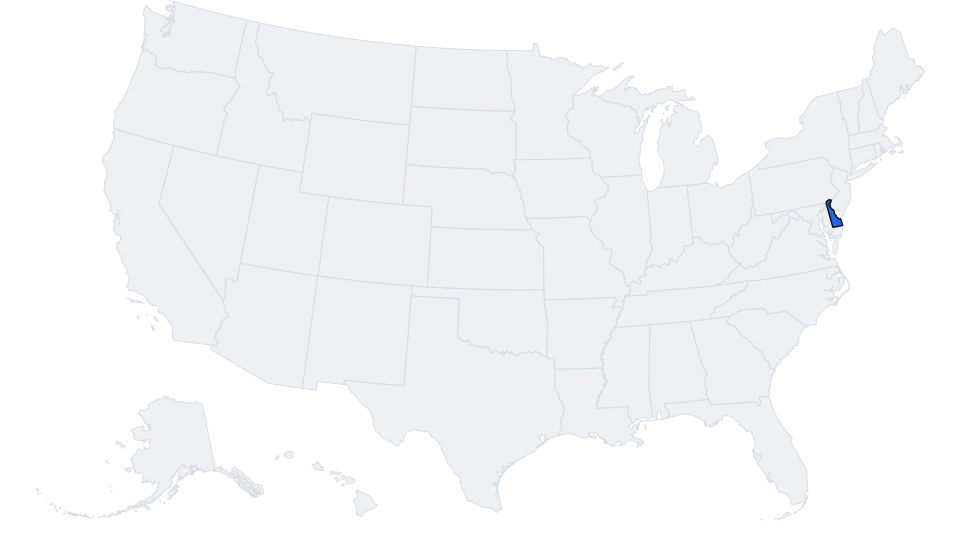
Map of the United States with Delaware highlighted
Tax mechanics

Payroll tax in Delaware

State income tax

Applies

Delaware is a progressive-bracket state with a top marginal rate of 6.60% on income over $60,000 (single or joint). Employees earning $60K+ save the full stack - federal marginal rate plus 7.65% FICA plus 6.60% Delaware - on every Section 125 and Section 132(f) dollar. A $3,300 healthcare FSA election saves about $1,297 for a 22% federal bracket Delaware employee (22% plus 7.65% plus 6.60% equals 36.25%) versus about $1,050 in no-state-tax Florida. Matchbook widens Delaware under-election guardrails because the marginal savings-per-dollar is materially higher.

Delaware Unemployment Insurance (SUI)

Wage base $12,500 (2026)

Rate range: 0.1%-5.4% (2025 schedule); new employer rate 1.2% for non-construction; assessments can layer on top

Delaware's $12,500 SUI wage base means Section 125 salary reductions produce real but capped employer SUI savings only for employees still below $12,500 of YTD wages. Matchbook models the SUI dimension per employee per pay period rather than applying a blanket rate, and never promises SUI savings on salaried employees who cross the base in Q1.

Employer FICA

7.65% / 1.45% split

Employer FICA is 7.65% on wages up to the Social Security wage base ($176,100 in 2025; projected about $183,600 in 2026) and 1.45% above it. Matchbook models this per employee rather than quoting a flat rate.

Employer credits and levers

State and federal credits worth stacking

Credits that most broker ROI decks omit. Matchbook surfaces these in the employer report.

Delaware Research and Development Tax Credit

Refundable state credit equal to 10% of Delaware-apportioned QREs above the base amount, or 50% of the federal alternative simplified credit apportioned to Delaware. Small businesses (under $20M in gross receipts) get doubled rates. Annual $5M program cap, allocated pro-rata.

Source →

Delaware Blue Collar Jobs Tax Credit

Credit against corporate or personal income tax and gross receipts tax for qualified employers creating at least five new jobs and investing $200,000 ($40,000 per job) in qualified facilities. Bonus credits stack in targeted industries or in targeted areas. Worth flagging alongside Matchbook onboarding and retention modeling for Delaware manufacturers and logistics employers.

Source →

Delaware Historic Preservation Tax Credit

Transferable state credit of 20%-30% of qualified rehabilitation expenditures on certified historic structures, with bonus allocations for resident curator and low-income housing projects. Useful for employers weighing headquarters or facility investments in Wilmington, Dover, or New Castle historic districts.

Source →

Household programs

State programs that change what your employees should elect

Matchbook coordinates these against DCFSA, FSA, and HSA elections at the household level.

Childcare subsidy

Delaware Purchase of Care (POC)

Delaware's federal CCDBG-funded childcare subsidy administered by DHSS Division of Social Services. Eligibility generally up to 200% FPL for families with a qualifying work, training, or education need; parent copay on a sliding scale. Covers licensed centers and family childcare homes.

Matchbook: POC reduces a Delaware household's out-of-pocket dependent-care cost and therefore reduces the right DCFSA election. Matchbook asks Delaware employees whether they are enrolled in POC before recommending DCFSA contribution levels, and flags households near the 200% FPL threshold for a DCFSA-versus-subsidy comparison.

Source →

Preschool

Delaware Early Childhood Assistance Program (ECAP)

Delaware's state-funded Head Start-model program for income-eligible 3- and 4-year-olds, typically a partial-day school-year schedule. Operated through DOE in partnership with community providers.

Matchbook: ECAP rarely covers full working-parent hours, so DCFSA dollars still apply to wrap-around care. Matchbook models the correct DCFSA election as full-day cost minus ECAP-covered hours, not zero.

Source →

Paid leave

Healthy Delaware Families Act (PFMLA) - effective January 1, 2026

Delaware Paid Family and Medical Leave: up to 12 weeks of paid parental leave and up to 6 weeks in a 24-month period for medical, family caregiving, or qualified exigency leave. Mandatory for employers with 25+ employees in Delaware (parental only for 10-24). Contributions began January 1, 2025; benefits start January 1, 2026. Combined premium 0.8% of wages up to the Social Security base, splittable up to 50% to employees.

Matchbook: PFMLA is the single biggest 2026 coordination event for Delaware employers. Matchbook recalibrates short-term disability, FMLA, and PTO stacking so employees don't double-elect paid leave and STD, and flags employers who should lower STD elimination periods or renegotiate STD rates to reflect PFMLA as first-payer.

Source →

Health programs

Coverage coordination checkpoints

Delaware Healthy Children Program (CHIP) and Medicaid

Delaware Medicaid covers children up to 217% FPL. The Delaware Healthy Children Program (CHIP) covers children from 217% up to 222% FPL (higher under continuous eligibility rules) with monthly premiums by income tier. Administered by DHSS Division of Medicaid and Medical Assistance.

Matchbook: Employees declining dependent coverage on the employer plan should be screened against Medicaid and Delaware Healthy Children thresholds before Matchbook defaults to the family tier. Delaware's relatively generous thresholds often beat employer family-tier economics for lower-paid workers.

Source →

ACA Marketplace (Federally Facilitated Marketplace)

Delaware uses the federal exchange (HealthCare.gov) after winding down its state-based marketplace. 2026 employer-affordability threshold is 9.96% of household income. Enhanced premium tax credits expired at the end of 2025, so Delaware 2026 premiums see meaningful increases. Family-glitch fix still applies.

Matchbook: If employer family coverage exceeds 9.96% of household income, Matchbook surfaces the Marketplace dependent subsidy path - especially material in Delaware after enhanced PTC expiration, and doubly so for households where a working spouse is otherwise routed to a more expensive employer plan.

Source →

Retirement and wealth

State-level retirement and wealth context

DEPENDABLE (Delaware ABLE)

Delaware's Section 529A program for disabled beneficiaries, administered via the National ABLE Alliance. 2025 contribution limit $19,000; employed beneficiaries may add up to $15,060 more. $500K balance cap; $100K SSI asset-disregard cap.

Matchbook: FSA or HSA dollars reimburse medical expenses; DEPENDABLE covers broader qualified disability expenses. When SSI asset limits are in play, Matchbook routes disability-related spend to DEPENDABLE first.

Source →

Delaware 529 (DE529 Education Savings Plan)

Delaware allows a state income tax deduction for 529 contributions: up to $1,000 per taxpayer per year ($2,000 for joint filers), phased down above $200,000 AGI ($400,000 joint). Deduction is limited to contributions made to the DE529 Plan (home-state plan required).

Matchbook: Matchbook applies the DE529 home-state tilt in Delaware for households under the AGI phase-down. Above the phase-down, the deduction evaporates and any state's 529 is equivalent - Matchbook stops steering toward DE529 at that income level.

Source →

Section 132(f) commuter

Pre-tax commuter reality in Delaware

2025 IRC Section 132(f) cap is $325 per month for transit and $325 per month for qualified parking.

Parking and state credits

Parking: Wilmington CBD monthly parking typically runs $180-$280 and sits under the $325 cap; SEPTA Regional Rail Wilmington-to-Philadelphia monthly passes plus parking can cluster near the combined cap for reverse commuters.

State credit: None - Delaware has no state-level commuter tax credit layered on top of Section 132(f).

Disaster readiness

Delaware disaster-relief playbook

IRC Section 139 qualified disaster relief payments are not W-2 wages: no FICA, no FUTA, no federal income tax withholding, and the employer gets a full deduction. Triggered by a federal disaster declaration. Delaware exposure is coastal storms, nor'easters, tidal flooding along the Delaware Bay and Atlantic coast (Sussex and Kent), and remnants of tropical systems reaching the Mid-Atlantic.

  • Pre-drafted Section 139 policy template so Delaware employers can disburse tax-free relief within 48 hours of a federal declaration (for example a nor'easter or hurricane remnant hitting Sussex County).
  • Post-storm Section 125 election-change guidance: a coastal storm alone is not a listed change-in-status event under Treas. Reg. 1.125-4 - it qualifies only when it triggers a change in residence, employment, or cost-of-coverage.
  • FEMA Individual Assistance interaction: IRS Section 139 payments generally stack with FEMA IA, but Matchbook flags duplication risks in the disbursement log.
  • Delaware PFMLA interaction: qualified exigency leave under PFMLA is distinct from Section 139 disaster cash relief - Matchbook's disaster runbook keeps the two tracks separate in the employer comms template.
Matchbook for Delaware

What we ship specifically for Delaware employers

  • Progressive-bracket calibration in the employee savings engine - recompute marginal stacks at Delaware's 6.60% top rate and widen DCFSA, HSA, and FSA under-election guardrails for Delaware households above $60K.
  • PFMLA 2026 ramp playbook: short-term disability election-change runbook, STD-elimination-period recalibration, PTO bank disclosure, and employer-side premium-split decisions before January 1, 2026.
  • Delaware R&D and Blue Collar Jobs credit stacking calculator in the employer ROI report for Delaware manufacturers, pharma, and bio employers.
  • SUI savings line modeled per-employee against the $12,500 wage base rather than assuming full-year SUI savings on salaried employees.
  • Purchase of Care and ECAP wrap-around logic in the DCFSA recommender, ingesting DHSS and DOE eligibility rules for Delaware households.
  • Delaware Healthy Children (CHIP) and Medicaid screener at open enrollment to route lower-paid households away from employer family-tier premiums when appropriate.
  • IRC Section 139 coastal-storm and nor'easter playbook template with a pre-drafted employer policy and post-storm Section 125 election-change guidance.
  • DE529 home-state tilt below the AGI phase-down, with automatic neutrality above it.
  • Benefits graph ingests: Delaware Division of Revenue credit allocations, Delaware DOL SUI and PFMLA rate notices, DHSS POC and CHIP eligibility, DOE ECAP eligibility, FEMA DR numbers for Delaware, and FFM 2026 rate filings.

Pilot Matchbook with a Delaware-aware engine.

Talk to us about a 30-day pilot calibrated to Delaware payroll, programs, and disaster rules.