State playbook - Connecticut

Matchbook, tuned for Connecticut payroll, PFMLA, and programs.

Connecticut stacks a 2%-6.99% progressive income tax on top of federal and FICA, adds a 0.5% employee-funded Paid Leave payroll assessment, and runs a dense layer of state-specific levers - Care 4 Kids, HUSKY, Access Health CT, CHET 529, and employer credits for apprenticeships and human capital investment - that a generic benefits platform misses.

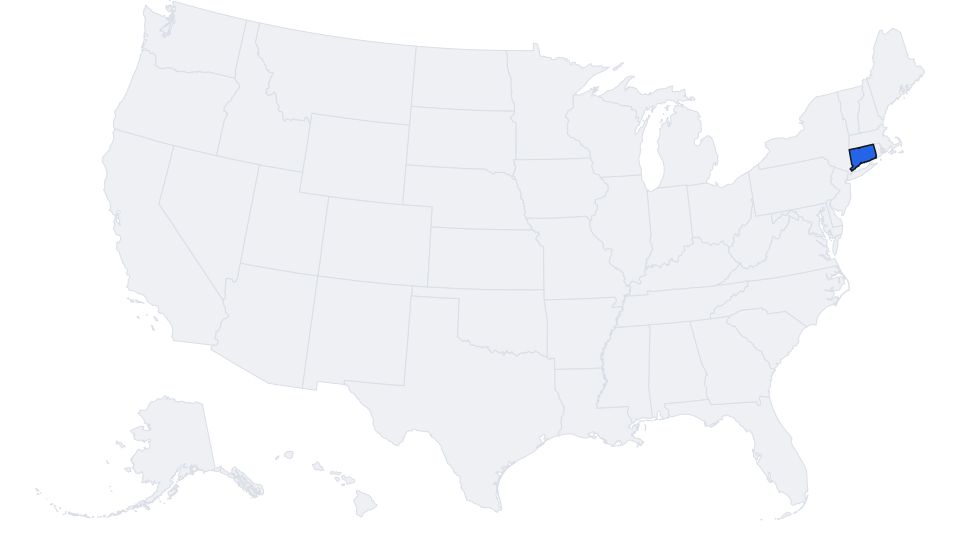
Map of the United States with Connecticut highlighted
Tax mechanics

Payroll tax in Connecticut

State income tax

Applies

Connecticut runs a progressive income tax with seven brackets from 2% to 6.99% for 2025 and 2026. The 2024 rate cut dropped the 5% bracket to 4.5% and the 3% bracket to 2% for the bottom of each filer's income, the first CT income-tax rate reduction since the tax was enacted in 1991. A CT employee in the 5.5% effective marginal band saves roughly federal plus 7.65% FICA plus 5.5% CT plus 0.5% CT PFMLA on every Section 125 dollar - meaningfully wider than the federal-only stack in no-tax states. Matchbook recalibrates the under-election guardrails upward for Connecticut households because the marginal cost of forfeiture is offset by a richer savings-per-dollar yield.

Connecticut Unemployment Insurance Tax

Wage base $26,100 (2025); indexed annually to 0.5 times the state average annual wage

Rate range: 1.1%-7.8% experience-rated; new employer rate 2.5% for 2025; solvency surcharge continues per CTDOL notice

Connecticut's wage base is indexed and rose from a long-frozen $15,000 to $25,000 in 2024 and $26,100 in 2025 under Public Act 21-5. The larger base means Section 125 and Section 132(f) salary reductions actually produce employer UI savings on a larger share of the workforce than in low-base states like Florida. Matchbook models the CT UI match per employee against current YTD wages rather than flat-lining it.

Employer FICA

7.65% / 1.45% split

Employer FICA is 7.65% on wages up to the Social Security wage base ($176,100 in 2025; projected about $183,600 in 2026) and 1.45% above it. Matchbook models this per employee rather than quoting a flat rate. The CT Paid Leave employee contribution is 0.5% of wages up to the Social Security wage base and is a post-FICA deduction, not a pre-tax line.

Employer credits and levers

State and federal credits worth stacking

Credits that most broker ROI decks omit. Matchbook surfaces these in the employer report.

Connecticut Human Capital Investment Credit

5% corporation business tax credit for qualifying human capital expenditures including in-state job training, work education programs, donations to higher education for technology and equipment, planning and construction of daycare facilities, and childcare subsidies paid on behalf of employees. Nonrefundable; carryforward available. A direct lever for employers funding dependent care assistance programs or on-site childcare in CT.

Source →

Connecticut Apprenticeship Training Tax Credit

Corporation business tax credit of up to $7,500 or 50% of wages paid to qualified apprentices in manufacturing, plastics, construction, and related trades. Requires a registered apprenticeship with the CT Department of Labor Office of Apprenticeship Training. Stacks with the federal Work Opportunity Tax Credit for eligible hires.

Source →

Connecticut Neighborhood Assistance Act (NAA) Tax Credit

60% credit (100% for qualifying energy conservation projects) for corporate contributions to approved community programs including childcare, employment training, and affordable housing. Statewide annual cap $5M; minimum contribution $250. Applications filed through municipalities; CT DRS allocates credits by October each year.

Source →

Federal IRC Section 45F (stacks with CT Human Capital Credit)

Federal employer-provided childcare credit. 25% credit with $150K cap in 2025; rises to 40% with $500K cap in 2026, and 50% with $600K cap for small employers. Matchbook surfaces the combined CT Human Capital Investment plus federal 45F modeled benefit when a CT employer evaluates on-site or sponsored care.

Source →

Household programs

State programs that change what your employees should elect

Matchbook coordinates these against DCFSA, FSA, and HSA elections at the household level.

Childcare subsidy

Care 4 Kids

Connecticut's federally-funded childcare subsidy for low and moderate income working families. Income eligibility at entry up to 60% State Median Income, up to 75% SMI at redetermination; copays capped at 7% of household income under federal 2024 CCDBG rules. Administered by CT Office of Early Childhood.

Matchbook: Care 4 Kids reduces out-of-pocket dependent care cost and therefore reduces the right DCFSA election. Matchbook screens CT employees against Care 4 Kids thresholds before recommending DCFSA contribution levels, and surfaces the interaction with CT Paid Leave bonding leave.

Source →

Preschool

Connecticut Smart Start / CT Preschool

State-funded preschool expansion through the CT Office of Early Childhood including Smart Start, School Readiness, and Child Day Care Contracts. The 2024 Blue Ribbon Panel on Child Care recommendations drove continued expansion in the FY2026-27 biennium toward universal access for 3 and 4 year olds.

Matchbook: Part-day preschool programs in CT typically require wrap-around care that remains DCFSA-eligible. Matchbook models the split between state-funded preschool hours and full-day center cost rather than zeroing out DCFSA for CT preschool families.

Source →

Paid leave

Connecticut Paid Family and Medical Leave (CT PFMLA)

Employee-funded 0.5% payroll contribution up to the Social Security wage base, administered by the CT Paid Leave Authority. Up to 12 weeks of wage replacement (14 for pregnancy-related incapacity) at up to 95% of base weekly earnings capped at 60 times the CT minimum wage. Job protection is provided separately by the CT FMLA law, not the wage-replacement program.

Matchbook: CT PFMLA coordination is a Matchbook-critical workflow: the 0.5% is post-tax and does not reduce the Section 125 stack, but it interacts with short-term disability elections, employer top-up policies, and parental leave planning. Matchbook models PFMLA-plus-STD-plus-employer-top-up as a single replacement curve and flags double-dip or gap risk at open enrollment.

Source →

Health programs

Coverage coordination checkpoints

HUSKY Health (CT Medicaid and CHIP)

HUSKY A (Medicaid for children, parents, pregnant people), HUSKY B (CHIP for children up to 323% FPL with tiered premiums), HUSKY C (Medicaid for aged, blind, disabled), HUSKY D (Medicaid expansion adults up to 138% FPL). Administered by CT Department of Social Services.

Matchbook: Employees declining dependent coverage on the employer plan should be screened against HUSKY B thresholds before Matchbook defaults to the family tier. HUSKY B at 323% FPL is materially wider than most states and changes the right answer for CT households between 200% and 323% FPL.

Source →

Access Health CT (state-based ACA Marketplace)

Connecticut runs its own state-based exchange. 2026 employer-affordability threshold is 9.96% of household income. Enhanced federal premium tax credits expired at the end of 2025; CT continues a state-funded Covered Connecticut program for residents up to 175% FPL with zero premium and zero cost-sharing on qualifying silver plans.

Matchbook: If employer family coverage exceeds 9.96% of household income, Matchbook surfaces the Access Health CT dependent subsidy path, and the Covered Connecticut path for lower-income households where employer coverage is unaffordable. Family-glitch fix applies.

Source →

Retirement and wealth

State-level retirement and wealth context

ABLE CT

Connecticut's Section 529A program for disabled beneficiaries, administered in partnership with the National ABLE Alliance. 2025 contribution limit $19,000; employed beneficiaries may add up to $15,060 more under ABLE to Work. $550K Connecticut account balance cap; $100K SSI asset exclusion.

Matchbook: FSA or HSA dollars reimburse medical expenses; ABLE CT covers broader qualified disability expenses and receives a CT income tax deduction on the same terms as CHET contributions when funded by the account owner. When SSI asset limits are in play, Matchbook routes disability-related spend to ABLE CT first.

Source →

Connecticut Higher Education Trust (CHET) 529

Connecticut offers a state income tax deduction of up to $5,000 per year for single filers and $10,000 for married filing jointly on contributions to CHET, with a five-year carryforward on amounts exceeding the annual cap. Direct-sold CHET plan administered by Fidelity.

Matchbook: CHET carries a meaningful in-state tilt because of the deduction. Matchbook weights CHET as the default 529 for Connecticut employees in the household recommender unless an out-of-state plan's cost or fund selection advantage clearly exceeds the 4.5%-6.99% marginal deduction value.

Source →

Section 132(f) commuter

Pre-tax commuter reality in Connecticut

2025 IRC Section 132(f) cap is $325 per month for transit and $325 per month for qualified parking.

Parking and state credits

Parking: Stamford and downtown Hartford CBD parking frequently approaches or exceeds the $325 monthly cap; New Haven and Bridgeport parking usually sits below the cap. Metro-North New Haven Line monthly commutation from Stamford to Grand Central runs well above the $325 transit cap and truncates the pre-tax benefit.

State credit: None - Connecticut has no state-level commuter tax credit, though CT DOT operates programs like CTrides to support employer commute plans.

Disaster readiness

Connecticut disaster-relief playbook

IRC Section 139 qualified disaster relief payments are not W-2 wages: no FICA, no FUTA, no federal income tax withholding, and the employer gets a full deduction. Triggered by a federal disaster declaration, which recent Connecticut events - Superstorm Sandy (2012), the August 2024 severe storms and flooding, and periodic nor'easters and ice storms - have qualified for.

  • Pre-drafted Section 139 policy template so CT employers can disburse tax-free relief within 48 hours of a federal declaration.
  • Post-storm Section 125 election-change guidance: a nor'easter or ice storm alone is not a listed change-in-status event under Treas. Reg. 1.125-4 - it qualifies only when it triggers a change in residence, employment, or cost-of-coverage.
  • FEMA Individual Assistance interaction: IRS Section 139 payments generally stack with FEMA IA, but Matchbook flags duplication risks in the disbursement log.
  • CT PFMLA coordination during declared disasters: CT PFMLA is not a disaster leave program, but may apply if a covered family member's serious health condition is caused by the event. Matchbook separates PFMLA-eligible leave from employer-granted disaster paid time off in the disbursement log.
Matchbook for Connecticut

What we ship specifically for Connecticut employers

  • Progressive-bracket calibration in the employee savings engine - recompute marginal stacks at the employee's CT bracket (2%, 4.5%, 5.5%, 6%, 6.5%, 6.9%, 6.99%) plus the 0.5% post-tax PFMLA line, and widen DCFSA and FSA under-election guardrails for CT households.
  • CT Human Capital Investment Credit plus federal IRC Section 45F stacking calculator in the employer ROI report - high leverage for CT employers funding childcare or employee training.
  • Care 4 Kids and CT Preschool wrap-around logic in the DCFSA recommender, ingesting CT Office of Early Childhood eligibility rules.
  • CT PFMLA coordination workflow: layer the 0.5% employee contribution, state wage-replacement curve, employer short-term disability, and employer top-up into a single replacement model at open enrollment.
  • HUSKY B screener at 323% FPL to recover dependents who should not be on the employer family tier.
  • CHET 529 default for CT residents in the household college-savings recommender, with the $5K/$10K deduction value modeled at the employee's CT bracket.
  • IRC Section 139 nor'easter and hurricane playbook template with pre-drafted employer policy and post-storm Section 125 election-change guidance.
  • Benefits graph ingests: CT DRS credit allocations, CTDOL UI rate notices, OEC Care 4 Kids and preschool eligibility, CT Paid Leave Authority rate and benefit tables, Access Health CT 2026 rate filings, and FEMA DR numbers for Connecticut.

Pilot Matchbook with a Connecticut-aware engine.

Talk to us about a 30-day pilot calibrated to Connecticut payroll, programs, and disaster rules.