State playbook - Arkansas

Matchbook, tuned for Arkansas payroll, ARKids, and tornado alley.

Arkansas cut the top marginal rate to 3.9% (Act 1 of the 2024 Second Extraordinary Session), caps the employer SUI win at a $7,000 wage base, and stacks ARKids First, ARHOME (with a 2027 work requirement returning), the Arkansas Brighter Future 529 deduction, and a $500K-per-year childcare facility credit - levers a generic national broker deck never models.

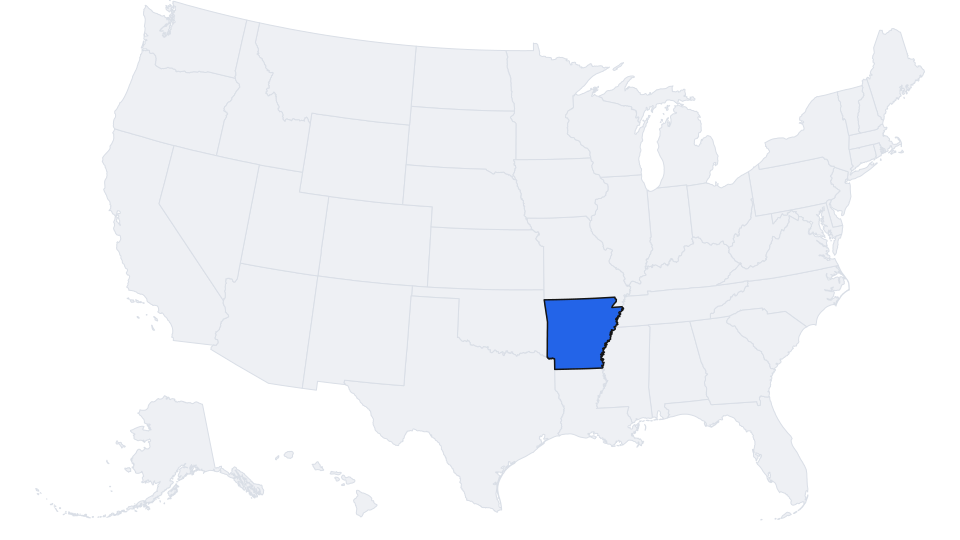
Map of the United States with Arkansas highlighted
Tax mechanics

Payroll tax in Arkansas

State income tax

Applies

Arkansas has a graduated individual income tax with a top marginal rate of 3.9% for tax years 2025 and 2026, down from 4.9% in 2023. The stack for a pre-tax dollar is federal marginal plus 7.65% FICA plus 3.9% state at the top bracket, so a $3,300 healthcare FSA election saves about $1,180 for a 22% federal bracket Arkansas employee. Matchbook recomputes the marginal stack at 3.9% (not a flat 4.9% or 5.0% that older state tables still show) and widens DCFSA and FSA under-election guardrails for mid-income Arkansas households where the state layer is material.

Arkansas Division of Workforce Services Unemployment Insurance

Wage base $7,000 (2026)

Rate range: 0.1%-5.0% plus stabilization rate; new employer rate 3.1% (reduced under Act 196 of 2023)

The Arkansas UI wage base is locked at $7,000 as long as the UI Trust Fund sits above $600M at June 30, with statutory increments capped at $2,000 per year (Act 196 of 2023). Because the wage base is so low, Section 125 salary reductions deliver zero employer UI savings for any salaried worker - they clear $7K of YTD wages in the first few pay periods. Matchbook suppresses the Arkansas UI savings line in the employer ROI report for anyone above the base and models the full 7.65% FICA match as the only meaningful payroll-tax win.

Employer FICA

7.65% / 1.45% split

Employer FICA is 7.65% on wages up to the Social Security wage base ($176,100 in 2025; projected about $183,600 in 2026) and 1.45% above it. Matchbook models this per employee rather than quoting a flat rate.

Employer credits and levers

State and federal credits worth stacking

Credits that most broker ROI decks omit. Matchbook surfaces these in the employer report.

Arkansas employer-provided childcare credit (A.C.A. 26-51-508)

Income tax credit for employers that construct, renovate, expand, or repair an on-site childcare facility or provide childcare benefits for employees. Credit is capped at $500,000 per employer per year; a licensed provider may claim up to $25,000. Statewide annual cap is $15M, with $3.75M reserved for rural employers and small businesses. Stacks with federal IRC Section 45F.

Source →

Federal IRC Section 45F (stacks with Arkansas credit)

Federal employer-provided childcare credit. 25% credit with $150K cap in 2025; rises to 40% with $500K cap in 2026, and 50% with $600K cap for small employers. Matchbook surfaces the combined Arkansas plus federal modeled benefit when an employer evaluates on-site or sponsored care.

Source →

Arkansas Youth Apprenticeship / Work-Based Learning credit (A.C.A. 26-51-509)

Income tax credit of $2,000 or 10% of wages paid per qualifying youth apprentice, whichever is less, capped at $10,000 per employer per year. Requires certification from the Office of Skills Development or the U.S. Office of Apprenticeship. Relevant to Arkansas manufacturing, healthcare, and trades employers building pipeline programs.

Source →

InvestArk sales and use tax credit (Consolidated Incentive Act 182 of 2003)

For established Arkansas businesses (2+ years in state) investing $5M or more at a single location in plant or equipment. Credit equals 0.5% above the sales and use tax rate on eligible project costs, applied against direct-pay sales and use tax liability (capped at 50% of that liability per year; 5-year carryforward). Not a benefits lever directly but a major Arkansas CFO incentive Matchbook flags alongside the childcare credit to protect state tax capacity.

Source →

Household programs

State programs that change what your employees should elect

Matchbook coordinates these against DCFSA, FSA, and HSA elections at the household level.

Preschool

Arkansas Better Chance (ABC) Program

State-funded pre-K for children birth to five, targeted at households up to 200% FPL, administered by the Division of Elementary and Secondary Education. Delivered through school districts and community providers; hours vary by site but most ABC classrooms are part-day, not full workday coverage.

Matchbook: ABC covers part of the day, so Matchbook treats the DCFSA election as full-day care minus ABC-funded hours, not zero. We ingest ABC site hours to compute the wrap-around cost correctly.

Source →

Childcare subsidy

Child Care Assistance / School Readiness Assistance (SRA)

Income-qualifying childcare subsidy. New copay rules took effect October 1, 2025, with updated provider reimbursement rates on November 1, 2025; about 9,763 families saw average monthly copay increases of roughly $211, so the share of care cost families must cover has risen.

Matchbook: The 2025 SRA copay increases shift cost back to households - Matchbook recalibrates the DCFSA recommendation to cover the new parent share, not the pre-October subsidized rate.

Source →

Health programs

Coverage coordination checkpoints

ARKids First (Medicaid and CHIP)

Two-track children's coverage: ARKids A is full-scope Medicaid (no premiums or copays) for lower-income children; ARKids B is the separate CHIP track for children without employer-sponsored coverage who have been uninsured 90+ days or lost coverage involuntarily. Children must be under 19.

Matchbook: Before Matchbook defaults an Arkansas employee to the family tier on the employer plan, it screens the children against ARKids A and ARKids B thresholds. For an involuntary-loss-of-coverage household, ARKids B waives the 90-day uninsured rule.

Source →

ARHOME (Arkansas Medicaid expansion)

Successor to Arkansas Works, covering adults 19-64 using Medicaid dollars to purchase private Marketplace plans. Post-unwind enrollment dropped to about 240,000 by October 2024 with roughly 76% of disenrollments procedural. The five-year renewal is in play in 2025, and a new work requirement (with data-matching rather than self-reporting) is targeted for 2027.

Matchbook: Open enrollment is the right touchpoint to recover procedurally-disenrolled ARHOME adults onto the employer plan or back onto Marketplace coverage. Matchbook flags these households and tees up a 2027 work-requirement readiness reminder.

Source →

Arkansas Health Insurance Marketplace (SBM-FP)

Arkansas runs a state-based exchange on the federal platform (HealthCare.gov) via the Arkansas Insurance Department and Act 107 of 2019. For 2026, Arkansas required insurers to apply Silver loading for the first time, and benchmark premiums jumped from $458 to $774 on average (about 69%, the largest increase in the country), with enhanced federal PTCs expired at end of 2025.

Matchbook: The 2026 Arkansas benchmark shock makes the family-glitch fix and employer-affordability math (9.96% threshold) far more valuable. Matchbook surfaces the Marketplace dependent-subsidy path aggressively for Arkansas households where employer family coverage is above the affordability line.

Source →

Retirement and wealth

State-level retirement and wealth context

Arkansas ABLE Plan

Arkansas's Section 529A program for disabled beneficiaries, administered by the Arkansas Treasurer. Arkansas taxpayers can deduct up to $5,000 (single) or $10,000 (joint) of ABLE contributions from Arkansas AGI, with recapture on non-qualified withdrawals or rollouts to another state's ABLE plan.

Matchbook: When SSI asset limits are in play, Matchbook routes disability-related spend through ABLE first (captures the Arkansas deduction) and reserves HSA or FSA for strictly medical items.

Source →

Arkansas Brighter Future 529 Plan (formerly GIFT Plan)

Arkansas's direct-sold 529, administered by the Arkansas Section 529 Plan Review Committee. Arkansas taxpayers may deduct up to $5,000 (single) or $10,000 (joint) of contributions from Arkansas AGI; contributions above the cap can be carried forward up to four years. In-state plan is required to earn the deduction.

Matchbook: Unlike Florida (no state deduction), Arkansas has a real home-state 529 tilt. Matchbook recommends in-state Brighter Future 529 for Arkansas employees capturing the 3.9% deduction, with a note on the four-year carryforward for lump-sum contributors.

Source →

Section 132(f) commuter

Pre-tax commuter reality in Arkansas

2025 IRC Section 132(f) cap is $325 per month for transit and $325 per month for qualified parking. Arkansas monthly transit passes (Rock Region METRO, Ozark Regional Transit) are well below the cap, so the binding constraint is election behavior, not the statutory limit.

Parking and state credits

Parking: Downtown Little Rock monthly parking typically runs $60-$150, well below the $325 cap. The 132(f) parking benefit is still worth enabling but will rarely be the largest pre-tax line for Arkansas employees.

State credit: None - Arkansas has no state-level commuter or transit pass credit.

Disaster readiness

Arkansas disaster-relief playbook

IRC Section 139 qualified disaster relief payments are not W-2 wages: no FICA, no FUTA, no federal income tax withholding, full deduction to the employer. Triggered by a federal disaster declaration. Arkansas saw DR-4865-AR (March 2025 severe storms and tornadoes) and DR-4873-AR (April 2025 severe storms, tornadoes, and flooding) with Individual Assistance in 16+ counties, plus recurring ice-storm and tornado exposure in the New Madrid and Ouachita corridors.

  • Pre-drafted Section 139 policy template so employers can disburse tax-free relief within 48 hours of an Arkansas federal declaration (tornado, flood, or ice storm).
  • Post-storm Section 125 election-change guidance: a tornado or ice storm alone is not a listed change-in-status event under Treas. Reg. 1.125-4; it qualifies only when it triggers a change in residence, employment, or cost-of-coverage.
  • FEMA Individual Assistance interaction: Section 139 payments generally stack with FEMA IA for Arkansas DR-4865 and DR-4873 recipients, but Matchbook flags duplication risks in the disbursement log.
  • Arkansas-specific employer disaster leave review: Arkansas has no statutory paid disaster leave, so employer policy is the governing rule, and Matchbook surfaces a template aligned with Act 1032 of 2023 emergency declarations.
Matchbook for Arkansas

What we ship specifically for Arkansas employers

  • 3.9%-top-rate calibration in the employee savings engine - recompute marginal stacks at Arkansas's reduced 2025-2026 rate and widen DCFSA and FSA under-election guardrails accordingly.
  • Arkansas childcare facility credit (A.C.A. 26-51-508, $500K cap) plus IRC Section 45F stacking calculator in the employer ROI report for Arkansas employers considering on-site or sponsored care.
  • ABC and School Readiness Assistance wrap-around logic in the DCFSA recommender, with the October 2025 SRA copay changes baked into parent-share calculations.
  • Suppress the UI savings line for salaried workers in the Arkansas employer FICA and SUI report - the $7,000 wage base (Act 196 of 2023) makes it misleading.
  • ARKids A / ARKids B screener before defaulting to family-tier employer coverage, with a 90-day uninsured-rule waiver path for involuntary loss households.
  • ARHOME redetermination screener at open enrollment to recover procedurally-disenrolled adults, plus a 2027 work-requirement readiness reminder.
  • Brighter Future 529 home-state deduction recommender (up to $5K single / $10K joint, four-year carryforward) in the household savings planner.
  • IRC Section 139 tornado / ice-storm playbook template with pre-drafted policy and Arkansas-specific disbursement workflow keyed to FEMA DR numbers.
  • Benefits graph ingests: Arkansas DFA CIT credit allocations, AR DWS UI rate notices, DESE ABC and SRA eligibility and copay tables, ARKids and ARHOME enrollment feeds, AHIM 2026 rate filings, and FEMA DR numbers for Arkansas.

Pilot Matchbook with a Arkansas-aware engine.

Talk to us about a 30-day pilot calibrated to Arkansas payroll, programs, and disaster rules.