State playbook - Alaska

Matchbook, tuned for Alaska payroll, the PFD, and earthquake-and-wildfire country.

Alaska has no state income tax, which compresses the employee pre-tax stack, but it is the only state besides New Jersey and Pennsylvania where employees pay into SUI - and the wage base is $51,700 in 2025, not Florida's $7,000 - so Section 125 salary reductions actually move the employer and employee payroll-tax needle. The Permanent Fund Dividend, Denali KidCare, and IRC 139 earthquake and wildfire relief are levers most broker ROI decks miss.

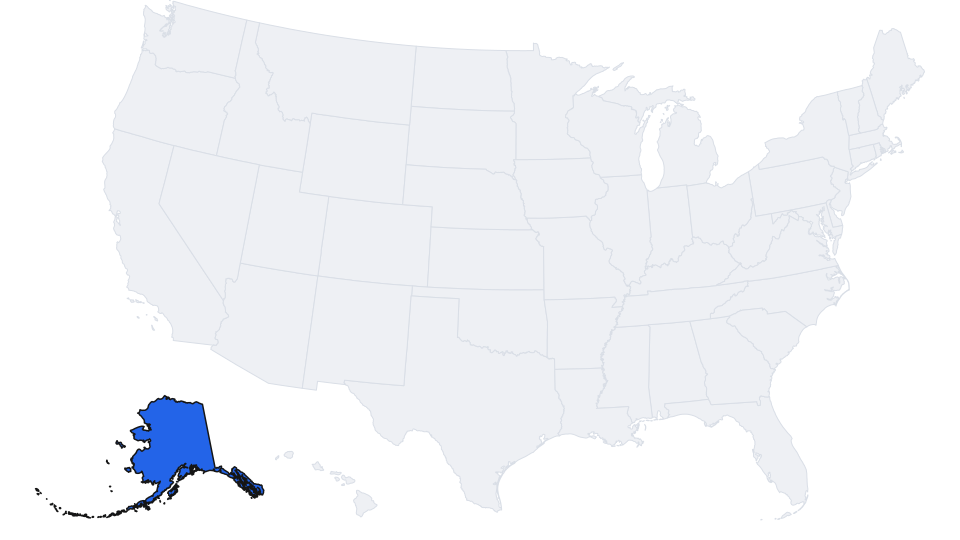
Map of the United States with Alaska highlighted
Tax mechanics

Payroll tax in Alaska

State income tax

No state income tax

Alaska has no personal income tax. The employee pre-tax savings stack is federal marginal rate plus 7.65% FICA plus 0.50% employee SUI (2025) - no state marginal layer. A $3,300 healthcare FSA election saves about $1,080 for a 22% federal bracket Alaska employee versus about $1,360 for the same California employee. Matchbook calibrates under-election guardrails for Alaska the way it does for Florida and other no-income-tax states, but adds the employee SUI line which most no-tax-state models drop.

Alaska Unemployment Insurance (Employment Security Tax)

Wage base $51,700 (2025); $49,700 (2024)

Rate range: Employer rates for 2025 range from 1.00% to 5.40% depending on experience; new employer rate 1.73%. Employees pay 0.50% of wages up to the taxable wage base in 2025.

Alaska is one of only three states (with New Jersey and Pennsylvania) that levies SUI on the employee. Because the wage base is $51,700 in 2025, Section 125 salary reductions produce real employer AND employee SUI savings across the full year for most workers - unlike Florida where the $7,000 base zeroes out by February. Matchbook shows both lines in the Alaska employer ROI report and surfaces the employee-side SUI savings inside each household recommendation.

Employer FICA

7.65% / 1.45% split

Employer FICA is 7.65% on wages up to the Social Security wage base ($176,100 in 2025; projected about $183,600 in 2026) and 1.45% above it. Matchbook models this per employee rather than quoting a flat rate, and adds the Alaska-specific 0.50% employee SUI savings line for Section 125 elections.

Employer credits and levers

State and federal credits worth stacking

Credits that most broker ROI decks omit. Matchbook surfaces these in the employer report.

Alaska Education Tax Credit (AS 43.20.014)

Alaska corporate income taxpayers, insurance premium taxpayers, fisheries business taxpayers, mining license taxpayers, and oil-and-gas taxpayers can claim a credit for cash contributions to Alaska accredited nonprofit colleges and universities, K-12 school districts, vocational education programs, and certain other educational entities. The credit is 50% of contributions up to $100,000 plus 100% of the next $200,000 plus 50% over $300,000, capped at $1 million per taxpayer per year. Extended by SB 189 (2022) through 2024; confirm current-year extension before modeling.

Source →

Federal IRC Section 45F employer-provided childcare credit

Alaska has no state-level employer childcare tax credit, so federal IRC Section 45F is the primary lever. 25% credit with $150K cap in 2025; rises to 40% with $500K cap in 2026, and 50% with $600K cap for small employers under the 2025 tax law changes. Matchbook surfaces the federal modeled benefit when an Alaska employer evaluates sponsored or on-site care, especially relevant given Alaska's documented childcare supply gap.

Source →

Alaska new-employer and experience-rated UI handling

Alaska Department of Labor publishes annual Employment Security Tax rate schedules; new employers pay 1.73% in 2025. Experience rating can push rates to 5.40%. Matchbook pulls each employer's current rate from the DOLWD notice to compute true Section 125 employer SUI savings rather than assuming a default.

Source →

Household programs

State programs that change what your employees should elect

Matchbook coordinates these against DCFSA, FSA, and HSA elections at the household level.

Household income

Alaska Permanent Fund Dividend (PFD)

Annual dividend paid to eligible Alaska residents from the Permanent Fund. 2024 PFD was $1,702 per resident; amounts vary year to year. The PFD is federally taxable and counts as household income for most federal means-tested programs (including ACA premium tax credit MAGI, though a portion of the child PFD can be taxed on the child's return under kiddie tax rules).

Matchbook: Matchbook's Alaska screener adds the expected PFD per household member to projected MAGI before running ACA affordability and KidCare eligibility checks. For a family of four the PFD alone adds around $6,800 of federal AGI - enough to move the needle on premium tax credit cliffs and on the DCFSA-versus-Child-and-Dependent-Care-Credit choice.

Source →

Childcare subsidy

Alaska Child Care Assistance Program (CCAP)

Income-qualifying Alaska families receive subsidized childcare through the Child Care Program Office. Eligibility and copay schedules are published by CCPO and updated periodically. Alaska has widely documented childcare supply shortages, especially outside Anchorage and the Mat-Su, which compresses the practical value of a DCFSA for many bush households.

Matchbook: CCAP reduces out-of-pocket dependent-care cost and therefore reduces the right DCFSA election. Matchbook asks Alaska employees whether they are CCAP-enrolled or eligible before recommending DCFSA contribution levels, and flags families in regions with no licensed care where a DCFSA may not be usable.

Source →

Preschool

Alaska Pre-Elementary and Head Start programs

Alaska does not operate a universal pre-K like Florida's VPK. Pre-elementary services are delivered through a mix of local school district programs, Head Start grantees, and tribal early-learning programs. Hours vary by site; wrap-around care remains DCFSA-eligible when the program is less than full day.

Matchbook: Because Alaska pre-K is not universal, Matchbook does not auto-subtract a set number of hours from the DCFSA recommendation. It asks for the specific program and hours and computes wrap-around need explicitly.

Source →

College savings

Alaska 529 (University of Alaska College Savings Plan / T. Rowe Price)

Alaska has no state income tax, so there is no state income tax deduction for 529 contributions. Alaska residents can use any state's 529 plan without a home-state penalty. The University of Alaska College Savings Plan offers an in-state tuition value guarantee for resident beneficiaries attending UA.

Matchbook: Matchbook does not over-weight the UA plan for Alaska employees on tax grounds. It does surface the UA tuition value guarantee as a household-specific factor when a family expects an in-state UA student.

Source →

Health programs

Coverage coordination checkpoints

Denali KidCare (Alaska CHIP and children's Medicaid)

Combined Medicaid and CHIP program for Alaska children and pregnant individuals. Covers children through age 18 up to 208% FPL and pregnant individuals up to 205% FPL (using Alaska-specific federal poverty guidelines, which are higher than the 48-state levels).

Matchbook: Employees declining dependent coverage on the employer plan should be screened against Denali KidCare thresholds before Matchbook defaults to the family tier. Matchbook applies the Alaska FPL table, not the 48-state table, which materially shifts eligibility.

Source →

Alaska Medicaid

Alaska expanded Medicaid in 2015. Adult expansion coverage runs up to 138% of the Alaska FPL. Alaska processes redeterminations through the Division of Public Assistance; Alaska-specific unwinding outcomes are published by DPA.

Matchbook: Matchbook's Alaska screener flags households that may have lost Medicaid for procedural reasons and surfaces either re-enrollment or employer dependent-tier enrollment as appropriate during open enrollment.

Source →

ACA Marketplace (Federally Facilitated Marketplace) for Alaska

Alaska uses the federal exchange at healthcare.gov. 2026 employer-affordability threshold is 9.96% of household income. Alaska has a long-running state reinsurance waiver (1332) that has suppressed individual-market premium growth, but enhanced premium tax credits expired at the end of 2025 so 2026 net premiums rise for many households.

Matchbook: If employer family coverage exceeds 9.96% of Alaska household income (including expected PFD), Matchbook surfaces the Marketplace dependent subsidy path. The family-glitch fix remains in effect.

Source →

Retirement and wealth

State-level retirement and wealth context

Federal ABLE accounts for Alaska residents

Alaska does not sponsor its own ABLE plan. Alaskans with qualifying disabilities enroll in another state's ABLE program (most plans are open to non-residents). 2025 contribution limit $19,000; employed beneficiaries may add up to $15,060 more under ABLE to Work. $100K SSI asset cap.

Matchbook: Because Alaska has no state ABLE and no state income tax deduction at stake, Matchbook selects among out-of-state ABLE plans by fees and investment lineup, not by home-state tax. FSA or HSA funds still come first for IRC 213(d) medical; ABLE covers broader qualified disability expenses.

Source →

Alaska 529 - tax treatment

With no Alaska personal income tax, 529 contributions generate no state deduction. Federal rules (including the 2024 Secure 2.0 529-to-Roth rollover and K-12 tuition use up to $10,000 per year) apply normally.

Matchbook: Matchbook treats 529 funding for Alaska households as a federally-driven decision and does not assume a home-state tax tilt when sequencing HSA, 401(k), and 529 contributions.

Source →

Section 132(f) commuter

Pre-tax commuter reality in Alaska

2025 IRC Section 132(f) cap is $325 per month for transit passes and vanpools and $325 per month for qualified parking.

Parking and state credits

Parking: Alaska transit is thin outside Anchorage and Juneau, so the commuter benefit in practice is mostly qualified parking. Anchorage and Juneau downtown garage rates generally sit well below the $325 cap, so Matchbook sets conservative default elections and flags vanpool formation as the more common Section 132(f) use case on the North Slope and in remote work camps.

State credit: None - Alaska has no state-level commuter tax credit.

Disaster readiness

Alaska disaster-relief playbook

IRC Section 139 qualified disaster relief payments are not W-2 wages: no FICA, no FUTA, no federal income tax withholding, and the employer gets a full deduction. Triggered by a federal disaster declaration. Recent Alaska qualifying events include the November 2018 Anchorage earthquake, repeated wildfire seasons, 2022 ex-Typhoon Merbok in western Alaska, and 2024 severe storms and landslides.

  • Pre-drafted Section 139 policy template so Alaska employers can disburse tax-free relief within 48 hours of a federal declaration covering earthquakes, wildfires, severe storms, or flooding.
  • Post-event Section 125 election-change guidance: a disaster alone is not a listed change-in-status event under Treas. Reg. 1.125-4 - it qualifies only when it triggers a change in residence, employment, or cost-of-coverage.
  • FEMA Individual Assistance interaction: IRS Section 139 payments generally stack with FEMA IA, but Matchbook flags duplication risks in the disbursement log. Alaska DR numbers (for example DR-4413 Anchorage earthquake, DR-4672 Merbok) feed the benefits graph.
  • Alaska-specific employer disaster leave review (Alaska has no statutory paid disaster leave, so employer policy is the governing rule), plus evacuation-travel cost handling for bush communities.
Matchbook for Alaska

What we ship specifically for Alaska employers

  • No-state-income-tax plus employee SUI calibration - recompute marginal stacks at 0% state income tax but add the 0.50% (2025) employee SUI line to each Section 125 recommendation, which Florida and Texas models do not include.
  • PFD MAGI adjustment in the household screener - add expected PFD per household member before running ACA affordability, Denali KidCare, and DCFSA-versus-CDCC logic.
  • Alaska Education Tax Credit modeling in the employer ROI report for CIT, insurance premium tax, fisheries business tax, mining license tax, and oil-and-gas taxpayers, including the tiered 50/100/50 structure up to the $1M cap.
  • Employer plus employee SUI savings surfaced separately for Alaska Section 125 elections because the $51,700 wage base makes both meaningful, unlike low-base states.
  • Denali KidCare eligibility using Alaska-specific FPL tables, not 48-state tables, with CCAP cross-check before DCFSA recommendations.
  • IRC Section 139 earthquake, wildfire, and severe-storm playbook with pre-drafted employer policy and post-event Section 125 election-change guidance tuned to Alaska hazard profile.
  • Commuter defaults that bias toward qualified parking and vanpool Section 132(f) use rather than transit, and explicit handling of North Slope and remote-camp rotations.
  • Benefits graph ingests: Alaska DOR Education Tax Credit filings, Alaska DOLWD ES tax rate notices, DHSS Denali KidCare and Medicaid thresholds, Alaska Department of Revenue PFD amount announcements, and FEMA DR numbers for Alaska.

Pilot Matchbook with a Alaska-aware engine.

Talk to us about a 30-day pilot calibrated to Alaska payroll, programs, and disaster rules.