State playbook - Alabama

Matchbook, tuned for Alabama payroll, childcare credits, and tornado season.

Alabama stacks a 5% top-bracket state income tax on pre-tax elections, opens a new 75% to 100% employer childcare credit (2025-2027) that pairs with federal IRC 45F, and keeps the Reemployment Tax wage base at $8,000 - so Matchbook suppresses employer SUI savings for most salaried workers while widening the employee savings stack for Alabama households.

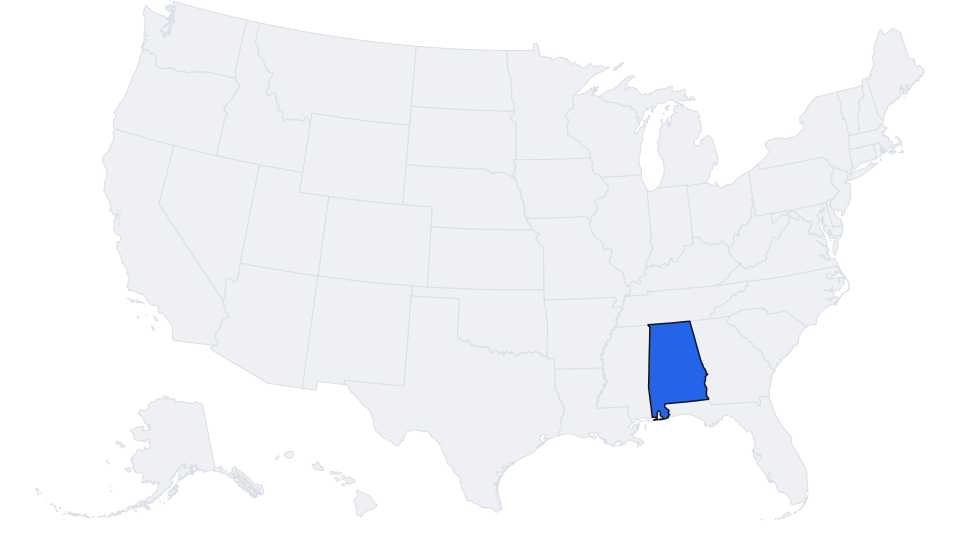
Map of the United States with Alabama highlighted
Tax mechanics

Payroll tax in Alabama

State income tax

Applies

Alabama has a graduated income tax of 2% on the first $500 of taxable income (single) or $1,000 (MFJ), 4% on the next $2,500 (single) or $5,000 (MFJ), and 5% on everything above $3,000 (single) or $6,000 (MFJ). Because those thresholds are so low, almost every full-time Alabama employee's marginal state rate is 5%. Alabama also allows a full deduction for federal income taxes paid, which lowers effective state liability for higher earners but does not change the marginal stack on a Section 125 election. A $3,300 healthcare FSA election saves about 22% federal plus 7.65% FICA plus 5% state (about $1,210 for a mid-bracket Alabama employee). Note: Alabama's temporary 'no tax on overtime' exemption sunset on June 30, 2025, so Matchbook's 2026 engine withholds state income tax on all overtime again.

Alabama Unemployment Compensation Tax

Wage base $8,000 (2025 and 2026)

Rate range: 0.20%-6.80% experience-rated; new employer rate 2.70%

Alabama's UC wage base is only $8,000, so Section 125 salary reductions produce zero employer UC savings for any salaried worker above roughly $8K YTD - they cross the base within weeks. Matchbook suppresses the UC savings line in the Alabama employer ROI report for anyone above base. The meaningful employer payroll-tax win in Alabama is the 7.65% FICA match on Section 125 and Section 132(f) elections.

Employer FICA

7.65% / 1.45% split

Employer FICA is 7.65% on wages up to the Social Security wage base ($176,100 in 2025; projected about $183,600 in 2026) and 1.45% above it. Matchbook models this per employee rather than quoting a flat rate.

Employer credits and levers

State and federal credits worth stacking

Credits that most broker ROI decks omit. Matchbook surfaces these in the employer report.

Alabama Employer Childcare Tax Credit

For tax years 2025-2027, Alabama employers may claim a refundable income tax credit for childcare expenses: 100% of eligible expenses for small businesses (fewer than 25 employees) and 75% for larger employers, capped at $600,000 per employer per year. Annual aggregate cap is $15M (2025), $17.5M (2026), $20M (2027). Credit reservations are issued on a first-come basis through My Alabama Taxes. Eligible expenses include construction, renovation, operation, and payments to a DHR-licensed Alabama Quality STARS facility.

Source →

Federal IRC Section 45F (stacks with Alabama credit)

Federal employer-provided childcare credit. 25% credit with $150K cap in 2025; rises to 40% with $500K cap in 2026, and 50% with $600K cap for small employers. Matchbook surfaces the combined Alabama plus federal modeled benefit when an employer evaluates on-site or contracted care.

Source →

Alabama Accountability Act scholarship credit

Dollar-for-dollar Alabama income tax credit for contributions to a Scholarship Granting Organization. C corporations may offset up to 100% of Alabama income tax liability with no per-taxpayer dollar cap; individuals/MFJ may offset 100% up to $100,000 per year. Program is capped at $40M per year statewide, first-come basis. A CIT-offset lever worth flagging alongside the childcare credit for Alabama employers with state tax liability.

Source →

Alabama Apprenticeship Tax Credit

Historic credit of $1,250 per qualifying apprentice (up to 10 per employer per year) plus an additional $500 for youth apprentices. The governing statute (Section 40-18-422) was repealed effective December 31, 2024 unless extended by the Legislature - Matchbook flags this as a credit the CFO should confirm status on before modeling 2026 ROI.

Source →

Household programs

State programs that change what your employees should elect

Matchbook coordinates these against DCFSA, FSA, and HSA elections at the household level.

Childcare subsidy

Alabama Child Care Subsidy Program (DHR)

DHR-administered subsidy for working or student parents of children under 13 (through 17 with documented disability). Income threshold is roughly 85% State Median Income at entry (about $54,756 for a family of four in 2025). Co-pays are on an income-based sliding scale; families apply through regional Child Care Management Agencies, not DHR directly.

Matchbook: The subsidy reduces out-of-pocket dependent-care cost and therefore reduces the right DCFSA election. Matchbook asks Alabama employees whether they qualify or are on a waitlist before recommending DCFSA contribution levels.

Source →

Preschool

Alabama First Class Pre-K

Tuition-free state pre-K for Alabama 4-year-olds (must be 4 by September 1). Available in all 67 counties, but seats are lottery-allocated and fill quickly each spring. Administered by the Alabama Department of Early Childhood Education.

Matchbook: First Class Pre-K covers the school day only; working families still need wrap-around care that is DCFSA-eligible. Matchbook models the correct DCFSA election as full-day center cost minus First Class Pre-K hours, not zero.

Source →

K-12 education savings

Alabama CHOOSE Act ESA

Refundable Alabama income tax credit funding an education savings account of $7,000 per student enrolled in a participating school or $2,000 per home-educated student (family cap $4,000). 2025-2026 AY eligibility is capped at 300% FPL (~$96K for a family of four); income cap is eliminated starting 2027-2028. Program is funded at $100M per year.

Matchbook: For Alabama households below 300% FPL, Matchbook flags the CHOOSE Act ESA as a K-12 lever that stacks with employer Dependent Care FSA (ages 12 and under) and 529 savings - three distinct buckets the household can coordinate at open enrollment.

Source →

Health programs

Coverage coordination checkpoints

Alabama ALL Kids (CHIP)

Alabama's CHIP program, administered by the Alabama Department of Public Health. Covers uninsured children up to age 19 in households up to 317% FPL (among the highest CHIP ceilings in the country). Medicaid for children covers up to 146% FPL. Low-fee and fee tiers apply above those thresholds with modest annual premiums.

Matchbook: Alabama employees declining dependent coverage on the employer plan - especially at the family tier - should be screened against ALL Kids thresholds before Matchbook defaults to the family election. Alabama's 317% CHIP ceiling is unusually generous.

Source →

ACA Marketplace (Federally Facilitated Marketplace)

Alabama uses HealthCare.gov (has not expanded Medicaid). 2026 employer-affordability threshold is 9.96% of household income. The 2023 family-glitch fix still applies: affordability is tested separately for employee-only and family tiers. Enhanced premium tax credits expired at the end of 2025, so Alabama 2026 Marketplace premiums see material increases; 91% of Alabama 2026 enrollees qualified for some subsidy.

Matchbook: If employer family coverage exceeds 9.96% of household income, Matchbook surfaces the Marketplace dependent subsidy path. In non-expansion Alabama this is especially material because there is no Medicaid off-ramp for the adult parent in the coverage gap.

Source →

Alabama Public Employee Paid Parental Leave Act of 2025

Effective July 1, 2025, SB199 provides 8 weeks of paid parental leave (100% of pay) to eligible full-time female state employees and educators for birth/stillbirth/miscarriage, 2 weeks to male state employees and educators, and 8/2 weeks for adoption of a child age 3 or under. Applies only to state-government and K-12/community college employees - not private employers.

Matchbook: For public-sector Alabama employers, Matchbook coordinates the 2025 PPL entitlement with short-term disability elections and HSA/FSA timing so families do not double-fund a disability benefit they already have. Private employers get a note that Alabama has no state-level paid family leave - so employer policy plus federal FMLA is the governing rule.

Source →

Retirement and wealth

State-level retirement and wealth context

Alabama ABLE Savings Plan

Alabama's Section 529A program for disabled beneficiaries, administered by the State Treasurer (launched May 17, 2021, replacing the prior Enable Savings plan). 2025 contribution limit $19,000 annually; employed beneficiaries may add more under ABLE to Work. $100,000 balance is disregarded for SSI.

Matchbook: FSA and HSA dollars reimburse medical expenses; ABLE covers broader qualified disability expenses. When SSI asset limits are in play, Matchbook routes disability-related spend to Alabama ABLE first.

Source →

CollegeCounts 529

Alabama's direct-sold 529 plan, administered by the State Treasurer. Alabama residents deduct up to $5,000 (single) or $10,000 (MFJ, if both spouses contribute) of contributions to CollegeCounts or PACT from Alabama taxable income each year. Out-of-state 529 contributions do NOT qualify for the Alabama deduction.

Matchbook: At Alabama's 5% top marginal rate, the maximum state tax savings from a $10K MFJ CollegeCounts contribution is about $500. Matchbook tilts Alabama residents to CollegeCounts over out-of-state plans and models the deduction alongside DCFSA for families balancing childcare and college saving.

Source →

Section 132(f) commuter

Pre-tax commuter reality in Alabama

2025 IRC Section 132(f) cap is $325 per month for transit and $325 per month for qualified parking; 2026 cap is $340 per month for each.

Parking and state credits

Parking: CBD parking in Birmingham, Huntsville, Montgomery, and Mobile typically sits well below the monthly cap, so Matchbook's parking model for Alabama rarely hits the ceiling. Transit elections are dominant in Birmingham (MAX Xpress BRT and MAX fixed route) and Huntsville (Orbit) corridors.

State credit: None - Alabama has no state-level commuter tax credit or employer transit-benefit mandate.

Disaster readiness

Alabama disaster-relief playbook

IRC Section 139 qualified disaster relief payments are not W-2 wages: no FICA, no FUTA, no federal income tax withholding, and the employer gets a full deduction. Triggered by a federal disaster declaration. Alabama saw FEMA-3618-EM (Hurricane Helene, Sept 2024, Houston County), DR-4710-AL (severe storms and tornadoes, March 2023), and the March 13-16, 2025 tornado outbreak that killed people in Plantersville and Winterboro - the state is a recurring Section 139 venue.

  • Pre-drafted Section 139 policy template so employers can disburse tax-free tornado and hurricane relief within 48 hours of a federal declaration.
  • Post-storm Section 125 election-change guidance: a tornado alone is not a listed change-in-status event under Treas. Reg. 1.125-4 - it qualifies only when it triggers a change in residence, employment, or cost-of-coverage.
  • FEMA Individual Assistance interaction: IRS Section 139 payments generally stack with FEMA IA, but Matchbook flags duplication risks in the disbursement log.
  • Alabama-specific employer disaster leave review (Alabama has no statutory paid disaster leave, so employer policy is the governing rule).
Matchbook for Alabama

What we ship specifically for Alabama employers

  • 5% state-rate calibration in the employee savings engine - most Alabama salaried workers hit the 5% top bracket immediately, so the pre-tax savings stack is federal plus FICA plus a clean 5% layer.
  • Alabama Employer Childcare Credit plus federal IRC 45F stacking calculator in the employer ROI report, with a credit-reservation countdown tied to the statewide $15M (2025) / $17.5M (2026) caps.
  • Alabama Accountability Act SGO-donation lever for C corporations with state tax liability - 100% offset, no per-taxpayer cap, $40M annual statewide pool.
  • Suppress the UC savings line for salaried workers in the Alabama employer FICA-and-SUI report - the $8,000 wage base makes it misleading for anyone above entry wages.
  • First Class Pre-K and DHR Child Care Subsidy wrap-around logic in the DCFSA recommender so Alabama families do not over-elect DCFSA when state programs already cover part of the day.
  • ALL Kids screener (317% FPL ceiling) at open enrollment to flag households that should decline employer family coverage and enroll dependents in CHIP.
  • IRC Section 139 tornado playbook template with a pre-drafted employer policy and post-storm Section 125 election-change guidance - Matchbook pushes this to Alabama clients every February ahead of spring severe-weather season.
  • Benefits graph ingests: Alabama DOR credit reservation data, Alabama DOL UC rate notices, ADECE First Class Pre-K and DHR subsidy eligibility, FEMA disaster numbers for Alabama, and FFM 2026 rate filings via ALDOI.

Pilot Matchbook with a Alabama-aware engine.

Talk to us about a 30-day pilot calibrated to Alabama payroll, programs, and disaster rules.